
Modeling the Infodemic: A Petri Net Approach to Social Network Rumor Propagation
Modeling and simulation of rumor propagation in social networks based on Petri net theory
This paper proposes a novel framework for modeling and simulating rumor propagation in social networks by mapping the Susceptible-Infected-Removed (SIR) epidemic model onto Petri Net theory. The authors introduce a "multiple pieces of information" model that accounts for the competition between rumors and clarifications, achieving high consistency with real-world data from Weibo.
TL;DR
Researchers from Zhejiang University have bridged the gap between epidemiology and discrete event systems by remodeling rumor spreading using Petri Nets. By treating people as "tokens" and social transitions as "firings," they have created a modular framework that accounts for the competition between lies and truths, effectively simulating the role of celebrities and the impact of delayed clarifications.
Background: Beyond Differential Equations
For decades, the SIR (Susceptible-Infected-Removed) model has been the gold standard for predicting both biological viruses and viral information. However, traditional SIR models rely on continuous differential equations that struggle to capture the asynchronous, discrete, and competitive nature of the modern internet.
The authors argue that rumor propagation is essentially a "material flow" of information. Therefore, Petri Net theory—usually reserved for industrial control and manufacturing—is the perfect tool to visualize and simulate these complex interactions.
Methodology: The Petri Net Architecture
The researchers transitioned from a basic SIR model to a sophisticated dual-layer Petri Net.
1. The Building Blocks
The system defines:
- Places (Circles): Represent the state of individuals (Unwitting, Infected, Removed).
- Tokens (Dots): Represent the actual population.
- Transitions (Bars): Represent the events (Infection, Spreading, Forgetting).
2. The Celebrity Factor
Unlike standard models that treat all nodes as equal, this paper introduces a specialized sub-net for Celebrities. Their status acts as a feedback loop: as more celebrities "catch" the rumor, the probability of common people being infected increases exponentially.
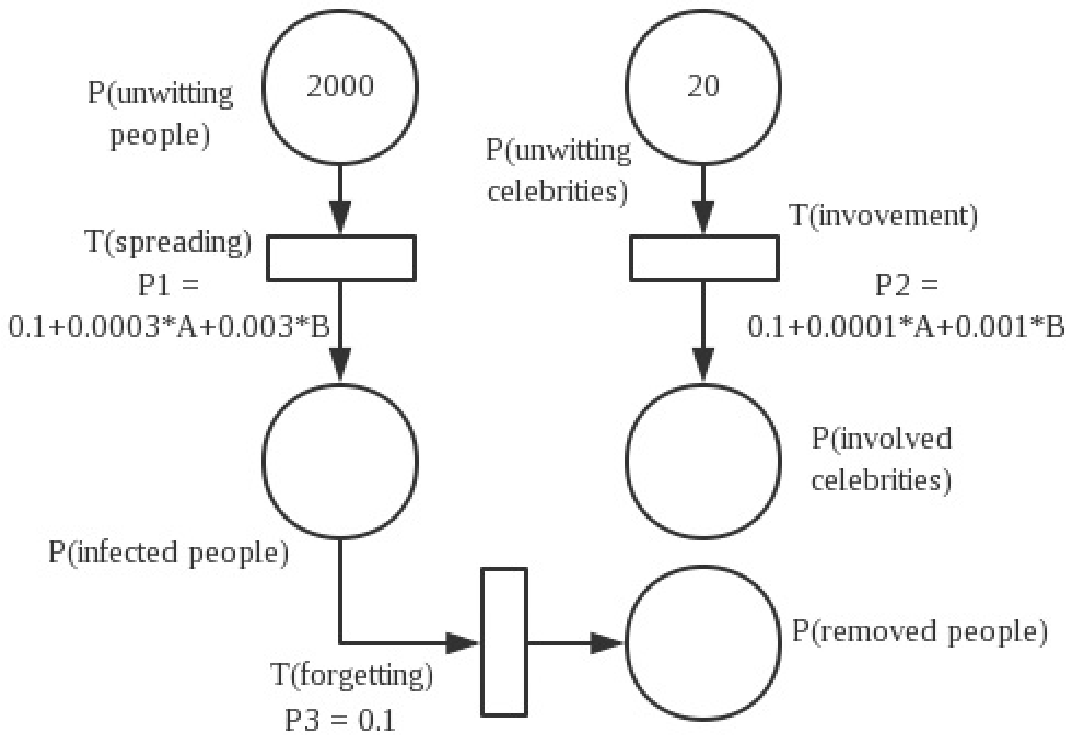 Figure 1: The single rumor Petri Net model featuring sub-networks for common people and celebrities.
3. Competition & Timing
The most realistic feature of the model is the Competition on Tokens. When a rumor and a clarification exist simultaneously, they compete for the "Unwitting" tokens. The researchers used Timed Transitions to simulate the real-world lag between the initial outbreak of a rumor and the official debunking.
Experimental Results: Validating with Weibo Data
The authors tested their model against real-world data from Weibo.com regarding a popular Chinese singer.
- The Single Rumor Case: Without clarification, the rumor persists until it is slowly forgotten (as shown in Figure 4).
- The Multi-Information Case: When the clarification unit is introduced, the "Infected" token count crashes rapidly, mirroring the real-world "rapid decline" observed in social media analytics.
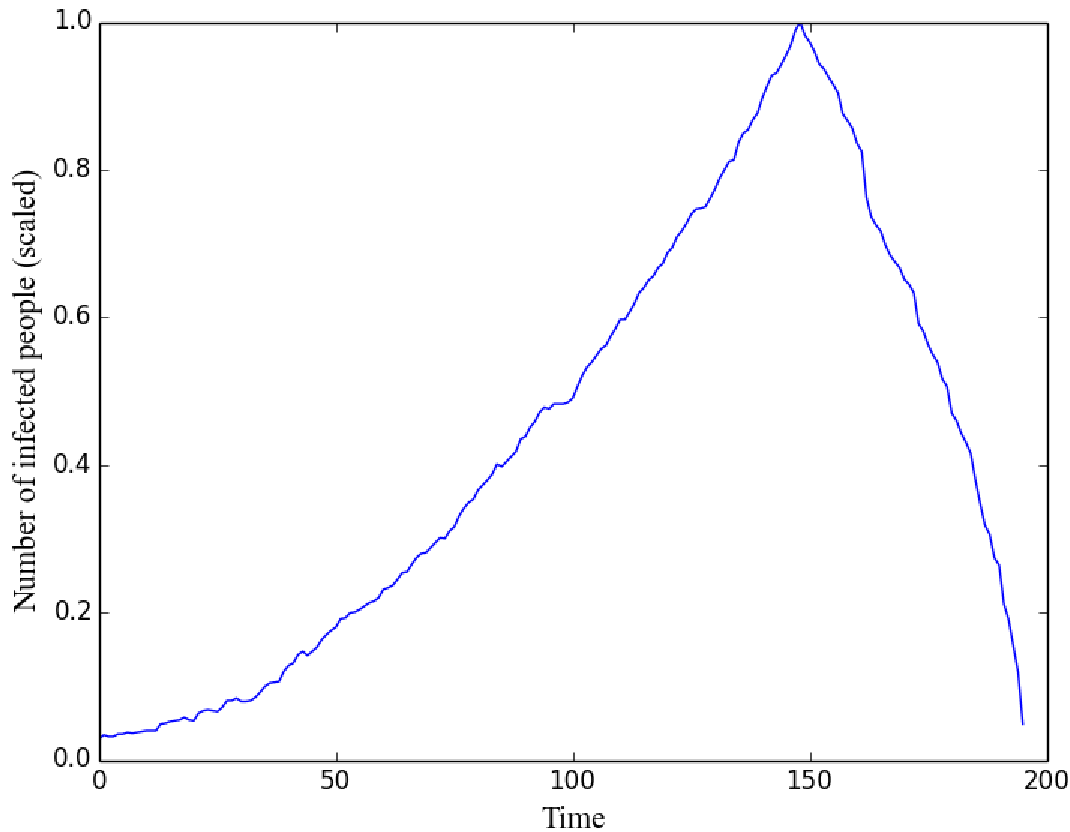 Figure 2: Real-world rumor spreading tendency on Weibo, showing the impact of clarification at T=5.
By tuning the Probability (P) functions, the authors achieved an explanatory power that matches the explosive growth curves of viral content.
Critical Insight: Why This Matters
The value of this research lies in its modularity. By treating the single rumor model as a "basic unit," researchers can stack these units to simulate increasingly complex scenarios—such as multiple conflicting rumors or "rumor wars" between different factions.
Limitations & Future Work
While the model is robust, it currently assumes a relatively homogeneous influence for celebrities. Future iterations could benefit from:
- Quantitative Pattern Recognition: Using larger datasets to automate parameter tuning.
- Topological Integration: Combining the Petri Net's state-transition logic with specific graph topologies (Small-world or Scale-free networks) to further increase accuracy.
Conclusion
This paper provides a fresh "Discrete Event System" perspective on social dynamics. It proves that Petri Nets are not just for factory floors; they are a sophisticated lens through which we can understand—and perhaps eventually control—the chaotic flow of information in our digital age.