
The Digital Smile: Quantifying the "Pet Effect" via Large-Scale Social Media Analysis
The Effect of Pets on Happiness: A Data-Driven Approach via Large-Scale Social Media
This paper introduces a data-driven framework to quantify the impact of pet ownership on happiness using large-scale social media data from Instagram. By leveraging a CNN-based pet classifier and the Face++ engine for smile detection across 300,000 images, the study establishes a scalable, automated methodology for psychological behavioral analysis.
TL;DR
Can owning a dog or cat actually make you happier? While psychologists have long said "yes," proving it at scale has always been slow and biased. This paper moves the lab to Instagram, using Convolutional Neural Networks (CNNs) and facial expression analysis on 300,000 images to prove that pet owners exhibit significantly higher "Smile Indices" than non-owners, with surprising differences between genders.
Problem: The Limits of the Questionnaire
Understanding human happiness usually involves asking people how they feel. However, traditional psychology faces two major "bottlenecks":
- Scalability: Surveying thousands of people over months is prohibitively expensive.
- Social Desirability Bias: People often lie or exaggerate their happiness on forms to meet social expectations.
The authors argue that social media provides an "undisturbed state" where users naturally broadcast their emotional lives. The challenge? How do you automatically identify who owns a pet and how happy they truly are without asking them?
Methodology: Pet Detection Meets Facial Analytics
The researchers proposed a three-stage computational framework to bridge the gap between pixels and psychology.
1. Identifying the "True" Pet Owner
It isn't enough to just see a dog in a photo; someone might just be visiting a friend. The authors used an AlexNet-style CNN architecture (pre-trained on ImageNet and fine-tuned on cat/dog datasets) to achieve 96% classification accuracy.
- The Insight: They applied a timeline analysis. A "Pet Owner" is defined as someone who posts images of the same type of animal consistently over time, whereas a "Pet Lover" posts sporadically.
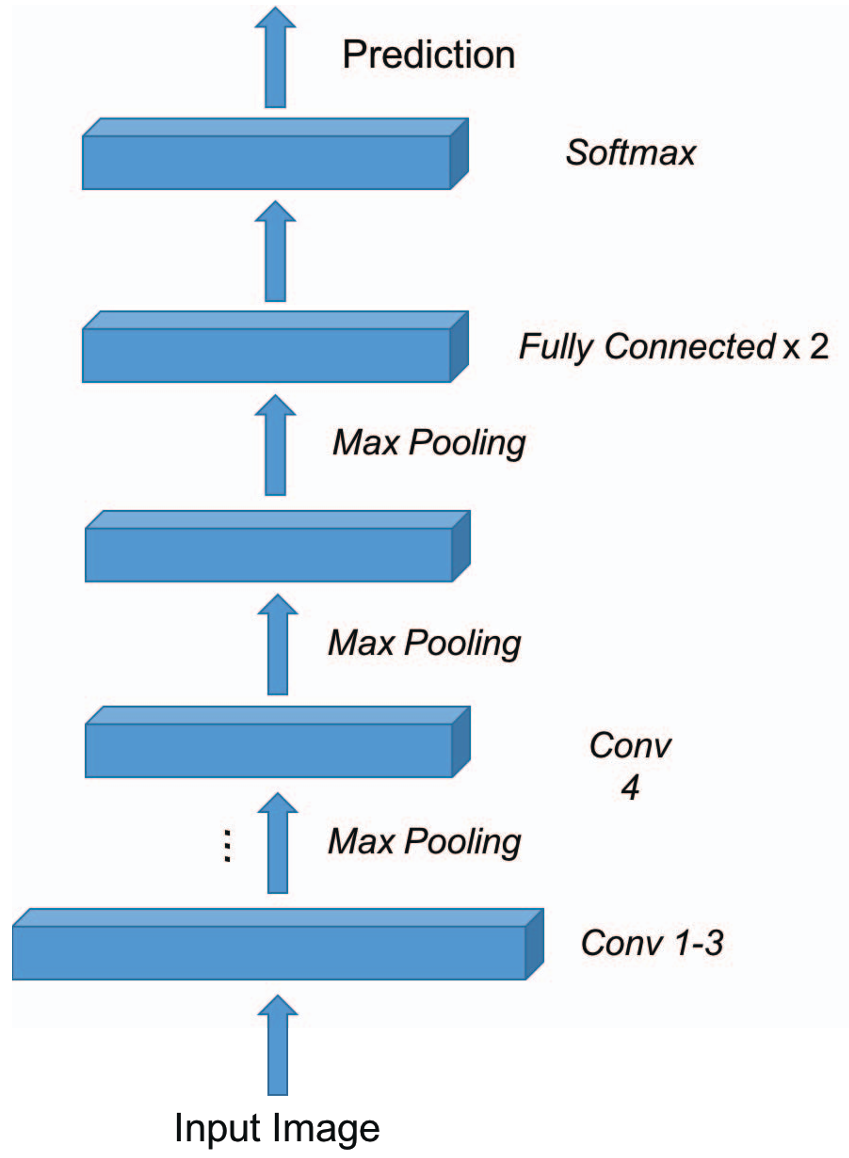 Figure: The CNN architecture used for robust pet detection.
2. Quantifying Happiness via the "Smile Index"
To measure happiness objectively, the team utilized the Face++ engine. They filtered for "selfies" (where the face takes up >10% of the image) and extracted a smile confidence score. The Happiness Index () for a user is calculated as the mean confidence score () of all detected faces over a time period :
Experiments and Results: Does the Tail Wag the Human?
The study analyzed 2,905 users over a six-month period. The results were statistically significant ().
- The Pet Boost: Pet owners were significantly less likely to fall into the "unhappy" bracket (0-20 score) and more likely to maintain a happiness score between 50 and 80.
- The Gender Paradox: Interestingly, the "Pet Effect" was more visible in men. While women generally had higher baseline happiness scores on Instagram, the marginal increase in happiness associated with owning a pet was more pronounced in male users.
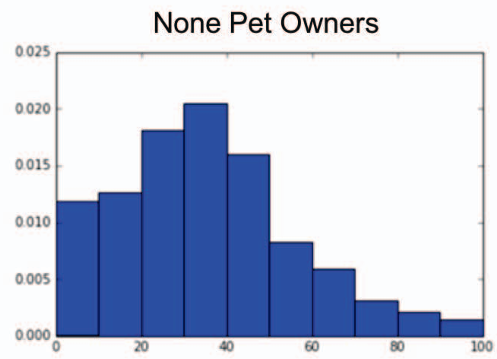 Figure: Comparison of happiness distributions between pet owners and non-owners.
Critical Analysis & Conclusion
The value of this work lies in its methodological shift. By moving from subjective self-reporting to objective computer vision, the researchers have created a blueprint for "Passive Psychological Monitoring."
Limitations & Future Work
- Positivity Bias: As the authors note, Instagram users tend to post "highly curated" versions of their lives, which may skew the baseline happiness higher than reality.
- Beyond Smiles: Future iterations could integrate Natural Language Processing (NLP) on captions to detect "hidden" sentiments that a smile might mask.
In conclusion, this paper provides a robust data-driven confirmation of the "Pet Effect." If you're looking for a reason to justify that new puppy, the data suggests your "Smile Index" will thank you.