
PITAS: Revolutionizing Photo Tagging with Zero-Vision Social Context
Photo identity tag suggestion using only social network context on large-scale web services
This paper introduces PITAS (Photo Identity TAg Suggestion), a novel system designed for large-scale social networks that suggests identity tags using exclusively social network context rather than visual features. By leveraging seven distinct co-occurrence contexts and an efficient ranking algorithm, the system achieves real-time performance and significant accuracy without the high computational overhead of face recognition.
TL;DR
PITAS (Photo Identity TAg Suggestion) challenges the status quo of photo tagging by proving we don't need expensive Face Recognition to suggest "who is in this photo." By utilizing only social network context—like who you usually hang out with or who comments on your albums—PITAS achieves a 73% top-10 precision with near-zero latency, making it the ideal solution for billion-user platforms.
Background & Motivation: The High Cost of "Seeing"
In the era of massive social media growth, platforms like Facebook handle billions of photo uploads monthly. Traditional AI approaches treat photo tagging as a Computer Vision problem. While accurate, this presents three major hurdles for large-scale services:
- Computational Cost: Running deep learning models on every face in every photo is prohibitively expensive.
- Storage Overhead: Storing high-dimensional facial embeddings for every user requires massive database infrastructure.
- Real-time Demand: Users expect suggestions instantly upon upload, particularly on mobile devices where bandwidth and processing power are limited.
The authors of PITAS argue that we can bypass these "vision" bottlenecks by answering a simpler question: Given your social circle and history, who is most likely to be in this photo?
Methodology: The Power of Seven Contexts
Instead of analyzing pixels, PITAS looks at seven specific Co-occurrence Contexts ( to ). These contexts act as social "fingerprints":
- Direct Interaction: Who has been tagged in this specific album before? ()
- Social Proximity: Who are the mutual friends between the uploader and the people already tagged in the photo? ()
- Engagement: Who frequently comments on the user's albums? (, )
- Co-tagging History: Who often appears in photos alongside the people already identified? ()
The Ranking Algorithm
The core of PITAS is a lightweight weighting function. Each friend is assigned a score based on which contexts they satisfy:
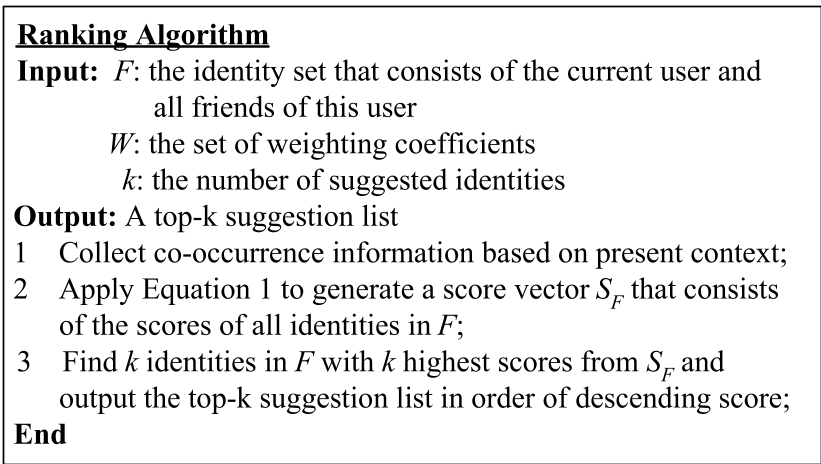
The weights () are determined by the conditional probability that a person appears given they are present in a specific context. This means the system "learns" that being tagged in the same album () is a much stronger predictor than merely being a mutual friend.
Experimental Results: Speed Meets Accuracy
Using real-world data from 400 Facebook volunteers (comprising over 68,000 photos), the researchers demonstrated that social signals are surprisingly predictive.
Performance Highlights:
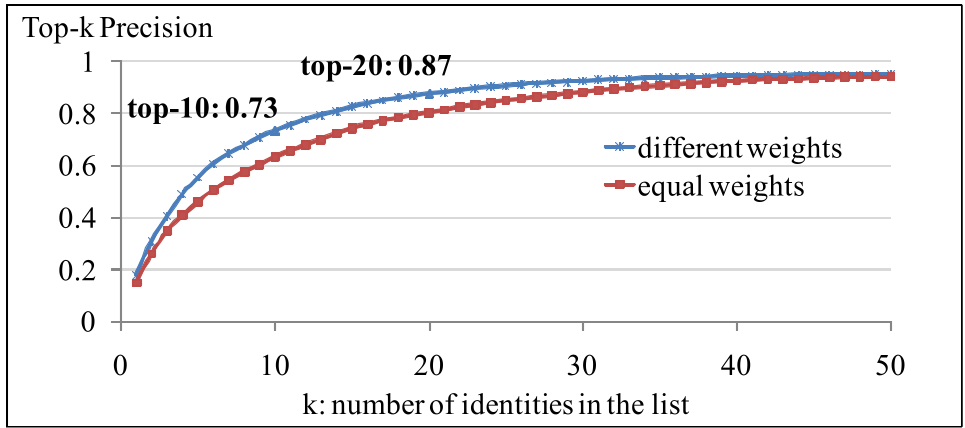
- Accuracy: The system hits 73% precision in the Top-10 suggestions. This is enough to satisfy most users, as their target tag is likely visible without scrolling.
- Efficiency: As shown in the table below, the execution time for 10,000 instances is just 20 seconds—averaging 2 milliseconds per request.

Key Insight: The "Cold Start" and Social Density
The researchers found that PITAS performs better as more photos are tagged in an album (Fig. 5). This makes intuitive sense: as the "social context" becomes denser, the algorithm's predictions sharpen. Conversely, the accuracy dips slightly for large group photos, likely because group shots often include "socially distant" acquaintances who aren't active in the uploader's online context.
Critical Analysis & Future Outlook
Takeaway: PITAS proves that for many web-scale tasks, "cheap" metadata can perform nearly as well as "expensive" visual data. This work provides a blueprint for building privacy-conscious and environmentally friendly AI by reducing the need for constant GPU-heavy inference.
Limitations:
- Cold Start: The system struggles when a user is new or has very few tagged photos.
- Non-Social Tags: It cannot suggest tags for people who are not in the user's friend list or social graph.
Future Work: The logical next step is a Hybrid System. Imagine using PITAS to narrow down 5,000 friends to a candidate list of 20, and then using a very small, fast visual model to pick the top 3. This would combine the best of both worlds: context-driven speed and vision-driven precision.