
CPP Model: Decoding How Social Influence Propagates Fitness in Health Networks
Analysis of Physical Activity Propagation in a Health Social Network
This paper introduces the Community-level Physical Activity Propagation (CPP) model, designed to quantify how social communications drive physical activity (walking/running steps) within a health social network. By leveraging a hierarchical Expectation-Maximization approach, it identifies community structures and their reciprocal influence strengths, effectively mapping out "Influencer" and "Influenced" groups.
TL;DR
Researchers have developed the Community-level Physical Activity Propagation (CPP) model to quantify "fitness contagion." By analyzing a real-world health social network (YesiWell), the study reveals that physical activity doesn't just spread randomly; it follows a distinct directional flow from high-performing "Influencers" to responsive "Influenced" users. The model demonstrates that social messaging can more than double the likelihood of a person increasing their daily step count.
Background & Motivation: Beyond BMI
While we know that "obesity spreads through social ties," we have lacked the engineering tools to reverse this process—propagating wellness. Existing intervention methods (like apps or websites) often fail because they treat users as isolated individuals. The authors argue that the social communication channel is the missing link.
The core challenge lies in granularity:
- Node-to-node models are too complex and prone to overfitting.
- Global models ignore the fact that people cluster into communities with shared behaviors (Inductive Bias).
Methodology: The CPP Model
The CPP model builds on the Independent Cascade (IC) framework but shifts the focus to communities.
1. Identifying Traces
A "trace" is defined when user A sends a message to user B, and user B subsequently increases their activity (steps) within a specific time window ( week).
2. Hierarchical Clustering
The network is partitioned using METIS to create a hierarchy. The model then looks for an optimal "cut" in this hierarchy—a level where the groups are distinct enough to be meaningful but simple enough to be useful.
3. Responsibility & EM Algorithm
The model introduces (user responsibility), which represents the probability that a specific message was the actual cause of an activity increase. An Expectation-Maximization (EM) algorithm then learns the influence strengths between these communities.
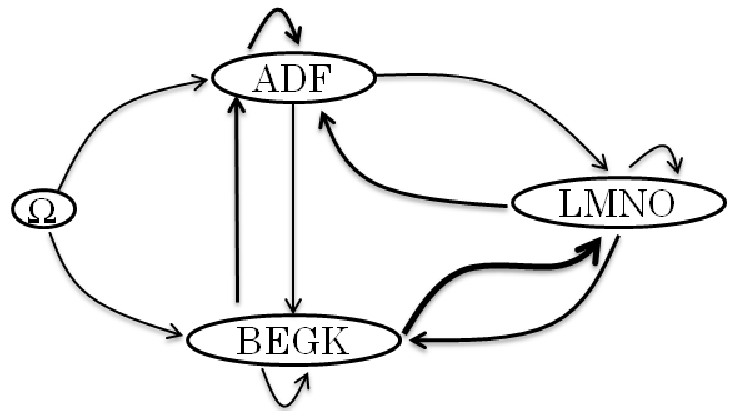 Figure: The detected community structure. Edge thickness represents the strength of inter-community influence.
Experiments: The Three Archetypes of Health
The study applied the CPP model to the YesiWell dataset, tracking 123 users over ten months, including their biometrics (BMI), biomarkers (Cholesterol, etc.), and daily steps.
The model categorized users into three fascinating groups:
- The Influencers (Circles): High physical activity, lowest BMI, and highest "Wellness Scores." They act as the primary sources of health propagation but are rarely influenced by others.
- The Influenced (Rectangles): These users started with lower activity but showed massive improvements in their Wellness Scores and step counts after interacting with Influencers.
- The Non-Influenced (Triangles): Users with high BMI and low activity who remained largely unaffected by social communication.
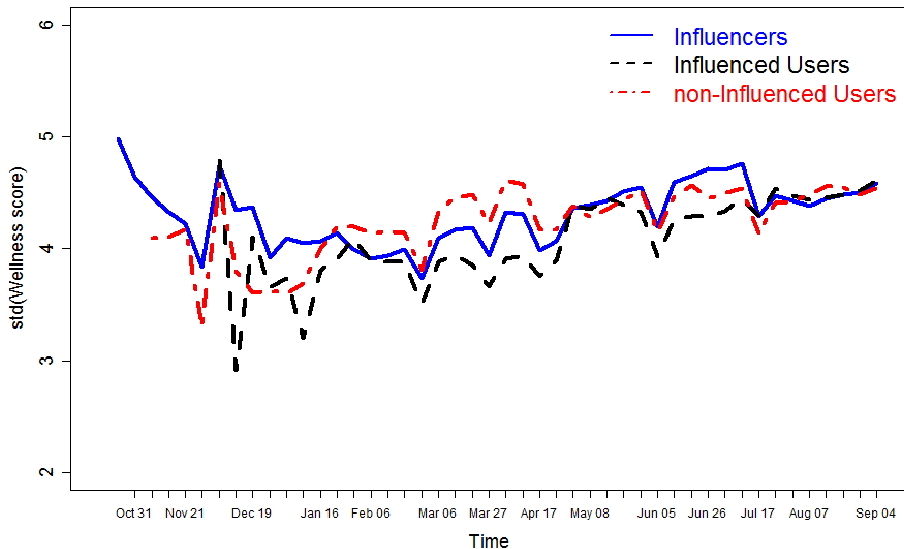 Figure: Standard deviation and average of Wellness Scores, highlighting the significant growth in the "Influenced" group.
Critical Analysis & Deep Insights
The most striking finding is that the propagation network is almost acyclic. This suggests a hierarchical flow of "fitness energy" rather than a reciprocal exchange.
Key Takeaways:
- Wellness Score > BMI: The authors proposed a novel "Wellness Score" combining lifestyle, biometrics, and biomarkers, which proved more sensitive to social influence changes than BMI alone.
- Intervention Strategy: For health apps, the strategy shouldn't be "connect everyone." Instead, it should be "identify the Influencer communities and bridge them to the Influenced communities."
- The Resilience of the Non-Influenced: Social communication alone is not a silver bullet. The "Non-Influenced" group requires different intervention modalities beyond passive social propagation.
Conclusion
The CPP model moves health informatics from simple tracking to dynamic influence analysis. It provides a roadmap for designing social-aware health interventions that leverage existing community structures to fight the "obesity cascade" with a "wellness cascade."
Future work will likely integrate "Homophily" (the tendency of similar people to bond) to further refine how influence probabilities are calculated.