
Harmonizing Physics and Social Ties: A Matching Game for D2D Content Sharing
2614_Physical-Social-Aware D2D Content Sharing Networks A Provider-Demander Matching Game.
This paper proposes a physical-social-aware provider-demander matching scheme for D2D content sharing networks. It utilizes a two-sided one-to-one matching game combined with Dinkelbach iteration to optimize pairing and power control, achieving a win-win equilibrium between content providers and demanders.
TL;DR
In the world of Device-to-Device (D2D) communications, we often assume users are happy to share their data. In reality, sharing costs energy and battery. This paper introduces a distributed matching game that treats D2D sharing not just as a physics problem, but as a social interaction. By balancing link quality (Physics) with trust and reciprocity (Social), the system finds a "win-win" stable match between those who have content and those who need it.
The "Altruism Myth" in D2D Networking
Most prior works in D2D caching and sharing operate on a dangerous assumption: that mobile users are completely altruistic. In a real-world network, providing content consumes a device's remaining energy and storage. Furthermore, the presence of malicious or selfish nodes can degrade the user experience.
The challenge isn't just finding a provider with a strong signal; it's finding a provider who is willing to help and whom the requester can trust. Existing "one-sided" optimization models often sacrifice the provider's battery for the requester's speed, leading to an unstable system where providers eventually opt-out.
Methodology: The Two-Sided Preference Framework
The researchers break the problem down into two dimensions:
1. Physical-Aware Preferences
- For Demanders: Priority is given to the Link Rate (). Can I get my video or file fast?
- For Providers: Priority is given to Remaining Energy. How much battery will this cost me?
2. Social-Aware Preferences
- Social Closeness (): Using Jaccard’s coefficient to measure common friends. This filters out "strangers" or potentially malicious entities.
- Social Reciprocity (): A "give-and-take" balance. Providers are more willing to help users who have helped them in the past.
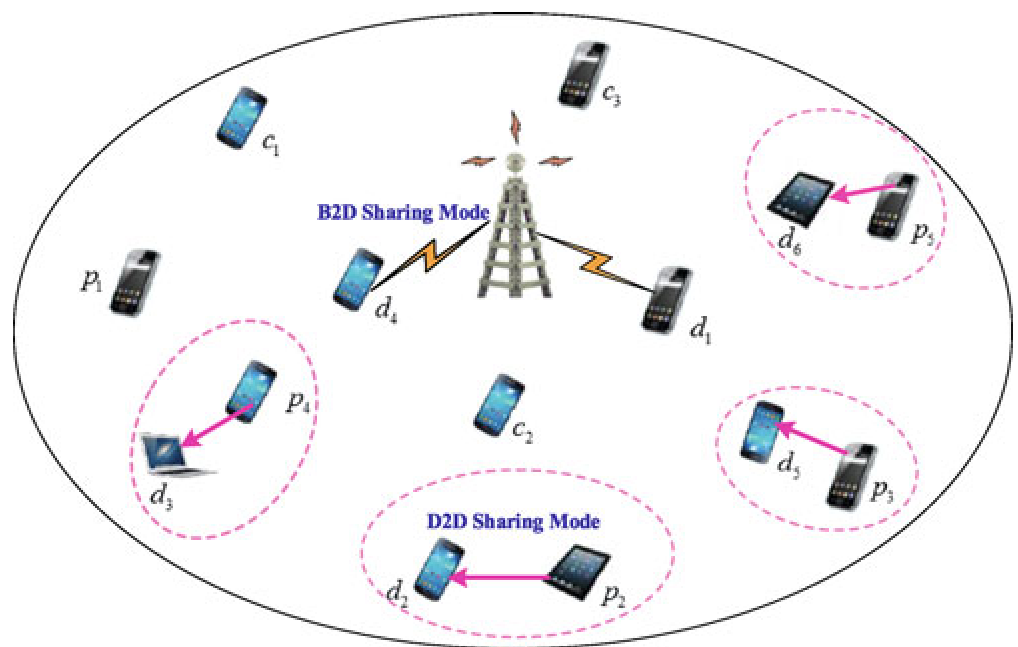 The model uses weighted directed graphs to map these complex relationships into a rankable preference list.
The Algorithm: Dinkelbach + Deferred Acceptance
The problem is a "Mixed-Integer Non-Linear Programming" (MINLP) nightmare. To solve it, the authors propose a two-phase distributed approach:
- Phase I (Power Control): Uses Dinkelbach iteration to find the optimal transmit power that satisfies QoS while maximizing the provider's utility.
- Phase II (Pairing): Uses the Gale-Shapley (Deferred Acceptance) algorithm. Demanders "propose" to their top providers; providers "tentatively hold" the best offer and reject others, iterating until the network reaches a Two-Sided Stable Matching.
Experimental Insights & Results
The proposed algorithm was tested against centralized schemes that aim for global maximums.
- Efficiency: The individual utility of providers using the physical-social-aware criteria was significantly higher than using physical metrics alone. This proves that social reciprocity is a powerful incentive for cooperation.
- Security: As shown in the simulation results, the system effectively reduced the interactions between demanders and "negative" social nodes (malicious users).
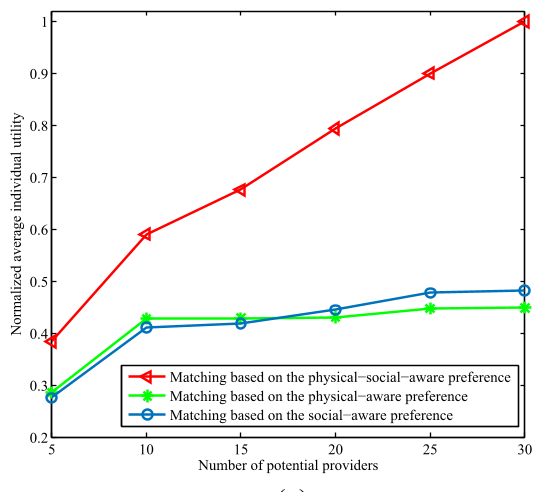 Performance of Physical-Social-Aware matching vs. baseline methods.
- Convergence: The algorithm converges rapidly (usually under 30 iterations for 50+ nodes), making it practical for real-world mobile implementation.
Summary & Critical Analysis
This work successfully bridges the gap between Information Theory and Social Science. By formalizing "trust" and "reciprocity" into mathematical weights, it creates a self-organizing network that doesn't rely on a central dictator to assign pairs.
Limitations: The current model assumes a one-to-one matching (one provider to one demander). In a high-density scenario, a "one-to-many" (multicast) approach might be more efficient. Additionally, the social metrics rely on historical data (), which might present a "cold-start" problem for new users in the network.
Future Outlook: This framework paves the way for "Social-Aware 6G," where network slicing and resource allocation will likely be driven not just by Mow/SNR, but by the social fabric of the users holding the devices.