
Beyond the Matrix: Boosting Recommendations with Physical and Social Context
Utilizing Physical and Social Context to Improve Recommender Systems
The paper introduces a multidimensional data model that integrates physical context (location, time) and social context (social networks) into recommender systems. It proposes a hybrid framework and demonstrates that "social neighborhoods" derived from friendship graphs significantly outperform traditional Collaborative Filtering (CF) in taste-related domains.
TL;DR
Most recommendation engines treat users as isolated points in a rating matrix. This paper argues that context is king. By integrating physical data (where you are) and social data (who you know) into a hybrid multidimensional model, the authors show we can solve the "cold start" and "relevance" problems that plague traditional Collaborative Filtering. Their "Social Recommender" notably outperforms standard algorithms in taste-related categories like leisure and night-life.
Problem & Motivation: The Context Gap
Imagine a mobile restaurant guide. Without context, it might recommend the "best" steakhouse in the city even if it's currently 2 AM and the place is closed, or if it's 50 miles away. Traditional Collaborative Filtering (CF) ignores:
- Physical Constraints: Location, time, and device capabilities.
- Social Influence: In "taste-related" domains (music, movies, clubs), we trust our friends more than a mathematical similarity score calculated from strangers.
The authors identify that the biggest hurdle for CF is the New User/Item Problem and Sparseness. If a user hasn't rated enough items, the system can't find their "neighbors."
Methodology: The Multidimensional Shift
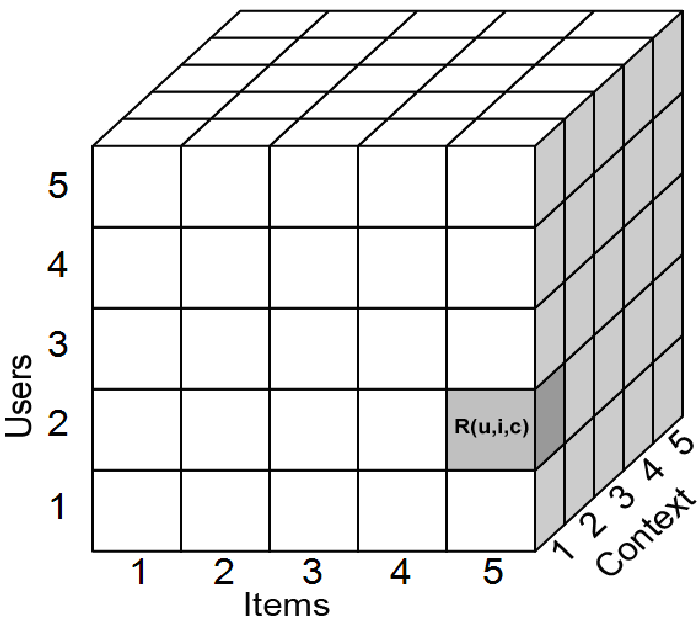
The core innovation is the expansion of the data model. Instead of a 2D User-Item matrix (), the authors propose a 3D User-Item-Context cube ().
1. The Hybrid Mobile Strategy
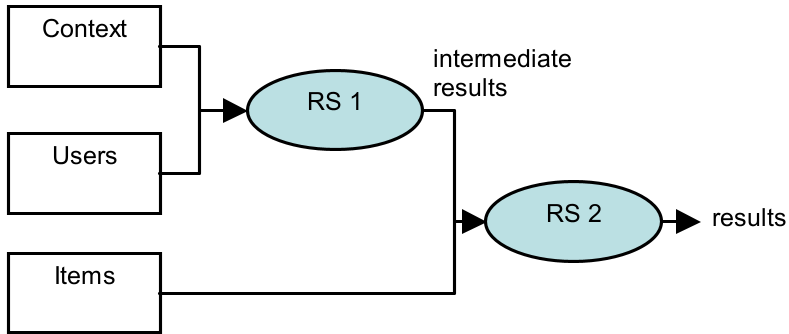
For mobile applications, they use a cascading hybrid approach.
- Step 1 (Context Filter): Narrow down items based on proximity or device capability (e.g., only show apps that run on the current bandwidth).
- Step 2 (Ranking): Rank these filtered items using collaborative ratings.
2. Replacing Similarity with Social Networks
In the social context experiment, they replace the standard "Pearson Correlation" (finding users with similar ratings) with Social Neighborhoods.
- Definition: Your neighborhood isn't people who rate like you; it's your actual friends and friends-of-friends.
- Why? Social ties are a proxy for shared taste and trust, and they exist even before a user has provided a single rating.
Experiments & Results: Social Beats Math
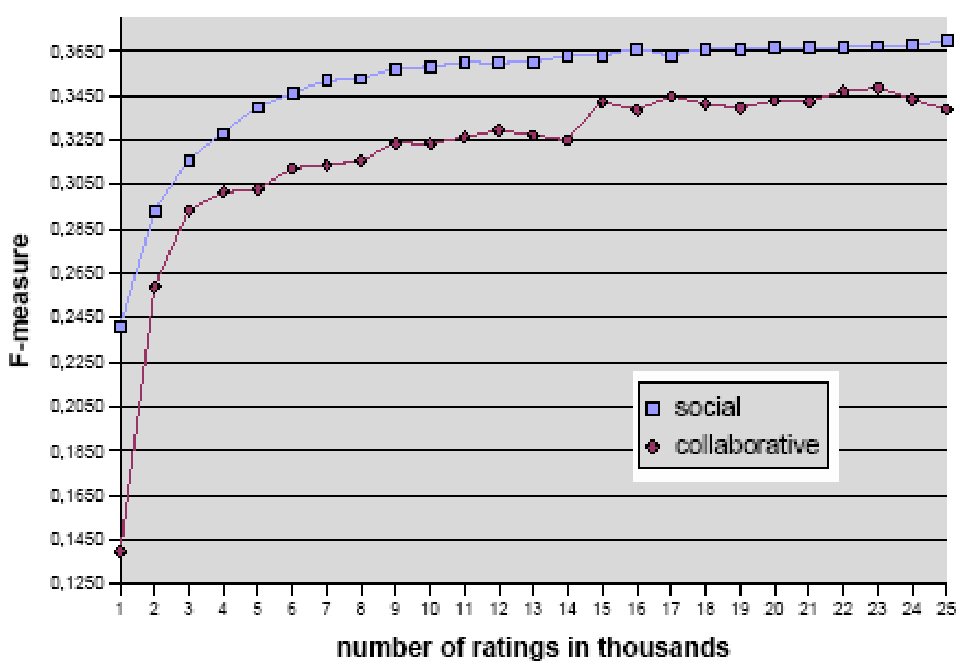
The researchers tested their theory using data from Lokalisten, a social community. They created 25 versions of a rating matrix, each progressively sparser (emptier), to see which algorithm broke down first.
Key Findings:
- Superior Accuracy: The Social Recommender consistently maintained a higher F-measure (a balance of precision and recall) than traditional CF.
- Lower Error: The Mean Absolute Error (MAE) was lower for the social approach, especially as data became scarce.
- Resilience to Sparseness: While traditional CF struggled when ratings were missing, the social network provided a stable backbone for predictions.
Critical Analysis & Conclusion
Takeaway
This work proves that Social Capital is a viable and often superior alternative to Rating Similarity. By utilizing the handshake-confirmed friendship graph, systems can offer "novel predictions" that users are more likely to accept because they come from a trusted peer group.
Limitations
- Domain Specificity: This works best for "taste-related" items. In "rational" domains (e.g., buying a medical device or high-end server), social context might be less relevant than objective specs.
- Privacy: Integrating social and physical context requires high levels of data access, raising significant privacy concerns for the end-user.
Future Outlook
As we move toward "ubiquitous computing," the context will only become more complex. The next frontier is likely dynamic social context—weighting recommendations based not just on who your friends are, but which friends you are currently with or interacting with in real-time.