
Beyond the Average: Event-Related Emotion Recognition in Affective Gaming
Physiological-Based Emotion Detection and Recognition in a Video Game Context
The paper introduces DAG, a new multimodal dataset focused on event-related affective gaming using physiological signals (ECG, EDA, Respiration, EMG) and behavioral data. Using machine learning (SVM), the authors achieve significant results in detecting game-event-related emotions and recognizing states across the Arousal-Valence (AV) dimensions.
TL;DR
Most "affective" games measure player stress over long periods, missing the "micro-moments" of joy or rage. This paper introduces the DAG dataset and a machine learning framework that shifts the focus to event-related psychophysiology. By analyzing physiological "spikes" during specific events like scoring a goal or committing a foul, the researchers achieved superior detection of high-arousal states using relative signal changes.
The Problem: The "Smoothing" Effect of Long Windows
In the world of Affective Computing, researchers often treat a 5-minute game session as a single emotional data point. However, emotions in gaming are dynamic and transient. A player might feel frustrated for 10 seconds after missing a shot and then immediately feel exhilarated after a successful tackle.
Current SOTA lacks:
- Temporal Precision: Standard 60s windows "smooth out" these critical transitions.
- Contextual Data: We need to know what happened in the game to understand why the heart rate spiked.
Methodology: The DAG Approach
The authors utilized FIFA 2016 to elicit a wide range of emotions. They monitored 58 participants using a suite of sensors: ECG (heart), EDA (skin conductance), Respiration, EMG (facial muscles), and Accelerometers (movement).
1. The Normalization Breakthrough
Physiological data is notoriously "noisy" because every human has a different baseline heart rate or sweat level. The authors tested three methods:
- Standard (Std): Basic Z-score normalization.
- Baseline-referenced: Comparing game data to a "resting" music phase.
- Delta (Precedent Moment): Comparing the current event's signal to the segment immediately preceding it.
Insight: The Delta method proved most effective. This suggests that the human body’s reaction to an event is a stronger emotional signal than the absolute physiological state.
2. Architecture & Feature Selection
The study utilized a Linear SVM classifier after extracting 173 features across time and frequency domains.
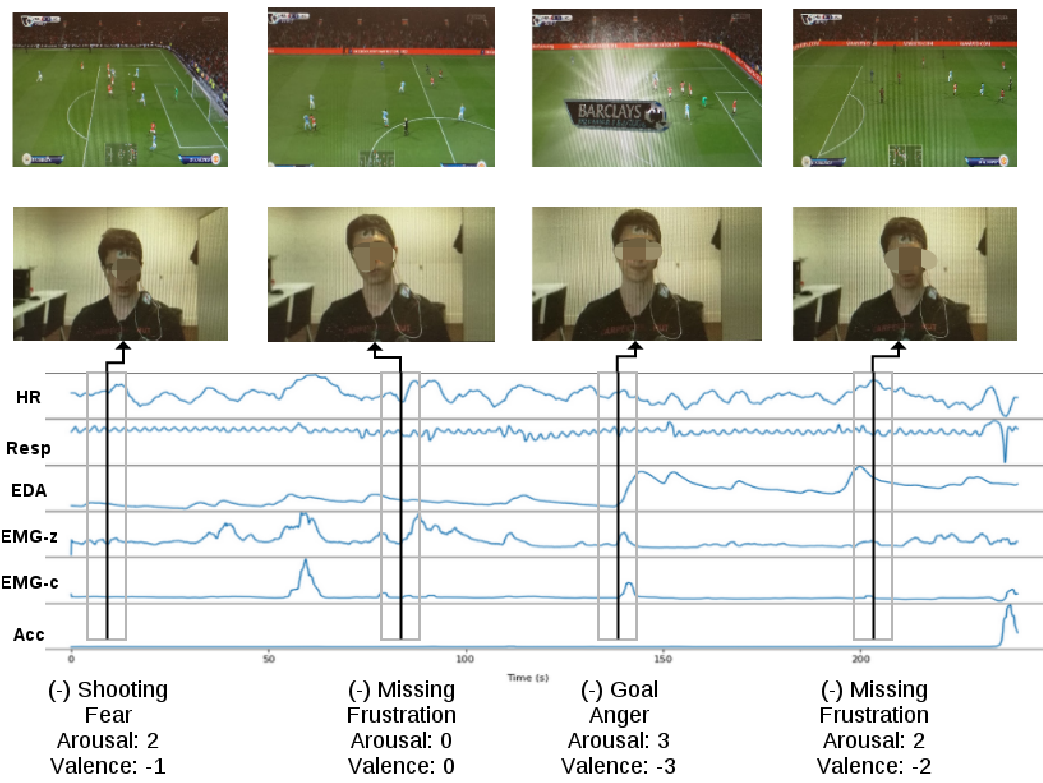 Figure 1: The synchronized experimental setup capturing gameplay, facial expressions, and physiological streams.
Key Results & Critical Findings
Detection vs. Recognition
The study bifurcated the task into:
- Emotion Detection: Is there an emotion occurring right now? (Binary: Emotional vs. Neutral).
- Emotion Recognition: Which specific emotion is it? (Classification: High/Low Arousal and Valence).
Performance Highlights:
- Arousal is easier to "see" than Valence: The models were significantly better at detecting intensity (Arousal) than whether the emotion was positive or negative (Valence).
- The 14-20s Sweet Spot: While 10s is enough to detect that something happened, the model needs 14-20 seconds of data to accurately categorize the emotion. This is due to the latency of the Peripheral Nervous System (PNS).
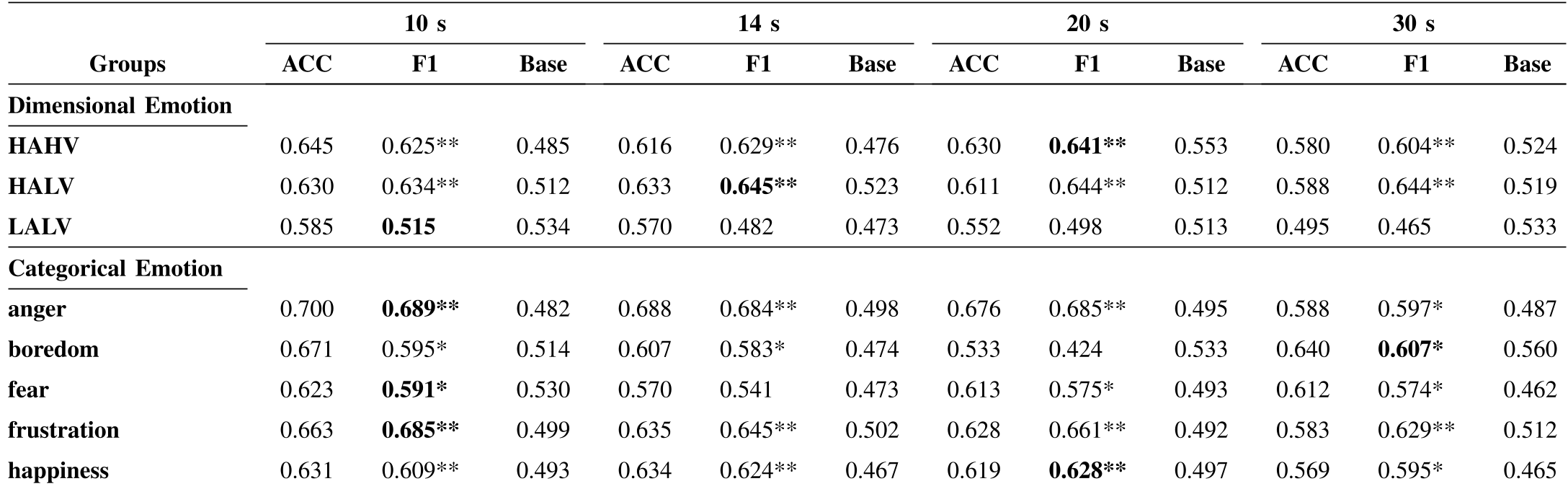 Table 1: Performance metrics showing that High Arousal, High Valence (HAHV) and High Arousal, Low Valence (HALV) segments are the most detectable.
Deep Insights: The "Signal" in the Noise
The study revealed a fascinating hierarchy of sensors:
- For Detection: Accelerometers (ACC) and Facial EMG (Zygomaticus) were paramount. If you move or twitch your face, the model knows you're reacting.
- For Recognition: Once the reaction is detected, EDA (Skin Conductance) and ECG (Heart Rate) become the heavy hitters for determining if you are angry, bored, or happy.
Critical Analysis & Conclusion
This work successfully bridges the gap between laboratory emotion theory and the chaotic reality of dynamic gaming. By proving that relative changes (delta) in physiology are better predictors than absolute baselines, the authors provide a roadmap for future "Biofeedback" games.
Limitations: The reliance on self-reporting via "video recall" can introduce cognitive bias—players might misremember how they felt 10 minutes ago. Future SOTA might involve real-time "probes" or gaze-tracking to validate these emotional labels in situ.
Final Takeaway: To build truly adaptive games, stop looking at the "average" player state. Look at the deviations triggered by the game's mechanics. The "Delta" is where the experience lives.