
Physiologically Inspired FER: Decoding Emotions via Facial Muscle Dynamics
Physiological Inspired Deep Neural Networks for Emotion Recognition
The paper introduces a physiologically inspired end-to-end deep neural network for Facial Expression Recognition (FER). It utilizes a novel "expression block" (e-block) and a specialized loss function to learn expression-specific features, achieving State-of-the-Art (SOTA) results on datasets like CK+, JAFFE, and SFEW.
TL;DR
This research moves beyond generic deep learning by integrating physiological priors into CNNs. By using a novel "Expression Block" and relevance-map regularization, the model learns to focus specifically on the facial muscles and wrinkles that define human emotion. It breaks performance records on major FER benchmarks, proving that domain knowledge is the best antidote to data scarcity.
Background: The "Small Data" Wall in Emotion Recognition
While Deep Learning (DL) has revolutionized computer vision, Facial Expression Recognition (FER) remains a "stubborn" field. The primary reason? Data scarcity. Unlike general object recognition with millions of images, FER datasets are small, and facial expressions are highly idiosyncratic.
Current solutions like Transfer Learning (pre-training on ImageNet) often carry over "junk" features that have nothing to do with emotions. The authors of this paper argue that we should look back at physiology: facial expressions are simply the result of specific muscle movements (Action Units).
The Core Innovation: Expression-Specific Feature Learning
The authors propose a modular architecture designed to mimic the human focus on specific facial triggers.
1. The Architecture
The system is split into three functional modules:
- Facial-Parts Component: An encoder-decoder (U-Net style) that predicts a Relevance Map . This map identifies which pixels "matter" for an emotion.
- Representation Component: This contains the e-block. It performs an element-wise multiplication between the CNN's feature maps and the predicted Relevance Map.
- Classification Component: Standard fully connected layers that interpret the filtered, high-density features.
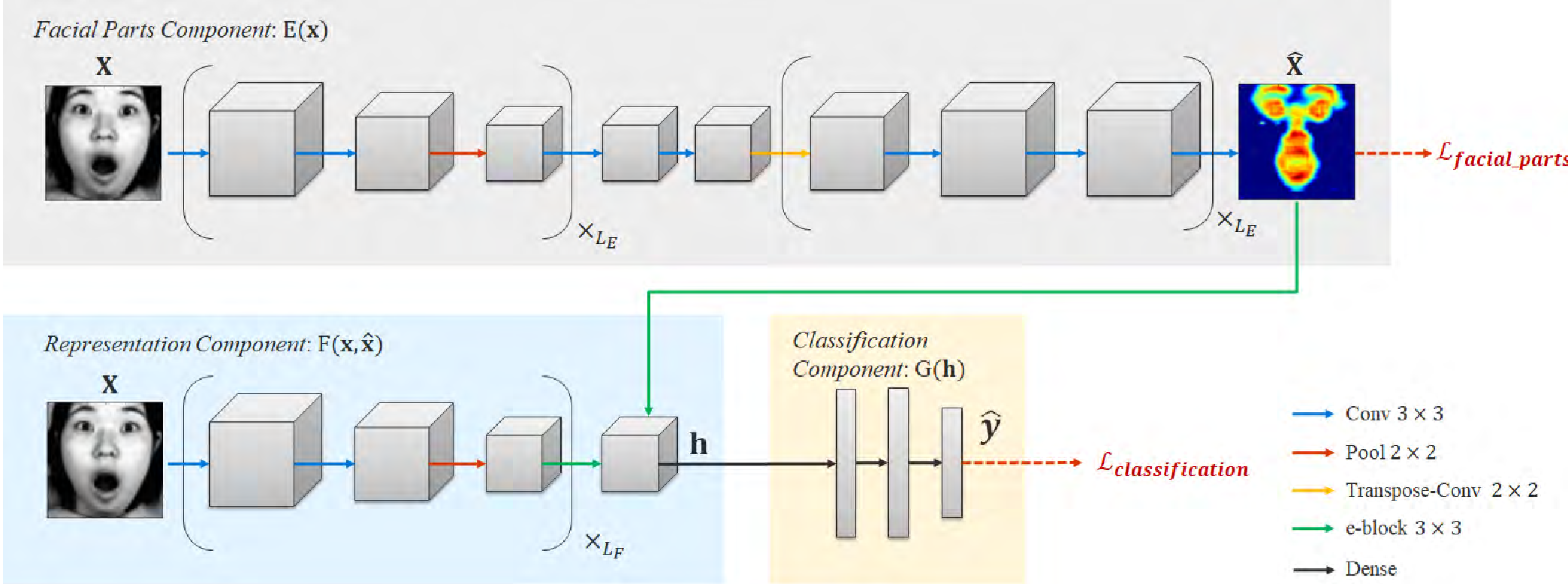
2. Why "Weak Supervision" is a Game Changer
The paper introduces a brilliant regularization strategy. Instead of just relying on manual landmark annotations (Fully Supervised), they use:
- Sparsity Loss ( norm): Forces the model to pick only the most essential areas.
- Contiguity Loss (Total Variation): Ensures the focused areas are smooth and physically meaningful, not just random noise.
Insight: The weakly supervised version actually outperformed the fully supervised one because it "discovered" expressive wrinkles and dimples that human-labeled landmarks often ignore.
Experimental Performance
The model was tested against both lab-controlled (CK+, JAFFE) and "In the Wild" (SFEW) environments.
- CK+ Results: Achieved 93.64%, a new SOTA for the 8-class task.
- SFEW (Wild): Achieved 50.12%. While this number looks lower, SFEW is notoriously difficult due to extreme lighting and angles; this score beats standard CNN baselines by a massive 8%.
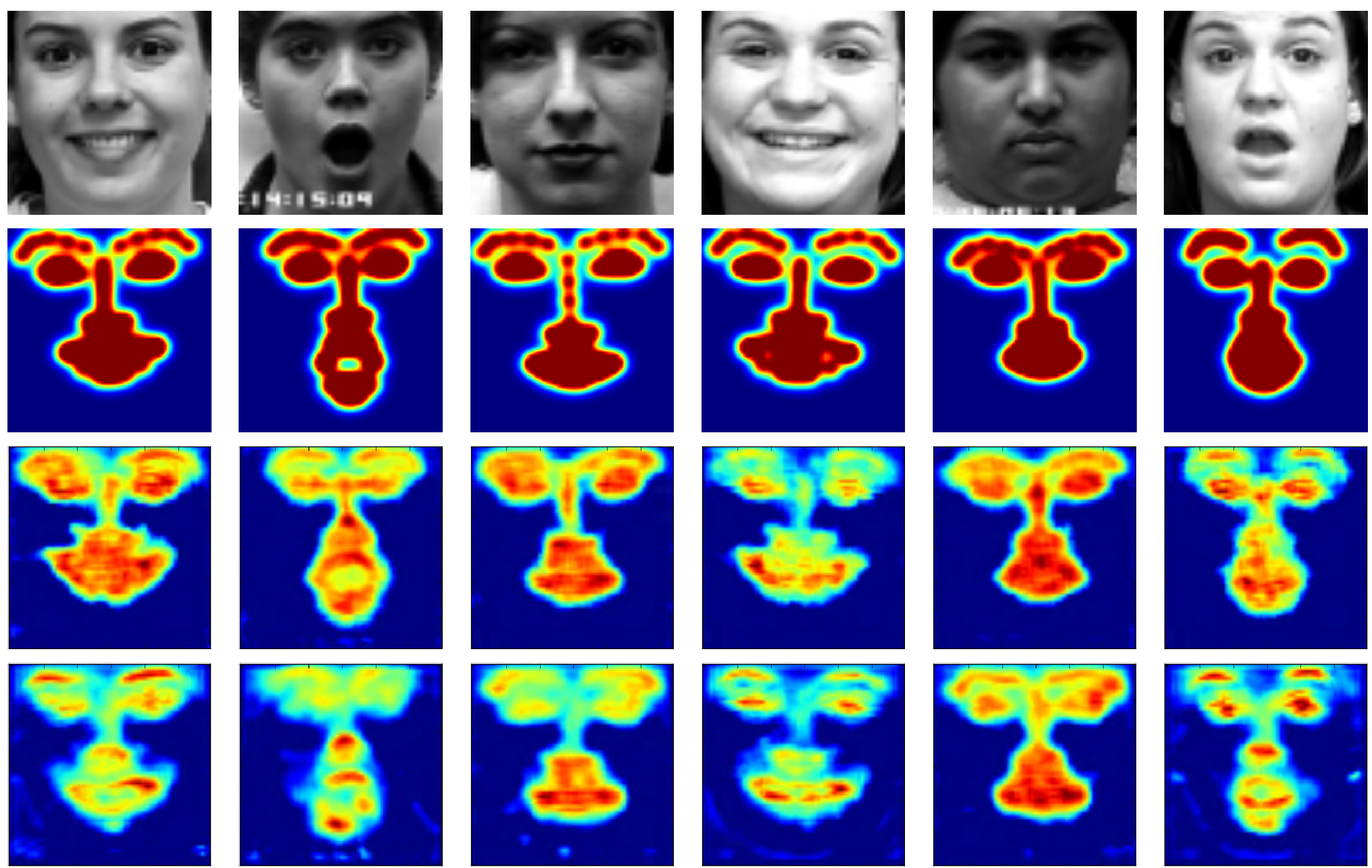 Figure: The relevance maps clearly highlight the mouth and eyes during a "Happy" expression, validating the physiological intuition.
Critical Analysis & Conclusion
The beauty of this work lies in its Inductive Bias. By forcing the network to justify where it is looking via the relevance map, the authors reduce overfitting.
Limitations:
- Hyperparameter Sensitivity: The weights for sparsity and contiguity ( and ) are crucial; one wrong setting results in "over-regularization," where the model ignores the face entirely.
- Static Limitation: The model uses static images. In reality, emotions are temporal. Extending this e-block logic to 3D-CNNs or LSTMs for video sequences is the logical next step.
Takeaway: If you are working with small datasets, don't just "fine-tune" a giant model. Design your loss function to reflect the physical reality of your data.