
Universal Signal Descriptors: A New Paradigm for Emotion Recognition in VR
Physiological Measurement for Emotion Recognition in Virtual Reality
This paper presents a framework for emotion recognition in Virtual Reality (VR) using non-invasive physiological sensors. By collecting multi-modal biosignals (EEG, ECG, EDA, etc.) during VR interactions, the authors propose a general-purpose feature extraction strategy that achieves a SOTA accuracy of 89.19% in arousal classification using SVM and robust feature selection.
TL;DR
Researchers have successfully transitioned from manually-crafted biological features to a general-purpose signal processing framework for detecting emotions in Virtual Reality. By extracting 90 universal descriptors from 24 different physiological channels and using robust -norm feature selection, they achieved an impressive 89.19% classification accuracy, outperforming traditional experts-defined methods.
Background: The Affective Computing Challenge in VR
As VR systems move from entertainment to therapeutic applications (such as treating social phobias), the ability to sense a user's emotional state—Affective Computing—becomes critical. However, accurately measuring emotions like "Arousal" (excitement) and "Valence" (pleasantness) is notoriously difficult. Physical movement in VR creates "noise" in the data, and traditional biological features often fail to capture the complex, non-linear relationships across different sensors.
The Problem: The Curse of Domain-Specific Features
Historically, researchers focused on domain-specific features:
- ECG: Looking specifically for Heart Rate Variability (HRV).
- GSR: Looking for the slope of skin resistance.
- EEG: Analyzing specific frequency bands like Alpha or Theta.
While these are biologically grounded, they are limited by our current understanding of physiology. If a specific signal doesn't fit the "classic" model, these features miss it. Furthermore, cable management and sensor noise in immersive VR environments often degrade these specific markers.
Methodology: Moving from "Expertise" to "Generalization"
The core insight of this paper is that signal characteristics matter more than biological labels. The authors measured 24 signals (including acceleration, respiration, pulse ox, and EOG) and treated them as raw data streams.
1. General-Purpose Feature Extraction
Instead of calculating "Heart Rate," the team calculated 90 universal descriptors for every channel, including:
- Spectral Entropy and Centroids (Frequency distribution).
- Wavelet Coefficients (MODWT) (Time-frequency resolution).
- Hjorth Parameters (Signal complexity and mobility).
- Higher-order Statistics (Skewness and Kurtosis).
2. The Model Architecture
To handle the resulting 2160-dimensional feature vector, they didn't just dump data into a classifier. They used a sophisticated Robust Feature Selection (RFS) method based on joint -norms to prune the noise.
 Fig 1: The non-invasive sensor setup used to capture multi-modal data during VR interaction.
Experiments and Results: Generalization Wins
The team compared three feature sets using a Leave-One-Out (Subject-Independent) cross-validation:
- Baseline (Mean/Std Dev): 74% Accuracy.
- Domain-Specific (Expert Features): 80% Accuracy.
- General-Purpose + RFS: 89.19% Accuracy.
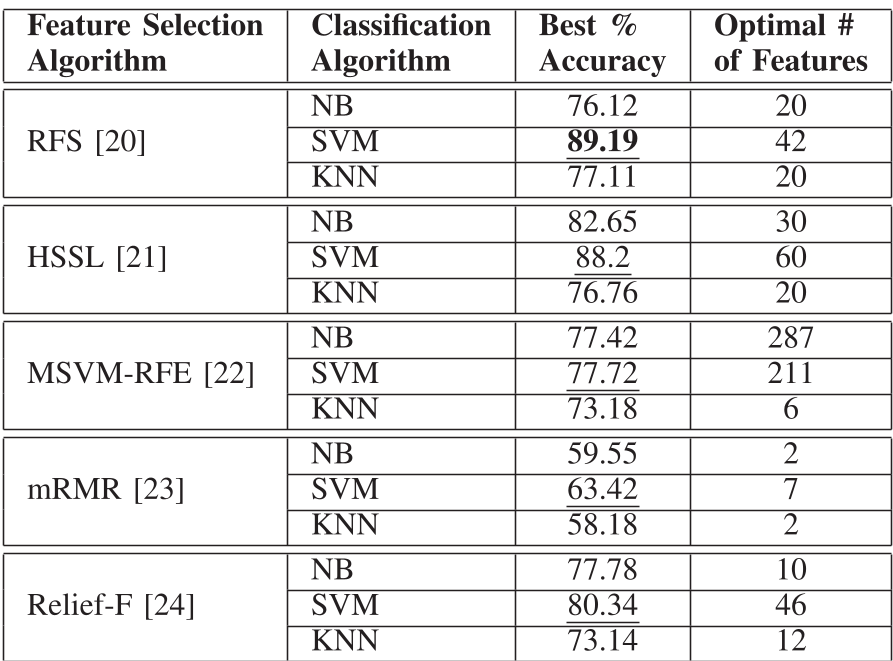 Table 1: Comparison of different Feature Selection and Classification algorithms.
The results prove that while "expert" features are good, a high-dimensional search through universal signal descriptors—paired with a classifier like SVM—captures subtle emotional signatures that humans might overlook.
Key Insight: The "Arousal-Valence" Grid
The study mapped subject responses to a 9-square grid. Interestingly, most VR sessions were rated as "Exciting" and "Pleasant," revealing a bias in current VR content towards high arousal.
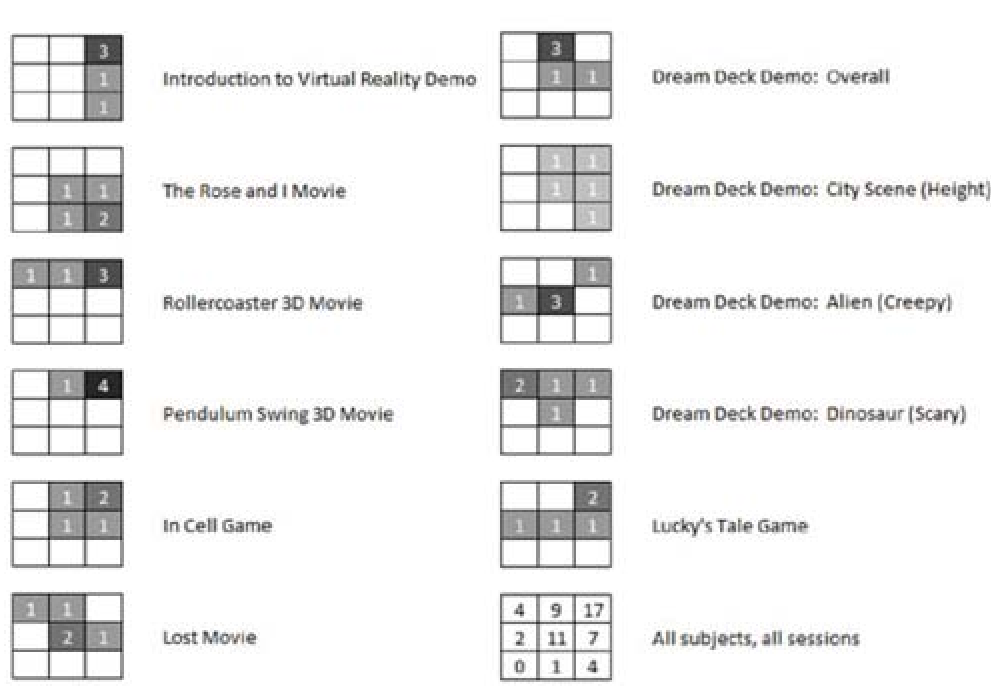 Fig 2: Heatmap of emotional responses. Most stimuli clustered in the high-arousal, positive-valence quadrant.
Conclusion and Future Outlook
The paper concludes that we don't necessarily need a PhD in Biology to build a great emotion classifier; we need better Signal Processing and Feature Selection.
Limitations:
- The sample size was small (5 subjects).
- The classification was simplified to "High Arousal" vs "Low/Moderate Arousal."
Future Direction: The authors suggest that future wearables (clothing with built-in sensors) will eliminate the "hassle" of adhesive electrodes, making this general-purpose feature strategy the standard for real-time emotional monitoring in the metaverse.
Takeaway for Researchers
If you are working on multi-sensor fusion, stop limiting yourself to "classic" features. Implement a wide net of signal descriptors and let automated feature selection algorithms like RFS or HSSL find the patterns for you.