
MSVM & Physiology: Decoding Human Emotions Through Internal Signals
Analysis of Physiological Signals for Emotion Recognition Based on Support Vector Machine
This paper presents a physiological-based emotion recognition system targeting four states: fear, disgust, joy, and neutrality. The authors employ a multi-sensor approach (SC, SKT, BVP) coupled with the International Affective Picture System (IAPS) for induction and utilize a tree-structured Multi-class Support Vector Machine (MSVM) for classification.
TL;DR
Researchers have developed a method to "read" emotions—specifically fear, disgust, joy, and neutral states—by analyzing internal physiological responses instead of external facial expressions. By combining Skin Conductance (SC), Skin Temperature (SKT), and Blood Volume Pulse (BVP) with a sophisticated Multi-class Support Vector Machine (MSVM), the study demonstrates that our bodies' involuntary reactions can identify our emotional state with high precision in controlled environments.
Background & Motivation: Why Physiological Signals?
Most emotion recognition systems rely on "outward" markers like facial expressions or voice tone. However, these are easily masked by social conditioning. Physiological signals, governed by the Autonomic Nervous System (ANS), are much harder to fake.
The challenge? These signals are "noisy" and highly individual. This paper targets the extraction of meaningful features from these signals to improve the accuracy of human-computer interaction (HCI).
Methodology: From Raw Signals to Feature Space
1. Data Acquisition and Induction
The study used the International Affective Picture System (IAPS) to elicit specific emotions. Subjects were shown standardized images while wearing biofeedback sensors on their non-dominant hand.
- Skin Conductance (SC): Measures sweat gland activity (linked to arousal).
- Skin Temperature (SKT): Reflects stress levels (temperature drops during fear/pain).
- Blood Volume Pulse (BVP): Tracks fluctuations in blood flow.
 Fig 1: The cyclic process of stimulus (S) and rest (R) used to collect clean physiological benchmarks.
2. The Power of Eigen-Features
Instead of just using raw averages, the authors employed Eigenvalue and Eigenvector analysis. By creating 2D and 3D covariance matrices between SC, SKT, and BVP, they captured the correlation between different bodily responses, rather than just isolated changes. This provides a much more mathematically robust representation of an "affective state."
3. Tree-Structured MSVM
Classification was handled by a Tree-Structured Multi-class SVM. Unlike standard SVMs that are binary (A or B), this version builds a hierarchy to separate emotions based on the "distance" between patterns, optimizing the decision boundary for maximum margin between states like "Joy" and "Disgust."
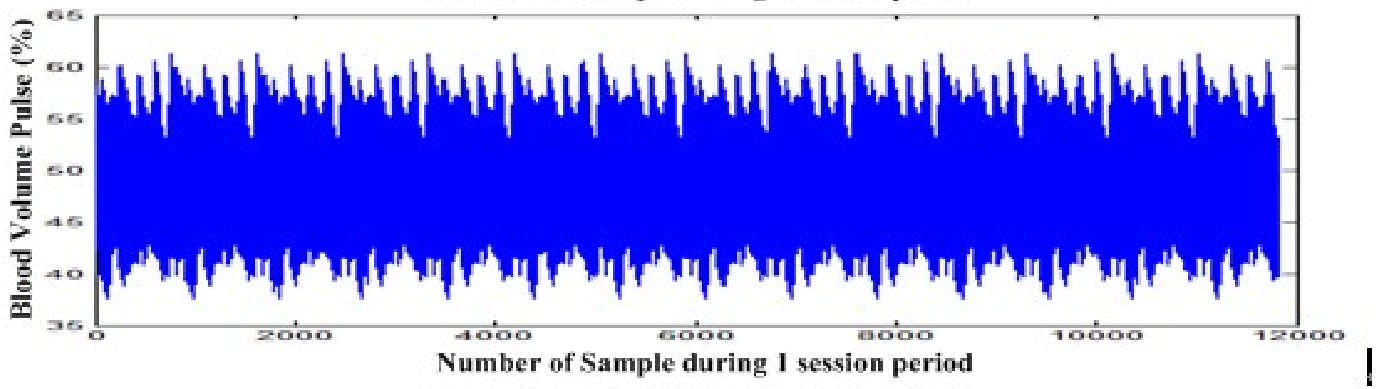 Fig 2: Visualization of the multi-channel physiological raw signal during a 'Fear' stimulus.
Experimental Results: High Precision, High Variability
The results showed that for individual subjects, the system is remarkably powerful.
- Successes: Subject 1 and Subject 3 reached 100% accuracy for Joy and Neutral states in initial trials.
- Challenges: Accuracy dropped significantly in later trials (some as low as 40%), suggesting that "sensor fatigue" or emotional habituation (getting used to the pictures) might be occurring.
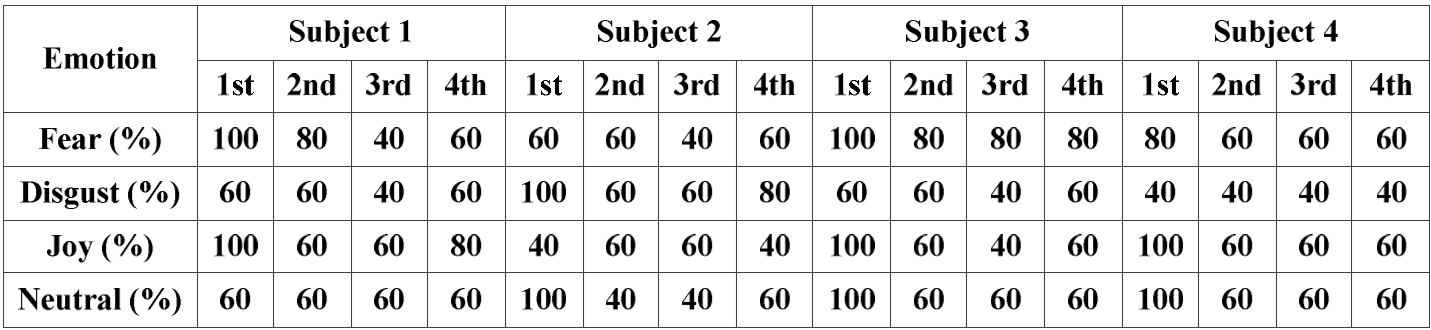 Table 1: Comparative accuracy across four subjects and four emotional categories.
Critical Insight & Conclusion
This research confirms that physiological "fingerprints" of emotion exist, and with enough data, they are highly discriminative. The use of Eigen-decomposition on multi-modal sensors effectively reduces the dimensionality of complex biological data into something a machine can understand.
Takeaway for the Future: While the current model excels in a "user-dependent" context (one model per person), the next frontier is user-independent recognition. To achieve this, researchers will likely need to move toward multi-modal stimuli—combining images with audio and video—to create stronger, more universal emotional responses.
Limitations
- Small Sample Size: Only 4 subjects participated.
- Context Sensitivity: The laboratory environment doesn't perfectly replicate real-world emotional volatility.
- Label Uncertainty: Physiological signals don't always align perfectly with the start/stop of a visual stimulus.