
PCS: Slashing Mobile Crowdsourcing Energy Costs via App Piggybacking
Piggyback CrowdSensing (PCS): Energy Efficient Crowdsourcing of Mobile Sensor Data by Exploiting Smartphone App Opportunities
This paper introduces Piggyback CrowdSensing (PCS), a framework designed to achieve energy-efficient mobile crowdsourcing by exploiting "Smartphone App Opportunities." By piggybacking sensor data collection, computation, and uploading onto existing user activities (e.g., phone calls or app usage), PCS achieves state-of-the-art energy savings while maintaining high data quality.
TL;DR
Mobile crowdsensing often kills smartphone batteries, deterring user participation. Piggyback CrowdSensing (PCS) solves this by hiding data collection, processing, and uploads inside the "shadow" of active user sessions (like when you're browsing or calling). By avoiding the high energy cost of waking a phone from an idle state, PCS delivers up to 90% energy savings across tasks like pothole detection and indoor localization.
The Motivation: The "Idle-Wakeup" Tax
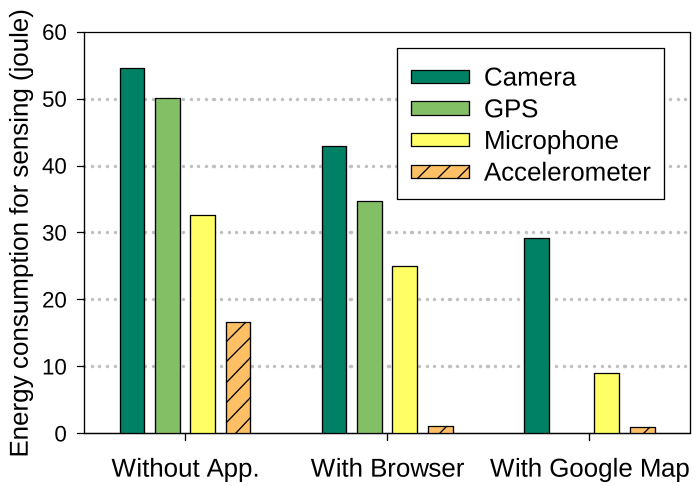
The hidden enemy of mobile sensing isn't just the sensor itself—it's the system overhead. Waking a phone's CPU from an idle sleep state to take a single GPS or WiFi sample can consume between 200mW and 600mW.
Prior works (Periodic or Context-driven sampling) trigger these wake-ups blindly. The authors of PCS realized that if a user is already using an app, the CPU is already "paid for." Collecting data at that moment incurs only a tiny marginal cost.
Methodology: Intelligence Under the Hood
PCS isn't just a greedy opportunistic sampler. If it sampled every time you opened an app, it would still drain your battery. Instead, it uses a two-stage intelligent core:
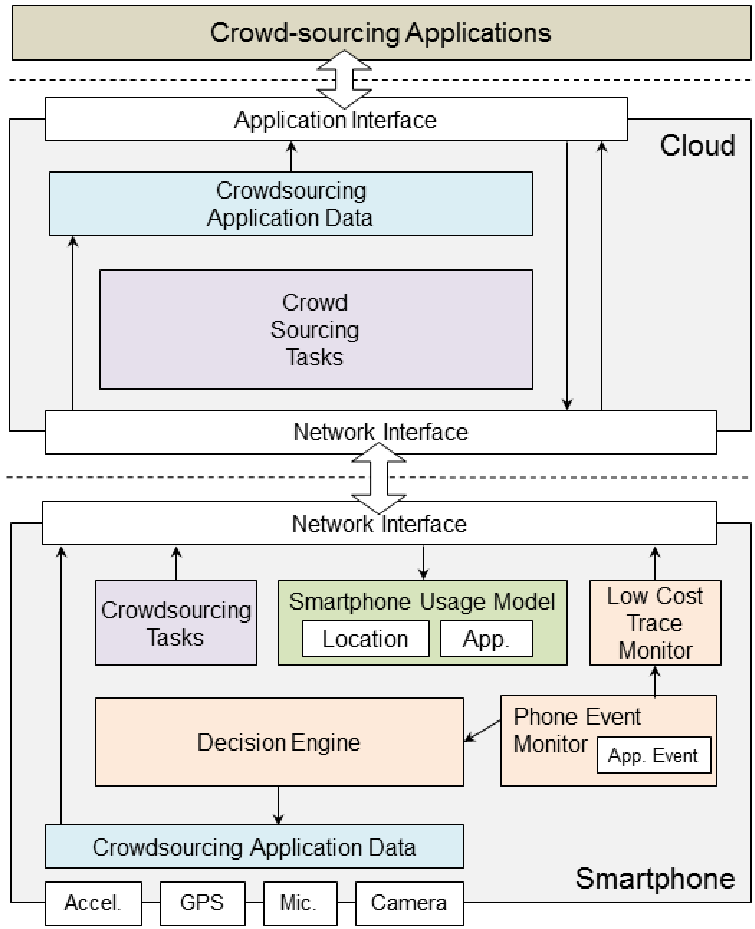
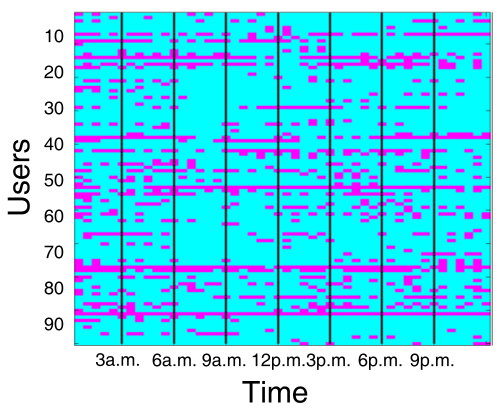
- Online Boosted Naive Bayes Model: It learns your personal habits. Do you check Twitter at 8 AM? Do you use Maps at the subway station? It predicts future "opportunities" without the energy cost of heavy background training.
- Sensing Decision Engine (SDE): This treats your battery as a "Knapsack." It calculates the Utility (data quality/relevance) and Cost (marginal energy) of your current app session versus predicted future sessions. Using an Index-Knapsack heuristic, it decides: "Should I sample now, or wait for the user to open Google Maps in 20 minutes for a 'cheaper' GPS lock?"
Performance: More Data, Less Heat
The researchers replayed traces from 1,320 users across multiple scenarios:
- Pothole Detection: PCS achieved 3x more data than periodic sampling.
- Speech Recognition: Efficiently extracted MFCC features in the background during active app use.
- Indoor Localization: This was the "final boss" experiment. Using 15 users over 25 days, PCS built a WiFi fingerprinting database.
The result? PCS could operate on a tiny fraction of the energy (0.3x) compared to manual surveying while maintaining a localization error of roughly 2-5 meters—more than sufficient for most commercial indoor navigation apps.
Critical Analysis: Why This Matters
PCS moves the needle from "active participation" (which fails for lack of users) to "invisible participation."
Pros:
- Extreme Efficiency: By amortizing the "tail states" of radio and CPU cycles, it makes sensing almost "free."
- User-Centric: Respects a "battery budget" set by the user.
Limitations:
- Coarse Mobility: To save energy, PCS doesn't track location exactly until a sample is needed, which might miss specific geographic hotspots if the user doesn't open an app there.
- The "Idle Gap": If a user doesn't touch their phone for 6 hours, PCS can't collect data, which might be a dealbreaker for time-sensitive environmental monitoring.
Conclusion
PCS proves that the most efficient way to run a mobile crowd is to be a "parasite" on existing user behavior. By intelligently aligning background chores with foreground active states, we can build massive global sensor networks without the user ever feeling the heat of a draining battery.
Takeaway: In the era of mobile-first AI, "Piggybacking" is the ultimate architectural strategy for sustainability.