
Piggyback Game: Rethinking Event Dissemination via Game Theory
Piggyback Game: Efficient Event Stream Dissemination in Online Social Network Systems
This paper introduces the "Social Piggyback Game," a game-theoretic framework for efficient event stream dissemination in Online Social Networks (OSNs). By modeling social links as rational players, it achieves a 1.5-approximation of the social optimal and reports a 302x improvement in system efficiency compared to state-of-the-art greedy heuristics.
TL;DR
In the world of Online Social Networks (OSNs) like Twitter or Facebook, disseminating "events" (tweets, likes, shares) is the single biggest workload. Current methods to optimize this traffic are either too slow to run on big graphs or too inaccurate to be useful. This paper introduces the Social Piggyback Game, treating each social link as a player in a game. It achieves a 302x efficiency boost and a near-optimal 1.5-approximation of the theoretical minimum traffic, turning an NP-hard graph problem into a fast-converging potential game.
The Problem: The High Cost of Being Social
In modern OSNs, user data is usually stored in materialized views across thousands of servers. When you post a tweet, your followers' views must be updated. This leads to two extremes:
- Push-all: Great for reading, but kills the network with writes (especially for celebrities).
- Pull-all: Great for writing, but creates massive latency when you open your feed.
"Social Piggybacking" is a clever middle ground. If User A follows B, and both follow C, B's server can "piggyback" C's updates when it sends B's updates to A. However, choosing which links should push, pull, or piggyback across a graph with billions of edges is an NP-hard combinatorial nightmare. Leading solutions like CHITCHAT take days to run, while parallel alternatives like PARALLELNOSY sacrifice nearly 60% of the potential traffic savings.
Methodology: From Global Optimization to Individual Rationality
The authors shift the perspective from a central "scheduler" to a Game Theoretic model.
1. The Social Piggyback Game
Instead of a central algorithm trying to optimize the whole graph, every social link is treated as a rational player. A link can choose:
- Push: Costs the producer's write frequency .
- Pull: Costs the consumer's read frequency .
- Piggyback via : Costs effectively zero if the "bridge" nodes and agree to help.
2. Reciprocity: The Secret Sauce
In a basic game, players might get stuck in infinite loops (oscillation). The authors solve this by introducing Reciprocity Factors (). These are small internal payoffs that reward links for being helpful to others. If a link chooses to "push" or "pull," it gains a reciprocity benefit if that action helps another link piggyback its data.
3. Mathematical Elegance: The Potential Function
The authors prove that this game is a Potential Game. This means there exists a global function that tracks the state of the game. Every time a single link makes a "best response" (choosing a strategy that lowers its own cost), the global function also decreases. This guarantees that the game must eventually reach a Nash Equilibrium.
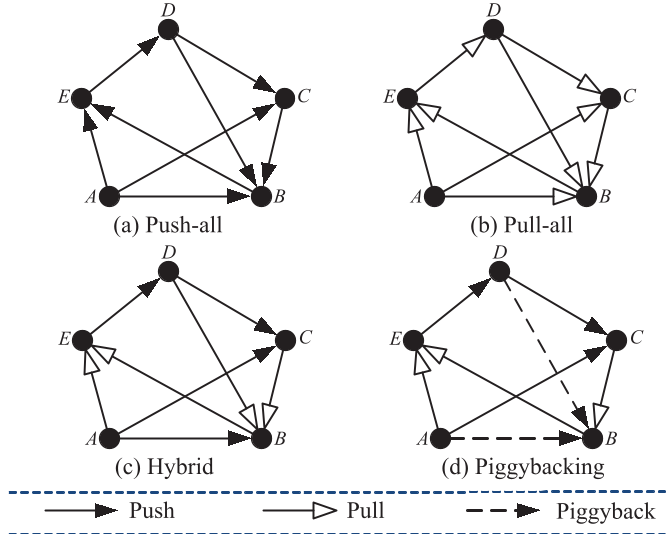 Fig 1. Visualization of Push, Pull, and Piggyback strategies in a social subgraph.
Accelerated Convergence
To handle graphs with billions of links (like the Twitter 2010 trace), the authors didn't just use vanilla game theory; they engineered the engine:
- Edge Coloring: By coloring edges, they ensure that links of the same color can update their strategies simultaneously without interfering with each other—enabling massive parallelism.
- Active Mechanism: Only links whose neighbors have changed their strategy need to be re-evaluated, drastically cutting down redundant math.
Experimental Results: 302x Better Efficiency
The PI-Game was tested against real-world traces from Twitter (54M users) and Flickr.
- Speed: While the industry-standard CHITCHAT took over 48 hours to process the Twitter graph, the PI-Game finished in 10 minutes on a standard cluster.
- Traffic Reduction: PI-Game achieved a 3.3x improvement ratio in traffic savings, outperforming the parallel baseline by 50%.
- Efficiency: When combining speed and quality, the PI-Game is 302x more efficient than previous state-of-the-art methods.
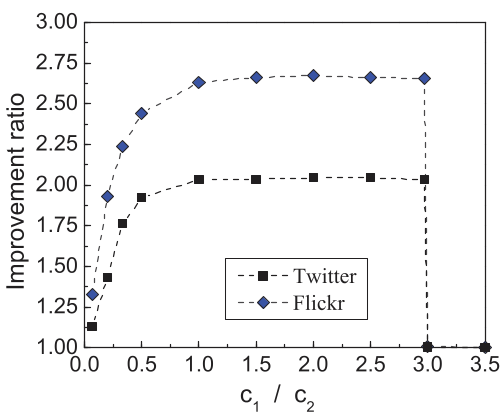 Fig 2. Convergence of the potential function over iterations, showing rapid optimization in the first 2-3 rounds.
Critical Insights & Conclusion
The core takeaway of this work is the power of decomposition. By proving that the event dissemination problem can be mapped to a potential game, the authors avoided the "curse of dimensionality" inherent in large graphs.
Limitations: The model assumes that production and consumption rates are relatively stable and known. In highly volatile workloads (e.g., breaking news events), the game might need to be re-run frequently, though its 10-minute execution time makes this much more feasible than previous methods.
This research provides a robust blueprint for using game theory to solve infrastructure-level problems in distributed systems, moving beyond simple heuristics to mathematically guaranteed equilibria.