
Social Piggyback Game: Radical Efficiency in Social Media Event Streams
Piggyback Game: Efficient Event Stream Dissemination in Online Social Network Systems
The paper introduces the Social Piggyback Game, a game-theoretic framework for optimizing event stream dissemination in large-scale Online Social Networks (OSNs). By modeling social links as rational players, it achieves efficient message delivery through a "piggybacking" mechanism, outperforming existing structural and link-based strategies in both computation speed and dissemination cost.
TL;DR
Researchers from HUST have pioneered a game-theoretic approach to solve the "event dissemination" nightmare in social networks. By treating every social link as a player in a game, they've achieved a 302x speedup in system efficiency, reducing inter-server traffic significantly compared to traditional methods used by giants like Facebook.
The "Push vs. Pull" Bottleneck
In Online Social Networks (OSNs), every time you post a status (Event Sharing) or refresh your feed (Event Browsing), a massive amount of data moves between servers.
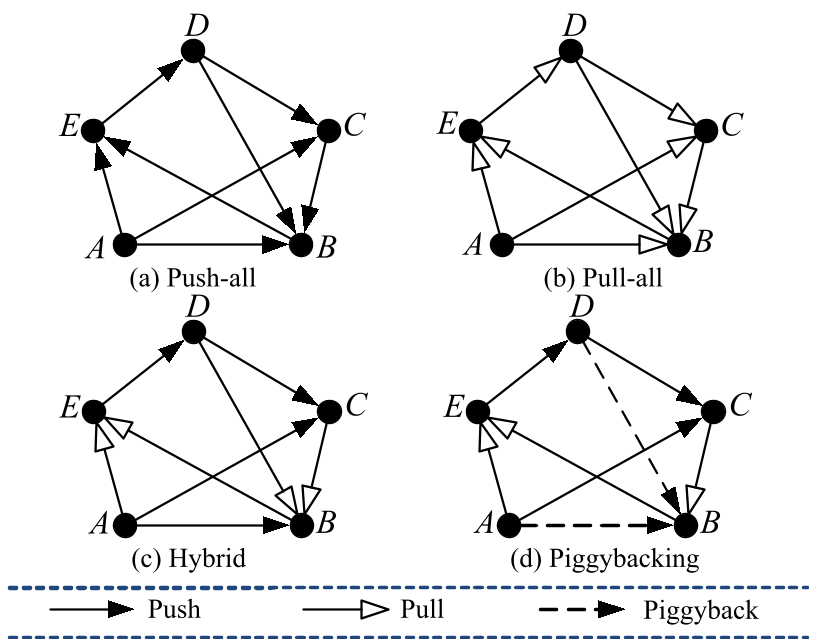
- The Push Problem: Pushing every update to every follower's "materialized view" wastes bandwidth if followers don't read.
- The Pull Problem: Pulling updates on-demand from every followee creates massive read latency at scale.
Previous "Hybrid" schemes tried to pick the best of both worlds, but they ignored a hidden weapon: The Piggyback Structure. If User A follows B, B follows C, and A also follows C, then A can "piggyback" C’s updates from B’s view rather than contacting C directly.
Why Previous Solutions Failed
Optimizing these triangular piggyback structures across a graph of billions of links is NP-hard. Existing algorithms like ChitChat use greedy heuristics that take days to run. Parallel versions like ParallelNosy are faster but lose over half the potential efficiency.
Methodology: The Social Piggyback Game
The authors propose a Piggyback Game. Instead of a central controller trying to solve the whole graph, each link (player) chooses its own strategy: Push, Pull, or Piggyback.
1. The Payoff Matrix
The brilliance lies in the Relevance Cost. By adjusting the "payoff" a link receives, the system incentivizes links to help others piggyback.
2. Ensuring Convergence
Using Potential Game Theory, the authors mathematically prove that this decentralised decision-making always converges to a Pure Nash Equilibrium. This equilibrium isn't just stable; it’s a 1.5-approximation of the absolute social optimum.
3. Scaling to Billions
To handle massive datasets like Twitter (1.9B links), the authors introduced:
- Link Coloring: Ensuring no two links in a processing group interfere with each other, allowing massive parallelism.
- Active Mechanism: Only re-calculating links that need to change, saving 69% of processing time.
Experimental Results
The researchers tested their "PI-Game" against real-world traces from Flickr and Twitter.
- Traffic Reduction: Reduced TCP traffic by 43% compared to architectures like Facebook’s TAO.
- Efficiency Factor: A staggering 302x improvement over the state-of-the-art structural algorithms on Twitter graphs.
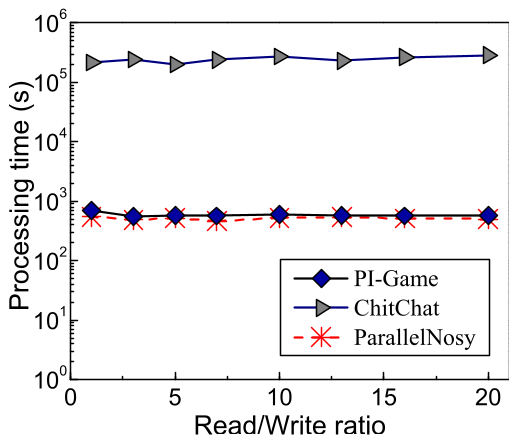 In the figure above, PI-Game maintains a high percentage of piggybacked links even as the Read/Write ratio shifts, ensuring the system remains lean.
Critical Analysis & Conclusion
Takeaways
- Game Theory for Systems: This work proves that distributed system problems can be elegantly solved by aligning individual incentives with global goals.
- Dynamic Resilience: The proposed "Dynamic Piggyback Game" allows systems to update strategies as users add/remove friends without re-calculating the entire graph.
Limitations
While the 1.5-approximation is excellent, it assumes uniform event sizes (e.g., 280-char tweets). Future work will need to address heterogeneous data (video previews vs. text) where "Push" and "Pull" costs vary significantly.
Future Outlook
As OSNs move toward decentralized or edge-computing architectures, game-theoretic models like the Social Piggyback Game will likely become the de facto standard for managing data flow without central bottlenecks.