
PILHNB: Decoding Social Evolution through Popularity, Interests, and Location
PILHNB: Popularity, interests, location used hidden Naive Bayesian-based model for link prediction in dynamic social networks
The paper introduces PILHNB, a link prediction model for dynamic social networks that integrates network structure with behavioral factors. It combines a Gaussian-weighted Latent Dirichlet Allocation (LDA) for interest mining and a Hidden Naive Bayesian (HNB) framework to achieve state-of-the-art accuracy across diverse real-world datasets.
Executive Summary
Link prediction is the art of forecasting future interactions in a network. While traditional models rely heavily on "who you know" (structural proximity), the PILHNB model (Popularity, Interests, and Location-based Hidden Naive Bayesian) argues that "who you are" and "where you go" are equally critical. By merging a modified Latent Dirichlet Allocation (LDA) for interest mining with a Hidden Naive Bayesian (HNB) framework, this paper achieves a significant performance leap in dynamic social networks, outperforming GNN-based and embedding-based baselines.
Problem & Motivation: The Static Trap
Real-world social networks are not frozen snapshots; they are living, evolving organisms. Most existing SOTA methods suffer from two major flaws:
- Structural Myopia: They over-index on common neighbors while ignoring that human connections are driven by shared hobbies, geographic mobility (location check-ins), and social hierarchy (popularity).
- Ignorance of Evolution: They fail to capture how a user's behavior changes between time and .
The authors' insight is simple yet powerful: to predict a link, one must quantify the evolutionary trajectory of both the network's skeleton (structure) and its soul (user behavior).
Methodology: The Core Engine
The PILHNB framework operates via a three-stage pipeline: Quantification, Modeling, and Prediction.
1. Multi-Factor Quantification
The model extracts five "Behavioral Elements":
- Common Interests: Mined from text (messages/comments).
- Interaction Frequency: How active the user is.
- Location Check-ins: Shared physical spaces.
- Popularity: The ratio of "fresh" links to total links.
- Attribute Similarity: Education, workplace, etc.
2. Gaussian-Weighted LDA
Standard LDA often fails due to the "power-law" nature of social data—high-frequency users create noise. PILHNB uses Gaussian weighting in the LDA process to normalize these distributions, ensuring that "interests" are accurately mapped to latent topics.
3. Hidden Naive Bayesian (HNB)
Traditional Naive Bayes assumes features are independent—a major fallacy in social data. The HNB module introduces "Hidden Parents" to represent Individual Dependency () and Combined Dependency () among neighbors.
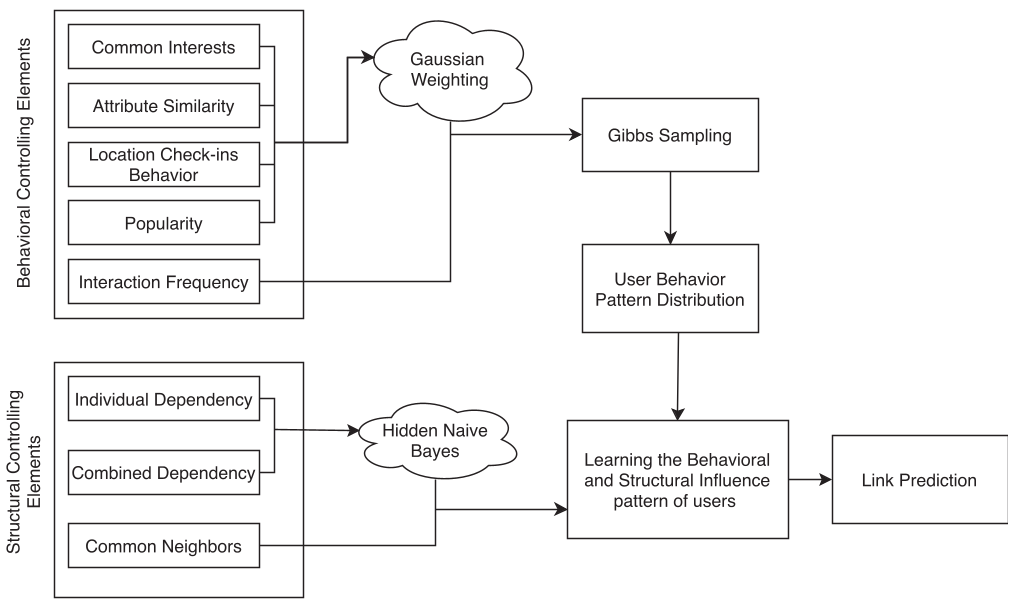 Figure 1: The PILHNB Model detail, showing the integration of behavioral elements into the Bayesian framework.
Experiments: Superior Predictive Power
The authors tested PILHNB against heavyweights like SEAL (GNN-based) and SLIDE.
SOTA Results
On the Facebook and Twitter datasets, PILHNB showed dominance, particularly in AUROC and Precision.
- Facebook AUROC: 0.8920 (vs. 0.8646 for SEAL).
- Twitter AUROC: 0.8767 (vs. 0.8087 for SEAL).
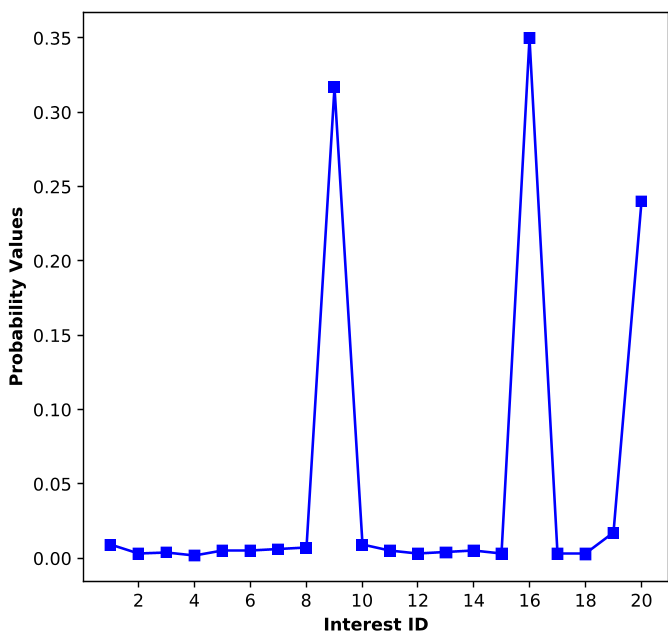 Figure 2: Analysis of latent interest distribution (K=10/20) and its impact on prediction accuracy.
Ablation Insights
The paper confirms that identifying the "Sweet Spot" for latent interests () and a small window for popularity () is essential. Notably, the "Combined Element" (Structural + Behavioral) always outperformed sub-models that only looked at one aspect.
Critical Analysis & Conclusion
Takeaways
PILHNB proves that in the era of multi-modal data, link prediction is a fusion task. By treating "popularity" as a dynamic variable rather than a static degree count, the model effectively mimics the "preferential attachment" seen in real-world fame cycles.
Limitations
- Complexity: The model is mathematically dense and involves heavy preprocessing for feature vectors.
- Cold Start: For new users with zero check-ins or messages, the behavioral module may revert to structural-only heuristics.
Future Work
The shift towards Location-Aware Dynamic Networks is just the beginning. The next frontier involves applying this multi-factor Bayesian logic to real-time recommendation engines and high-volume biological interaction data.