
PILHNB: Decoding Social Evolution through Popularity, Interests, and Location
PILHNB: Popularity, interests, location used hidden Naive Bayesian-based model for link prediction in dynamic social networks
The paper introduces PILHNB, a novel link prediction model for dynamic attributed social networks. It leverages a modified Latent Dirichlet Allocation (LDA) and Hidden Naive Bayesian (HNB) framework to synthesize structural data with behavioral factors like popularity, interests, and location.
TL;DR
Predicting who will connect next in a social network is no longer just about "friends of friends." The PILHNB model introduces a sophisticated Bayesian framework that integrates mobility (location), user popularity, and latent interests (mined via improved LDA) to forecast link formation. By treating social networks as dynamic, attribute-rich environments rather than static graphs, it achieves a ~13% boost in AUROC over leading benchmarks.
Background: Why Topological Heuristics are Failing
Standard algorithms like Common Neighbors or Adamic-Adar assume that the "shape" of the network is enough to predict its future. However, in modern social platforms, connections are driven by context:
- Mobility: People who visit the same gym or office are likely to connect.
- Popularity: Users gravitate toward "trending" nodes.
- Dynamic Interests: Your interests today (mined from posts) are better predictors than your friends list from three years ago.
Most existing work treats these as separate problems. PILHNB unifies them into a single probabilistic inference engine.
Methodology: The Three Pillars of PILHNB
1. Multi-Factor Quantification
The model identifies two categories of controlling elements:
- Behavioral: Latent Interest (I), Interaction Frequency (A), Location (L), Popularity (P), and Attribute Similarity (S).
- Structural: Common Neighbors (CN), and critical Hidden Dependencies (Individual vs. Combined).
2. Behavioral Pattern Discovery (Gaussian-LDA)
To extract "Interests" from noisy text data, the authors improved standard LDA with Gaussian weighting. This mitigates the "rich-get-richer" effect where high-frequency users drown out meaningful patterns from quieter nodes.
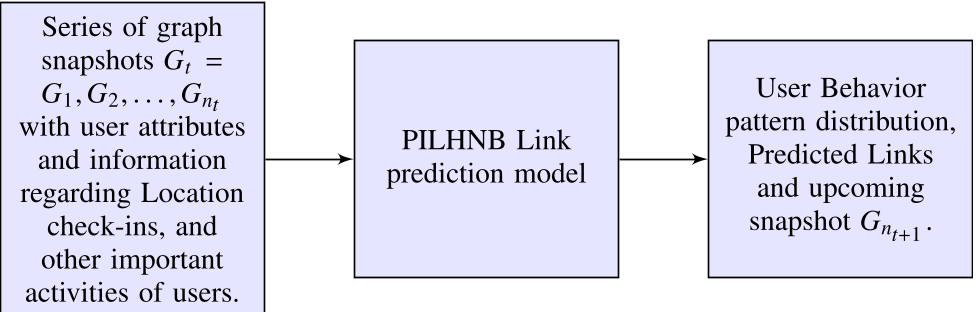
3. The Hidden Naive Bayesian (HNB) Engine
Unlike a standard Naive Bayes, which assumes all features are independent, PILHNB uses Hidden Naive Bayesian logic. It calculates:
- Individual Dependency (): How much one neighbor influences a link.
- Combined Dependency (): The collective influence of neighbor pairs.
This allows the model to capture the non-linear "social pressure" that leads to link formation.
Experimental Showdown: Outperforming GNNs and Embeddings
The authors tested PILHNB against heavyweights like SEAL (Graph Neural Network) and SemiGraph (Graph Embedding).
Key Findings:
- AUROC Dominance: On the Facebook dataset, PILHNB reached an AUROC of 0.8864, significantly higher than SEAL (0.8607) and 3-HBP (0.8256).
- The "Interest" Sweet Spot: The model performs best when the number of latent interests () is between 10 and 15. Too many interests introduce noise; too few cause over-generalization.
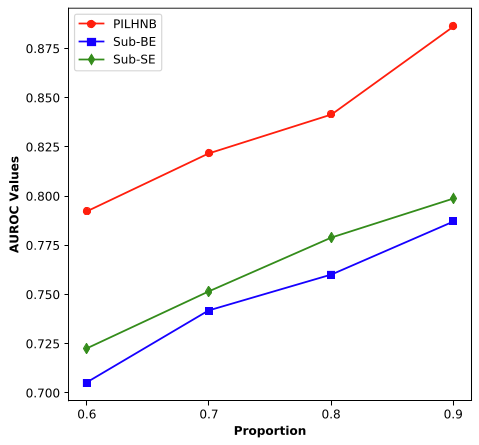 Figure: Performance across different training set proportions shows PILHNB (Blue) consistently leading.
Critical Insight: Why it Works
The success of PILHNB lies in its holistic view of a node. By considering Popularity (the fraction of fresh edges a node gains), the model captures "social momentum." Most GNNs view an edge as a binary state; PILHNB views it as a result of a behavioral trajectory.
Limitations
The primary trade-off is computational overhead. Calculating mutual information for combined dependencies () and running Gibbs sampling for LDA makes the preprocessing phase significantly heavier than simple structural heuristics.
Conclusion & Future Outlook
PILHNB proves that the "Social Intelligence" of a model depends on its ability to digest multi-modal data. As we move toward the Metaverse and more location-aware apps, integrating spatial-temporal behavior with relational topology will be the gold standard for recommender systems.
Takeaway: If you want to predict the next "Follow," look at where the user stands and what they are talking about, not just who they already know.