
Pinteresting: Decoding the DNA of Digital Curation
Pinteresting: towards a better understanding of user interests
This paper introduces "Pinteresting," a research framework for modeling user interests on the Pinterest platform. It proposes a taxonomy of interest representations—ranging from entity-based to latent Dirichlet allocation (LDA) topic models—to improve recommendation systems and social bookmarking experiences.
TL;DR
Released during the rapid ascent of Pinterest, this paper serves as a foundational blueprint for understanding how users express their identities through curated collections. It moves beyond simple "likes" to explore interest-based modeling, using entity linking and LDA topic modeling to transform a chaotic board of images into a structured, navigable map of human desire.
The Curation Crisis: Why Simple Tags Fail
By 2012, the web had moved from "searching" to "stumbling" and "pinning." Traditional information retrieval struggled with Pinterest for two reasons:
- The Sparse Label Problem: Users often leave boards uncategorized or give them cryptic names (e.g., "Someday" for a wedding board).
- The Contextual Shift: A picture of a chair isn't just "furniture"; depending on the board it's in, it represents "Minimalist Design," "Home Renovation," or "Vintage Photography."
The author, Ana-Maria Popescu, argues that to understand a user, we must understand the coherence and persistence of their curated collections.
Methodology: Three Layers of Interest
The paper proposes a hierarchical approach to representing what a user is actually "into":
1. Entity-Based Representations
Instead of treating a Pin description as a string of text, the system links it to a Knowledge Base (KB).
- Physical Linkage: Connecting a pin to an Etsy product or an IMDb entry.
- Semantic Anchor: Mapping a visual item to a Wikipedia entity to enable cross-platform recommendations.
2. Latent Topic Models (LDA)
This is where the "physical intuition" of the paper shines. By concatenating all pin descriptions in a board into a single "document," the author uses Latent Dirichlet Allocation (LDA) to find hidden clusters.
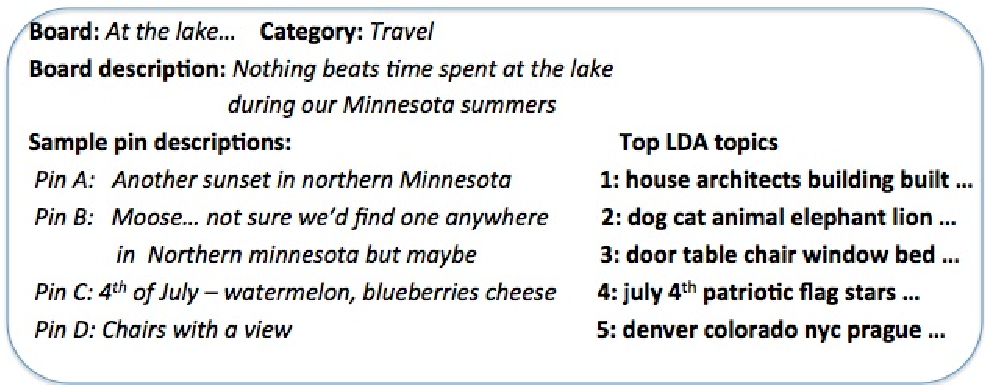 Figure 1: LDA reveals that a board titled "At the Lake" isn't just about water; it’s a cluster involving "cabin," "fishing," "moose," and "chairs."
3. Interest Dynamics
The paper identifies several "Interest Properties" that are now standard in RecSys:
- Coherence: Is the board focused or a "junk drawer"?
- Persistent vs. Time-Sensitive: Is this a lifelong passion for "Gardening" or a temporary obsession with "Blue Room Decor"?
Experiments: Mining the Pins
Using a crawl of 10,000 users, the research demonstrated that:
- Automated Categorization is essential, as the manually assigned category set is often incomplete or outdated.
- Social Signals (repins, likes) help distinguish between "core" interests and "peripheral" ones—a critical distinction for identifying domain experts on the platform.
Note: The paper highlights the workflow from Pin Collection to Interest Profile generation.
Critical Analysis & Future Outlook
The Takeaway: This work was early in recognizing that curation is a form of communication. While the techniques mentioned (LDA) have since been superseded by Embedding-based models and Transformers (like PinSage), the core philosophy remains: The context of a collection is more informative than the content of a single item.
Limitations:
- The 2012 era lacked deep visual feature extraction, relying heavily on text descriptions which may be brief or noisy.
- The "Social" aspect of collaborative curation was discussed but not fully quantified in the preliminary results.
Future Impact: This research paved the way for "Interest Graphs" that power modern discovery engines, shifting the focus from who you know (Social Graph) to what you love (Interest Graph).