
Pioneers of Influence: How to Quantify Viral Potential in Unknown Social Networks
Pioneers of Influence Propagation in Social Networks
The paper introduces a generalized diffusion framework on the Configuration Model (CM) to analyze influence propagation in social networks. By distinguishing between transmitter and receiver half-edges, the authors derive analytical conditions for viral outbreaks and provide specific estimators for the size of "good pioneers"—the subset of a population capable of triggering a large-scale cascade.
TL;DR
Is your viral marketing campaign actually viral, or are you just wasting your budget on the wrong "influencers"? This paper provides a mathematical skeleton to answer that question. By modeling social networks as Configuration Models and analyzing the statistics of "transmitter degrees," the authors provide a way to calculate the exact fraction of a population that can trigger a viral outbreak—even if you don't have a map of the network.
Contextual Positioning: Beyond Data-Mining Influencers
Most viral marketing research assumes you have a God-mode view of the network (e.g., a complete Facebook or Twitter graph). In reality, firms usually have blind spots. This paper steps into that void, offering a statistical guide for decision-making under high uncertainty. It is a theoretical bridge between pure graph theory (Configuration Models) and practical marketing strategy.
The Problem: The High Cost of "Hitting and Missing"
Viral marketing is inherently a "fat-tail" game. A campaign can fail repeatedly until it suddenly explodes. Current practitioners often rely on:
- Expensive Influencers: Targeting high-degree nodes that might not actually be "pioneers" for a specific product.
- Incentive Overdose: Paying users to share content, which can be less cost-effective than organic percolation.
The authors argue that if we understand the degree distribution of the network and the transmission probability of the campaign, we can predict if a "naive strategy" (randomly picking seeds) will work.
Methodology: The Dual Nature of Influence
The core innovation is the Enhanced Configuration Model. Instead of simple edges, nodes have "transmitter" and "receiver" half-edges.
The "Reverse Dynamic" Insight
To find a "good pioneer" (a node that can start a wildfire), the authors look at the problem backward. They ask: If we send an "acknowledgment" message back from every influenced node, who could have been the source? This reverse-flow creates a "dual graph" where the giant component represents the set of successful starting points.
 Equations 3 & 4: These generating functions are the "engine" used to find the zeros that define the viral threshold.
Experiments: Poisson vs. Power-Law
The paper tests three transmission behaviors:
- Bernoulli: Standard independent probability per friend.
- Node Percolation: You're either an "enthusiast" (influencing all friends) or "apathetic" (influencing none).
- Coupon-Collector: "Absentminded" users who repeat-share to the same small circle.
Key Findings
- Power-Law Resilience: Networks with Power-Law degree distributions (like real-world social networks) become viral much more easily (lower threshold ) but the size of the influenced population grows more slowly once the threshold is crossed.
- Pioneer Concentration: As shown in the simulation results, the relative size of influenced populations concentrates quickly, meaning statistical estimates from small samples (N=1000) are remarkably reliable.
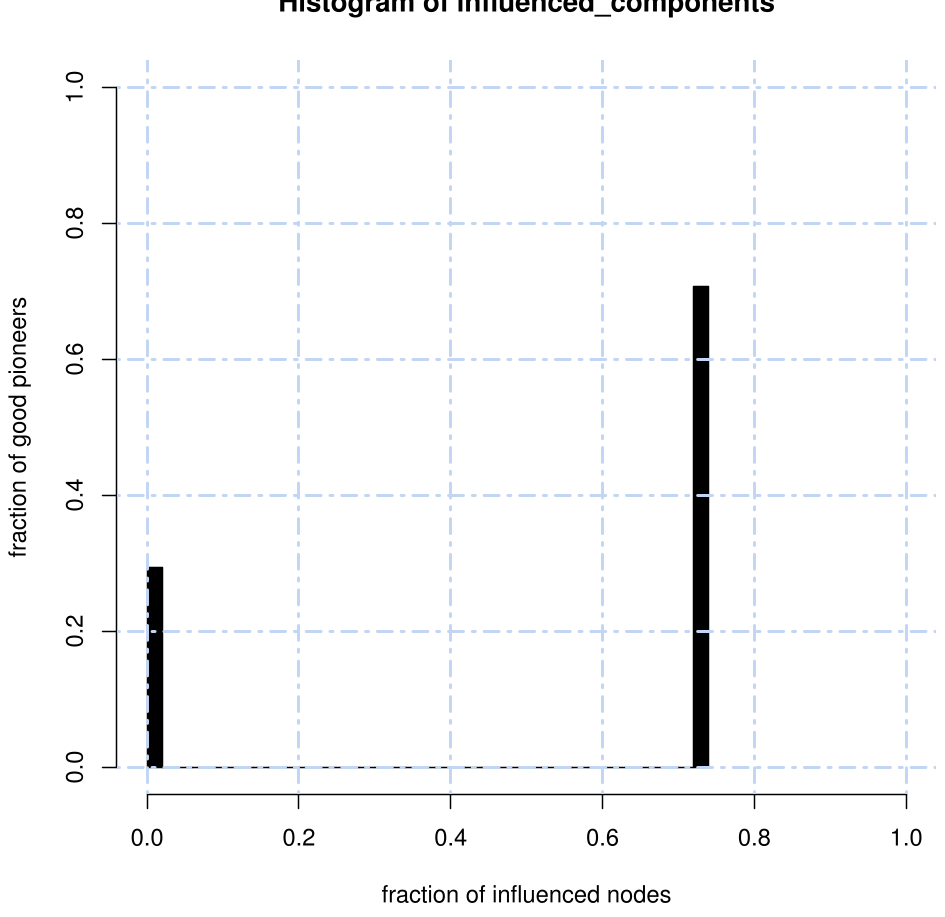 Figure 1: Demonstration of how influence sizes concentrate, justifying the use of statistical estimators for campaign evaluation.
Deep Insights & Conclusion
Why this matters for Product Teams
If you are launching a feature and want it to go viral, you don't need a full social graph. You need to survey your initial 1,000 "pioneers." By asking them two questions—"How many friends do you have?" and "How many did you tell/invite?"—you can plug those numbers into the authors' estimators to see if your campaign is mathematically capable of "going viral" or if the network is too fragmented.
Limitations
The model assumes a Configuration Model, which lacks "clustering" (the "friend of a friend is my friend" effect). In real networks, high clustering might slow down propagation but make it more dense in localized communities.
Future Outlook
The next frontier is identifying the "Centrality of Good Pioneers." If we can find these nodes not just by random sampling but by minimal local cues, viral marketing becomes a surgical strike rather than a blind gamble.