
[NVIDIA] PivotRL: High-Accuracy Agentic Post-Training at a Fraction of the Cost
PivotRL: High Accuracy Agentic Post-Training at Low Compute Cost
PivotRL is a novel post-training framework for long-horizon agentic LLMs that achieves high accuracy and compute efficiency. It bridges the gap between Supervised Fine-Tuning (SFT) and End-to-End Reinforcement Learning (E2E RL) by performing local, on-policy rollouts from filtered "pivotal" states in SFT trajectories and using functional verifiers for reward assignment.
TL;DR
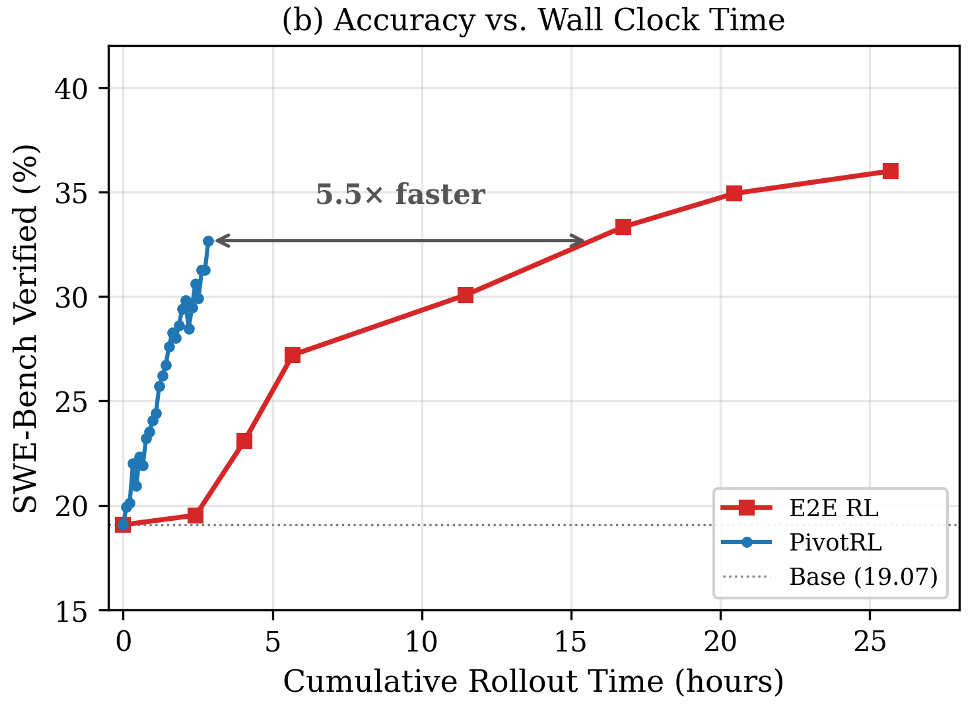
Researchers at NVIDIA and UC Berkeley have unveiled PivotRL, a framework that solves the "compute vs. generalization" dilemma in training AI agents. By filtering for critical decision points (Pivots) and rewarding functional success instead of verbatim mimicry, PivotRL outperforms SFT in accuracy, matches E2E RL in quality, and reduces training time by over 5x.
The Tension: Why Agents Are Hard to Train
Building a reliable agent (for coding, browsing, or tool use) typically follows two paths:
- Supervised Fine-Tuning (SFT): Fast but fragile. The model learns to parrot specific strings but loses its "common sense" in unrelated domains (Out-of-Domain degradation).
- End-to-End Reinforcement Learning (E2E RL): Robust but massive. It requires thousands of full-trajectory environment interactions, making it computationally expensive.
The authors observed a startling fact: 71% of randomly sampled turns in expert trajectories provide zero learning signal. They are either too easy or impossible, leading to a "dead" gradient in standard RL algorithms like GRPO.
The PivotRL Breakthrough: Focus and Flexibility
PivotRL transforms the SFT-to-RL pipeline through two surgical interventions:
1. Filtering for "Pivots"
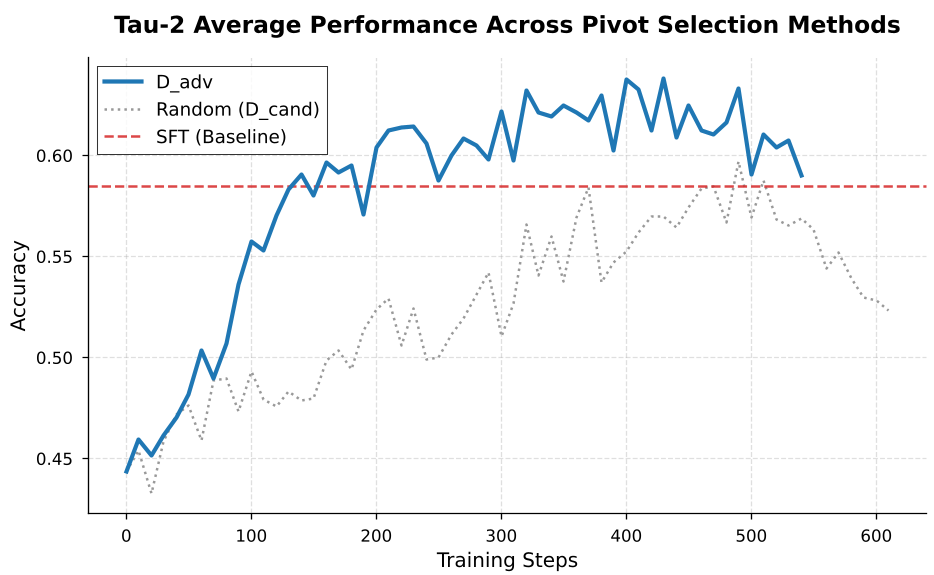
Instead of training on every step of a trajectory, PivotRL profiles states to find Pivots. These are intermediate turns where the model's current policy shows high variance—meaning it sometimes succeeds and sometimes fails. Mathematically, the paper proves that the natural gradient signal scales with reward variance. By skipping "settled" states, the model focuses its compute budget where it can actually learn.
2. Functional Rewards
The "Exact Match" trap (requiring the model's output to exactly match the SFT text) is too rigid. In PivotRL, if an agent suggests a tool call that is functionally equivalent to the expert's choice (e.g., a slightly different but valid bash command), it receives a positive reward from a domain-specific verifier.

Theoretical Insight: Preserving the "Brain"
A core contribution of PivotRL is the proof that functional reward-based RL acts as a KL-projection. It shifts probability mass toward successful actions while preserving the relative ordering of all other actions. This is the "secret sauce" for why PivotRL doesn't destroy the model's performance in math or general reasoning while it learns to be a better agent.
Results: Efficiency Without Sacrifice
The performance on agentic benchmarks like SWE-Bench Verified and -Bench shows clear superiority over SFT.
- In-Domain Excellence: PivotRL achieved an average of +14.11 points improvement over the base model, significantly higher than SFT's +9.94.
- OOD Retention: While SFT caused massive regressions in non-agentic tasks (dropping AIME25 scores by nearly 20 points), PivotRL maintained a near-zero change (+0.21).
- Compute Savings: Compared to E2E RL, PivotRL achieved matched accuracy with 4x fewer rollout turns.
From Research to Production
PivotRL isn't just a theoretical exercise. It is the core engine behind NVIDIA’s Nemotron-3-Super-120B. The method's ability to maintain high reward variance deeper into training leads to more stable and effective optimization.
Conclusion
PivotRL proves that for agentic post-training, less is more. By intelligently selecting where to roll out and being flexible about the "how" through functional rewards, we can build agents that are both powerful and efficient. This framework sets a new standard for production-scale RL, moving away from brute-force environment interaction toward targeted, high-signal learning.