
PIXEE: Breaking the Screen Barrier for Collective Emotional Expression
Demonstrating PIXEE: pictures, interaction and emotional expression
PIXEE is an interactive, multimodal system designed to enhance emotional connectedness in image-based social media by projecting scraped content onto large public displays. It utilizes automated sentiment analysis based on the Circumplex Model of Emotion, allowing users to interactively reclassify the emotional state of shared images through touch and sound.
TL;DR
PIXEE is a large-scale interactive installation that bridges the gap between private mobile social media and public collective experience. By scraping social media images and subjecting them to real-time sentiment analysis, it allows users to touch, re-classify, and "compose" the emotional landscape of an event through a multimodal interface involving color, sound, and gesture.
Background & Positioning
In the landscape of 2013-era HCI (Human-Computer Interaction), social media was largely a mobile-centric, "lean-back" activity. PIXEE, developed by an interdisciplinary team from Intel Labs and various academic institutions, represents a pivot toward Affective Computing. It moves beyond the "what" of an image to the "how" it makes us feel, positioning itself as a "cultural probe" that turns public walls into interactive mirrors of a community's psyche.
Problem: The Solitude of the Digital Stream
The authors identified a critical disconnect: while we share more images than ever, the emotional depth of these shares is often lost in automated feeds. Prior works like "We Feel Fine" visualized emotion but lacked the interactive agency for viewers to correct or redefine that sentiment. Additionally, the technical challenge of turning arbitrary physical environments (curved walls, irregular surfaces) into reliable touch-sensitive displays remained a barrier to true immersion.
Methodology: The Multimodal Affective Loop
PIXEE’s core innovation lies in its three-layered architecture:
- Sentiment Mapping: Using a customized version of the Linguistic Inquiry and Word Count (LIWC) and Russell’s Circumplex Model of Emotion, the system maps text captions to a 2D grid of Arousal (energy level) and Valence (positivity/negativity).
- Interactive Vision: Utilizing multiple depth cameras, the team developed algorithms to disambiguate interference patterns, allowing for high-fidelity gesture tracking on large, non-flat surfaces.
- Cross-Modal Feedback: When a user touches an image, they don't just see a change; they hear it. Each of the 16 emotional quadrants is paired with a specific musical motif, turning the interaction into a form of "emotional composition."
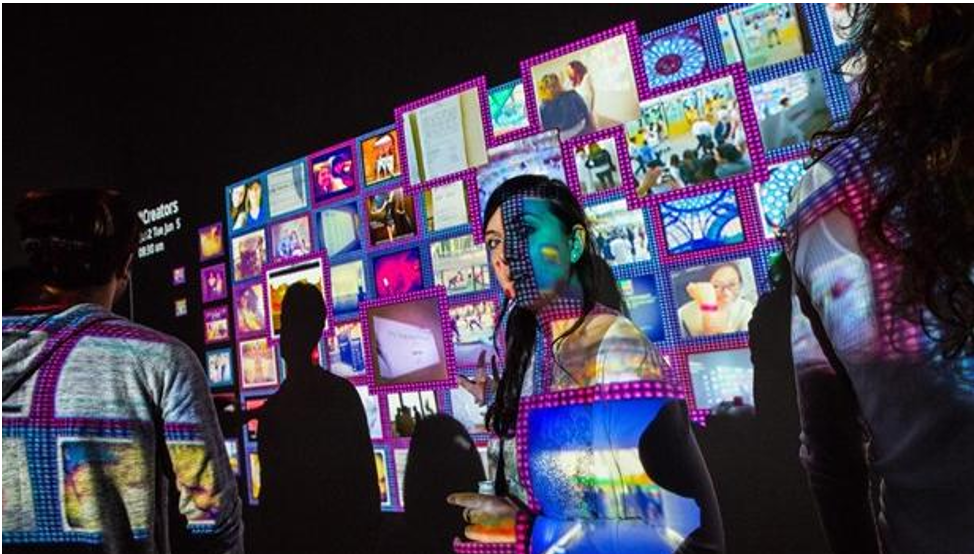 Figure 1: The PIXEE display in action, showcasing the color-coded frames that represent the sentiment of shared Instagram photos.
Experiments & Real-World Deployment
The system was not just a lab prototype but was battle-tested in 8 technology and art events across 6 countries.
- The Power of Reclassification: One of the most striking findings was how users in one city (e.g., Beijing) would re-interpret the emotional context of a photo uploaded in another (e.g., Paris). This demonstrated that "sentiment" is not a static metadata field but a dynamic, culturally-dependent interaction.
- Affective Mapping: During the CHI conference, the system served as a living "mood board," where attendee feedback on presentations could be aggregated into a spatial map of the event's collective energy.
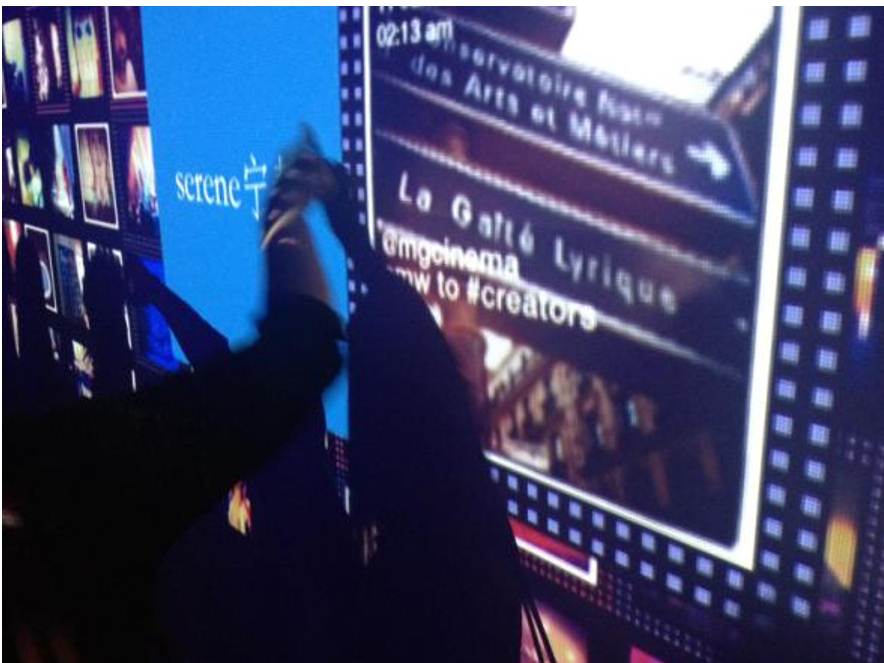 Figure 2: The UI for emotional reclassification, based on the Arousal-Valence grid.
Critical Analysis & Conclusion
Takeaway
PIXEE successfully demonstrates that technology can facilitate interpersonal connectedness by making emotion visible and malleable. The integration of audio-visual feedback makes the "invisible" data of sentiment tangible.
Limitations & Future Work
The system relies heavily on hashtagging and text-based sentiment analysis, which can be prone to errors in sarcasm or nuanced imagery without text. Future iterations could benefit from contemporary Computer Vision (CV) models that analyze the visual content of the image itself to calibrate the initial emotional frame, rather than relying solely on captions.
In conclusion, PIXEE remains a seminal example of how public displays can evolve from "information boards" into "empathy engines," a vision that remains highly relevant in today’s era of hyper-personalized but often isolated digital consumption.