
Smart Citizen: Scaling Urban Sustainability through Gamified Placemaking
Placemaking for Urban Sustainability
The paper introduces Smart Citizen, a gamified mobile application designed to foster long-term pro-environmental behavior and urban participation in Salzburg, Austria. It uniquely combines behavior change theories with a 7-stage participation framework, achieving a positive reception in a 31-user pilot study.
TL;DR
Addressing climate change at the city level requires more than just individual "nudges"; it demands a shift from passive residents to active co-designers of the urban environment. This paper presents Smart Citizen, an app that uses location-based play and a "city heartbeat" metaphor to guide users through 7 stages of engagement—transforming sustainable actions into a collective, community-building experience.
The Motivation: Moving Beyond Short-Term Nudges
Sustainability is a "wicked problem" often hindered by behavioral biases. Most people operate on System 1 thinking—fast, instinctive, and automatic. To adopt a sustainable lifestyle, we need to engage System 2 thinking—deliberative and reflexive.
The authors argue that current gamified apps are often "siloed"—they focus on a single behavior (like recycling) but fail to connect the user to the broader urban infrastructure or political decision-making process. The goal of Smart Citizen is to climb the "Ladder of Participation," moving users from simply receiving information to actively co-producing urban futures.
Methodology: The 7-Stage Engagement Framework
The core innovation of the Smart Citizen app is its structural mapping of features to a psychological and civic trajectory.
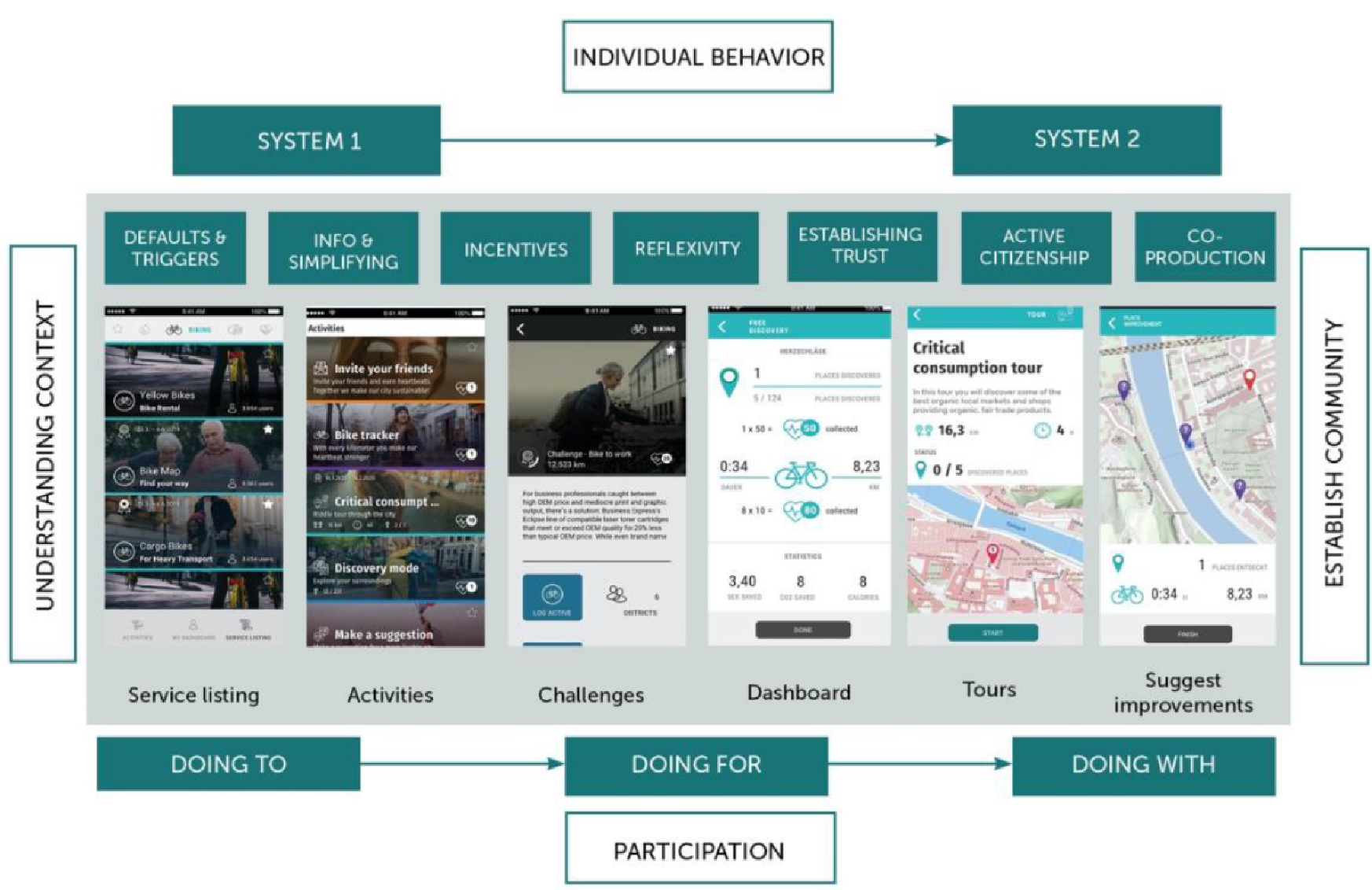
- Setting Defaults & Triggers: Establishing the app as the single-entry point for city services.
- Information & Simplification: A centralized service listing for mobility and consumption.
- Incentives: Using the "Heartbeat" metaphor and badges to reward actions.
- Reflexivity: Dashboards that show individual and collective impact.
- Establishing Trust: Curated tours that introduce residents to local sustainable businesses.
- Active Citizenship: Participating in consultations and reporting design issues.
- Co-production: Face-to-face workshops and digital idea submission for urban planning.
Key Game Mechanics
- The Heartbeat Metaphor: Instead of abstract points, users collect "heartbeats" for the city. This fosters emotional attachment to the locality.
- Location-Based Tours: 11 thematic tours in Salzburg combine exploration with quizzes, reinforcing the connection between the user and their physical environment.
Experiments: Does Digital Play Lead to Civic Action?
The team conducted a 2-week pilot with 31 participants. The evaluation used the Technology Acceptance Model (TAM) and qualitative workshops to gauge impact.
Quantitative Performance
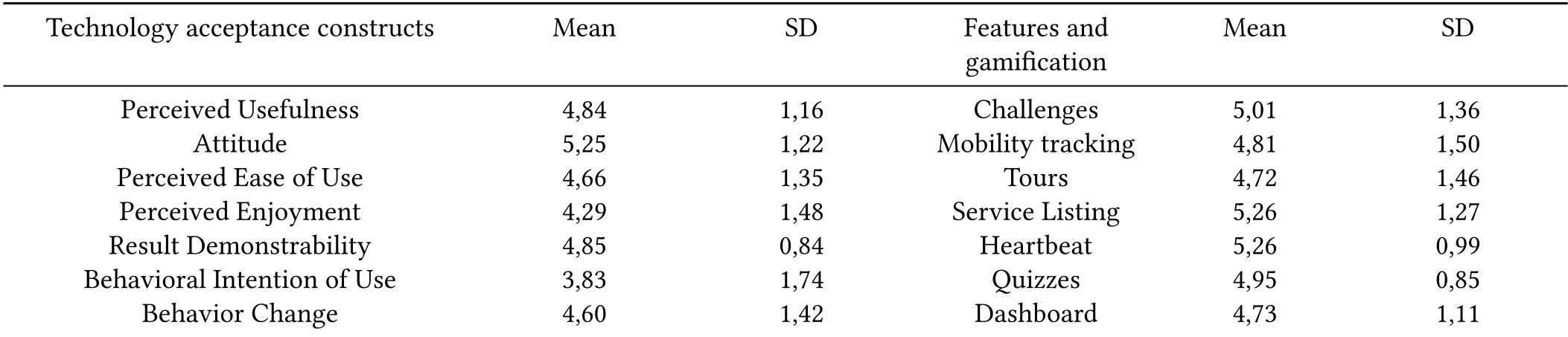
The study revealed that while users found the system easy to use and liked the concept, the intention to use it long-term varied based on their baseline interest in sustainability.
| Metric | Mean (1-7 Scale) |
|---|---|
| Attitude | 5.25 |
| Service Listing Utility | 5.26 |
| Heartbeat Metaphor | 5.26 |
| Behavioral Intention | 3.83 |
Qualitative Insights
- The "Mid-Spectrum" User: The app is most successful for people who want to be sustainable but find it too difficult or confusing in their daily lives.
- Community is Key: Users suggested adding features like daily "streaks" and community forums to strengthen the social fabric of the app.
- Seamless Integration: A major takeaway for developers is the need for integration with wearables (e.g., Apple Watch) to make mobility tracking passive and frictionless.
Conclusion & Future Outlook
Smart Citizen demonstrates that placemaking—the process of creating quality places that people want to live in—is a powerful tool for sustainability. By gamifying the city itself, the app bridges the gap between private habits and public policy.
Limitations: The two-week study was too short to prove long-term habit formation. The authors acknowledge that the next step is a massive multi-month deployment to see if "heartbeats" can truly sustain long-term pro-environmental behavior change.
Ultimately, this work suggests that the future of the Smart City isn't just about IoT sensors; it's about a gamified social layer that empowers citizens to take ownership of their environment.