
Planner Matters! Breaking the Long-Horizon Bottleneck via Unbalanced Multi-Agent Collaboration
The paper introduces a planner-centric multi-agent framework designed to enhance autonomous agents for long-horizon task completion across Web, OS, and tool-use environments. By decomposing the agent into specialized roles—Planner, Actor, and Memory Manager—and optimizing the Planner via reinforcement learning (GRPO), the system achieves state-of-the-art results, such as a 28% relative performance boost on WebVoyager for Qwen2.5-VL-7B.
TL;DR
In the quest for truly autonomous agents, the industry is moving from "Chatbots" to "Action-bots." However, long-horizon tasks—like booking a complex multi-city flight—often cause single-model agents to lose their way. This paper from UCSD reveals a game-changing insight: The Planner is the only part that really needs the "big brain." By using a high-capacity Planner with lightweight Actor and Memory modules, and optimizing only the Planner via RL, the authors set new SOTA benchmarks while significantly reducing training and inference complexity.
The Core Insight: Where Does Performance Come From?
In typical agent design, we often assume that improving the "whole model" is the only path to better performance. The authors challenged this by decomposing the agent into three roles:
- Planner: High-level decision-making and subgoal decomposition.
- Actor: Translating subgoals into mouse clicks or key presses.
- Memory Manager: Handling discrete task history and continuous multimodal embeddings.
Through a systematic scaling analysis (fitting success rates to model size), they discovered a "Scaling Law" for agents: The Planner's capacity dominates the success rate. Scaling the Planner yields almost the same marginal gains as scaling the entire system, while the Actor and Memory components reach a point of diminishing returns very quickly.
 Figure: Scaling the Planner (red line) shows a steep trajectory similar to scaling All Modules, proving it is the system's primary bottleneck.
Methodology: Planner-Centric Reinforcement Learning
Knowing that the Planner is the bottleneck, the authors proposed an unbalanced training strategy. Instead of fine-tuning the whole system (which causes "role confusion" and high costs), they used Group Relative Policy Optimization (GRPO) to optimize only the Planner.
The Training Loop
- VLM-as-Judge: A strong model (Qwen2.5-VL-32B) acts as the teacher, watching the entire trajectory and assigning a reward (1, 3, or 5) based on success, logic, and efficiency.
- Frozen Components: The Actor and Memory Manager are kept frozen. This ensures the Planner learns to work with existing execution capabilities rather than trying to relearn how to click.
- Hybrid Memory: The system integrates "Discrete Memory" (text summaries) and "Continuous Memory" (latent embeddings) to ensure the Planner has both semantic and visual context of past successes.
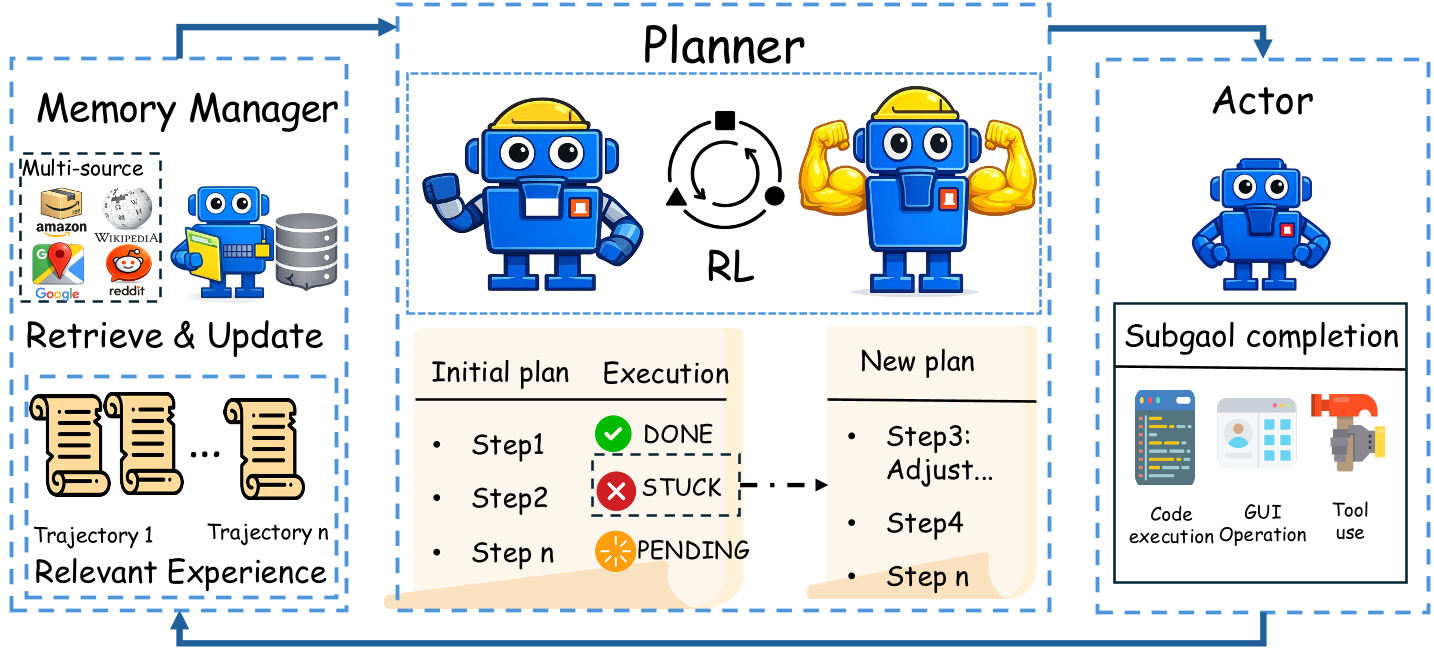 Figure: The multi-agent loop where the Planner interacts with the environment through the specialized Actor and Memory modules.
Experimental Results: Small Models, Big Performance
The results are striking. By optimizing the Planner, even a 7B-parameter system can punch far above its weight class:
- Standard Benchmarks: On WebVoyager, the Multi-Agent RL approach boosted Qwen2.5-VL-7B from a 12.5% success rate to 35.1%, surpassing GPT-4o in the same controlled setting.
- Out-of-Domain Generalization: The model wasn't just memorizing. It showed strong performance on OSWorld (operating system control) and MCP-Bench (API tool use), achieving 100% execution fidelity in tool-use tasks.
The "AHA!" Moment in Ablation
The authors tried "Joint Training" (tuning Planner and Actor together) and found it performed worse than Planner-only training. This suggests that forcing a single set of weights to handle both high-level strategy and low-level motor skills leads to interference—reaffirming the value of modular, unbalanced architectures.
Critical Analysis & Conclusion
Takeaway
This research provides a practical blueprint for building production-grade agents under a budget. Instead of deploying a massive 400B model for everything, use a strong "brain" (Planner) to guide efficient "muscles" (Actor).
Limitations
- Inference Latency: While each agent call is faster, a 3-agent loop still requires sequential processing.
- Reward Sparsity: Trajectory-level rewards are "coarse." A Planner might get lucky and succeed despite a bad intermediate step. Future work should look at Step-level Process Rewards.
Final Verdict: Planner Matters! proves that in the world of AI agents, intelligence is not just about size, but about how you distribute that size across the cognitive pipeline.