
Gaming in the Time of Corona: How COVID-19 Rewrote the Rules of Player Behavior
Analysis and Prediction of Player Population Changes in Digital Games During the COVID-19 Pandemic
This study investigates the impact of the COVID-19 pandemic on video game player populations using data from 1,963 Steam games. It employs empirical analysis and machine learning classification (including Random Forest and SVM) to analyze population surges and predict game popularity based on library features and tags.
TL;DR
The COVID-19 pandemic didn't just increase video game play; it fundamentally broke the "weekly rhythm" of the gaming world. Analyzing 1,963 Steam games, researchers found a 33% aggregate population surge and discovered that social distancing turned every day into a weekend. While "Multiplayer" and "Boardgame" titles skyrocketed, traditional machine learning models struggled to predict specific winners, achieving only 63% accuracy, suggesting that pandemic success was driven by complex social factors beyond simple game metadata.
Problem & Motivation: The Disruption of the Weekly Cycle
Before 2020, gaming followed a predictable heartbeat: low activity during the workweek and sharp peaks on Friday nights and Saturdays. This is known as Weekly Seasonality. When the world went into lockdown, the barrier between work/school and home collapsed.
The authors sought to answer:
- Did the pandemic growth actually outpace major industry events like the Steam Winter Sale?
- Did the "weekend peak" survive when everyone stayed home every day?
- Can we predict which games will thrive in a global crisis based on their intrinsic features?
Methodology: Correlating Cases with Clicks
The researchers combined Steam player data (collected since 2017) with global COVID-19 infection data.
1. Empirical Correlation
Using Pearson correlation, they mapped the rise of the virus against player counts. They identified March 16, 2020—the date the US announced social distancing guidelines—as the critical "inflection point."
2. Predictive Modeling
To predict "Popular Games" (defined as those with ≥33% growth), they tested five models:
- Decision Trees, Bagged/Boosted Trees
- Random Forest (RF)
- Support Vector Machines (SVM)

Key Insights: The Death of the Weekend
The most striking finding was the collapse of seasonality.
- Prior to COVID-19: 60% of games showed strict weekly patterns.
- During COVID-19: 76% of those games lost their weekly pattern.
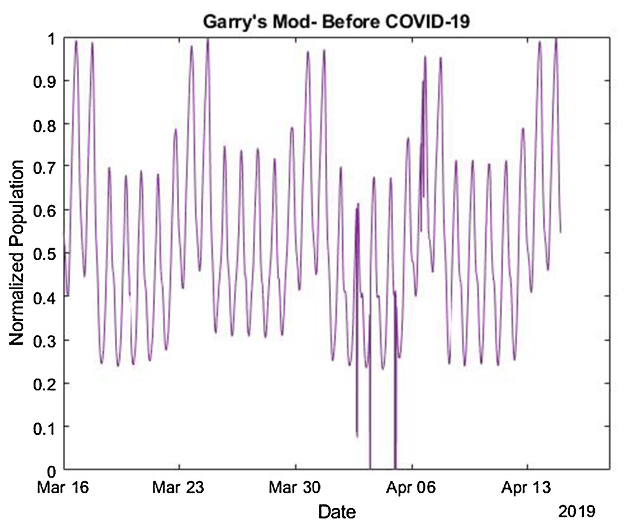 Figure: Garry’s Mod shows clear periodic peaks before the pandemic (Left) which vanish into erratic, high-volume play during the lockdown (Right).
Experiments & Results: What Makes a Game "Pandemic Proof"?
The Random Forest model performed the best, though the authors admit that 63% accuracy shows the difficulty of predicting human behavior during unprecedented events.
Feature Importance
According to the RF model, Tags were the absolute most critical feature, followed by the age of the game (days since release). Reviews and price were surprisingly less influential.
The "Social Escapism" Winners
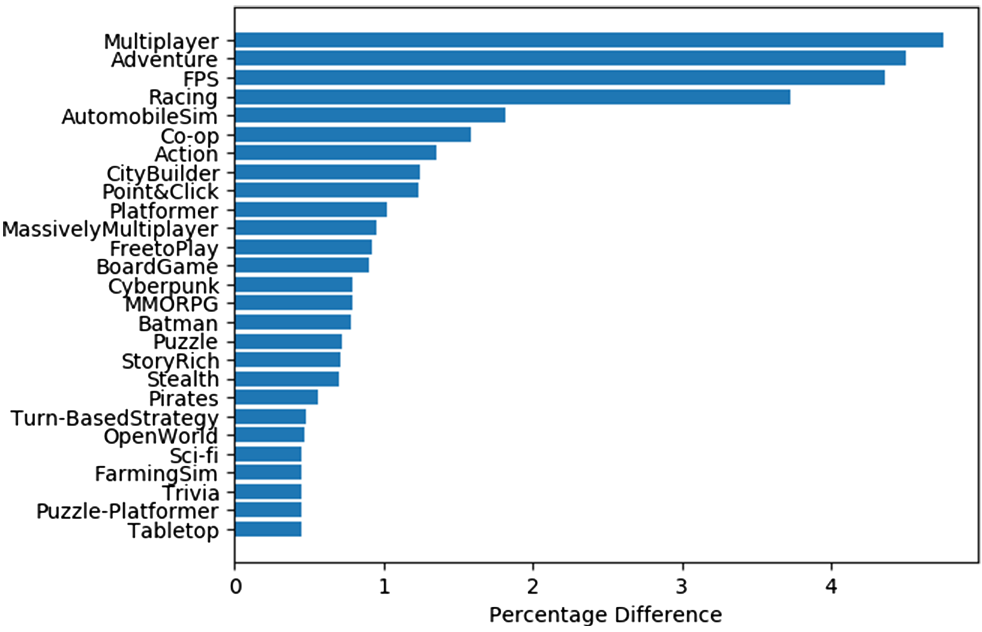
By analyzing tag differences, the research highlighted what users craved:
- Social Connection: Multiplayer, Co-Op, and MMORPG tags saw the highest relative gains.
- Digital Analogues: "Tabletop Simulator" (+480%) and "Jackbox Party Pack" (+520%) soared, as they allowed users to replicate social board game nights digitally.
- Thematic Relevance: "Plague Inc.: Evolved" saw a 245% increase as players sought to understand (or gamify) the pandemic itself.
Critical Analysis & Conclusion
Takeaway
The gaming industry proved resilient, but the "surge" wasn't uniform. The digital transformation of social spaces (Boardgames/Trivia) was the defining trend. The loss of seasonality suggests that in future crises, server infrastructure must be prepared for "peak loads" at any time of the week, not just weekends.
Limitations & Future Work
The 63% prediction accuracy indicates that "game features" (Metadata) aren't enough. Future models need to incorporate external circumstantial factors, such as specific regional lockdown severity. The researchers plan to investigate the longevity of these gains—did players stay, or did they leave as soon as the doors opened?
Final Thought: When the world stops moving, it turns to virtual worlds. This study provides the quantitative proof that games are no longer just "hobbies"—they are the primary social fallback for humanity in crisis.