
PodCastle and Songle: Bridging the Gap Between AI Speech/Music Analysis and User Experience
7672_PodCastle and songle crowdsourcing-based web services for spoken content retrieval and active music listening.
This paper introduces PodCastle and Songle, two pioneering crowdsourcing-based web services designed for spoken content retrieval and active music listening. By leveraging automatic speech recognition (ASR) and music understanding technologies combined with a "Human-in-the-loop" error correction interface, these systems achieve high-accuracy content searching and browsing.
TL;DR
Researchers at AIST Japan developed PodCastle and Songle, two web services that solve the "unsearchable audio" problem. By combining automated AI analysis (Speech Recognition and Music Information Retrieval) with a clever crowdsourcing interface, they created a system where users naturally correct AI errors while enjoying content, leading to a "spiral" of increasing data quality and better searchability.
The Problem: The "Black Box" of Audio Content
For decades, the web has been dominated by text-based search. While we can search the contents of a PDF, audio and video files remain "black boxes" to search engines, indexed only by titles or manual tags.
The Motivation: Automated tools like ASR (Automatic Speech Recognition) exist, but they aren't perfect. A mistake in a transcript means a search query fails. The authors realized that instead of waiting for "perfect AI," they could use crowdsourcing to fix errors—provided the correction process was integrated into the listening experience itself.
Methodology: The Spiral of Enhancement
The core philosophy of this work is the Spiral of Enhancement. It follows a three-step virtuous cycle:
- AI Analysis: Systems automatically generate transcripts for podcasts (PodCastle) or estimate beats, chords, and melodies for songs (Songle).
- User Experience: Users use these "unreliable" results to navigate content (e.g., clicking a transcript to jump to a specific word or seeing a song's structure).
- Collaborative Correction: When users notice an error, they can fix it via a simple interface. These corrections are shared globally, improving the experience for every subsequent user.
PodCastle: Searchable Podcasts
PodCastle provides a full-text search engine for podcasts. When a user clicks on a search result, the audio starts playing from the exact moment that word was spoken.
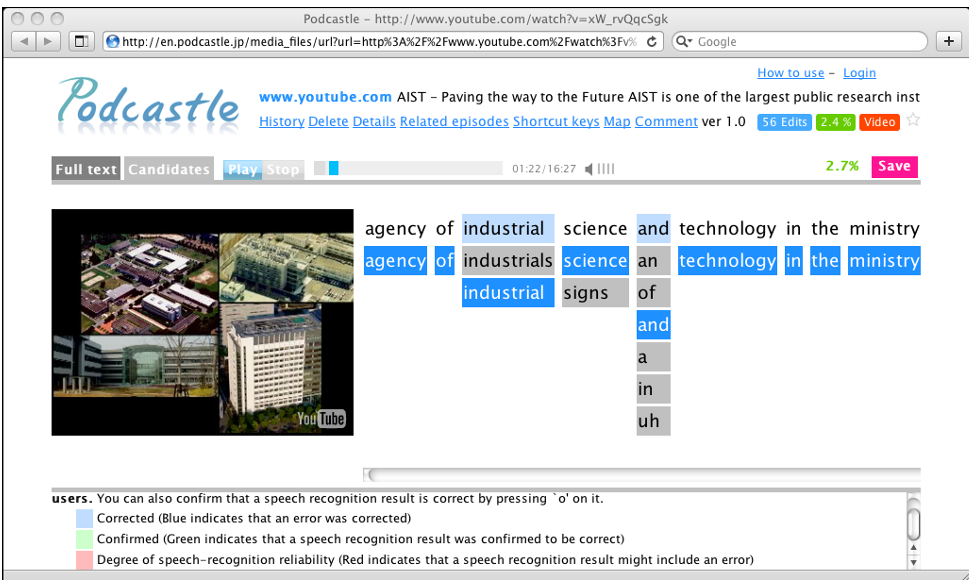 Figure 1: The PodCastle interface showing the synchronized transcript and the "error correction" interface which allows users to select alternatives from ASR N-best lists.
Songle: Active Music Listening
Songle takes this to the musical domain. It visualizes the "Music Map" of a song, including its chorus sections, chords, and beats. This allows for Active Listening, where a user isn't just a passive recipient but can navigate the song's structure.
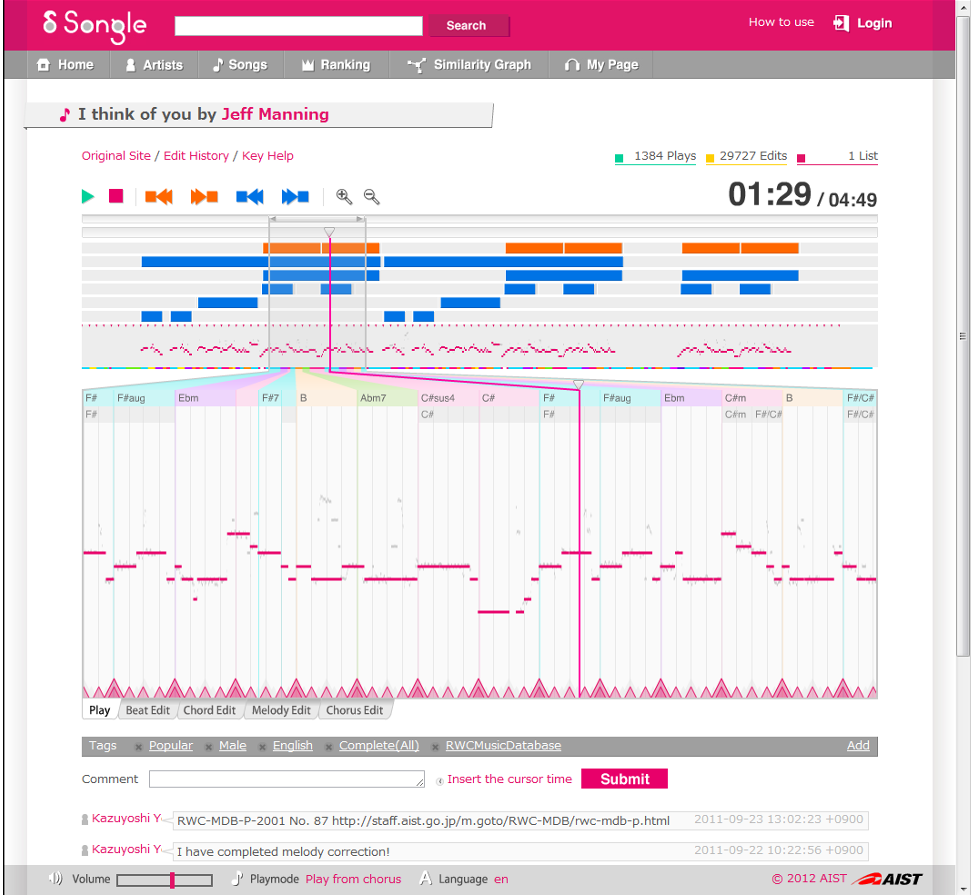 Figure 2: The Songle interface displaying automated musical structure estimation (Chorus, Chords, Beats) and the collaborative editing tool for users to refine these estimates.
Experiments and Real-World Impact
The researchers didn't just test this in a lab; they launched it on the web.
- Rapid Correction: In the first 5 hours of the PodCastle Japanese version's release, users corrected roughly 1,000 errors.
- Incentive Design: By making the corrections useful to the contributor (e.g., fixing a chord so they can play along with a guitar), the system bypasses the need for paid labeling.
- Accuracy: The "Human-in-the-loop" approach essentially turned a 70-80% accurate ASR system into a highly reliable search index over time.
Critical Analysis & Conclusion
Takeaway
PodCastle and Songle demonstrate that Human-AI Collaboration is more powerful than either in isolation. The "Spiral" framework ensures that as a service becomes more popular, its underlying AI data becomes more accurate.
Limitations
- Niche Content: Crowdsourcing works best for popular content; obscure podcasts or songs may never receive human corrections, leaving them stuck with raw AI errors.
- Vandalism: The paper focuses on "anonymous users," which raises questions about data integrity and the need for robust verification algorithms to prevent malicious edits.
Future Outlook
As we move into an era of Generative AI, the lessons from PodCastle and Songle remain vital. Using AI to "prime" the data and humans to "refine" it is likely the only scalable way to handle the explosion of multimedia content on the modern internet.