
Decoding Group Dynamics: A Fuzzy Approach to POI Recommendations in LBSNs
A POI group recommendation method in location-based social networks based on user influence
The paper introduces a novel POI group recommendation method for Location-Based Social Networks (LBSNs) that models user influence using fuzzy and non-fuzzy approaches. By mining check-in data across categories, distance, and time, it improves recommendation accuracy for ephemeral groups via a weighted average aggregation strategy.
TL;DR
Choosing a restaurant or a park with friends is rarely a democratic process of equal votes; some individuals naturally exert more influence than others. This paper presents a novel POI (Point of Interest) Group Recommender System that quantifies this "User Influence" by analyzing how a person's check-in habits change when they are alone versus when they are in a group. By applying Fuzzy C-Means clustering to behavioral shifts in distance, time, and category, the system achieves superior accuracy in suggesting locations that satisfy the whole group.
Problem & Motivation
Most Group Recommender Systems (GRSs) rely on simple aggregation strategies like Average (everyone is equal) or Least Misery (don't pick anything anyone hates). However, these ignore two critical realities of human geography:
- Social Influence: A "leader" in a group often dictates the category or location, while others conform.
- Spatial Constraints: Unlike choosing a movie, choosing a POI involves physical distance. People are generally less flexible about how far they are willing to travel than they are about what time they eat.
The authors noticed that prior work often treated "influence" as a binary or static trait, failing to account for the "fuzzy" nature of human behavior and the specific constraints of spatial data.
Methodology: The Core of Influence
The researchers developed a multi-dimensional feature vector, Du, to capture the difference between solo and group behavior across several axes:
- Preferences: Differences in the favorite category of venue, the distance from home, and the preferred time of day (hour).
- Personality: Using check-in frequency and diversity as proxies for Conscientiousness and Neuroticism (based on the Big Five model).
Architecture Overview
The workflow follows a clear pipeline: from raw check-in data to individual preference modeling, followed by influence calculation via clustering, and finally, group aggregation.
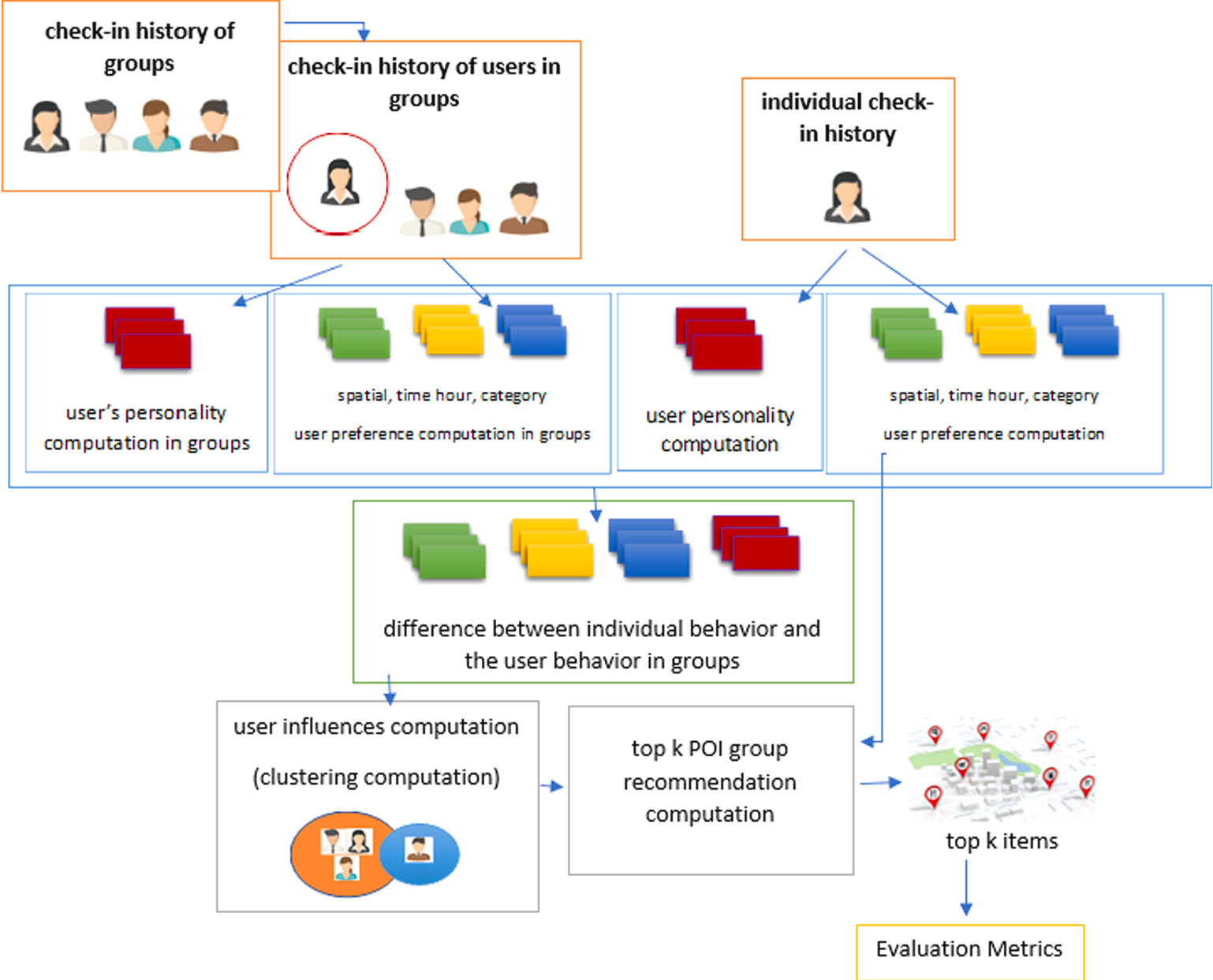
The secret sauce lies in Fuzzy C-Means (FCM). Instead of just saying a user is "Influential" or "Not," FCM assigns a membership grade. This grade acts as a weight in the final aggregation formula:
This ensures that the final recommendation is mathematically skewed toward the preferences of those who historically "drive" the group's decisions.
Experiments & Results
The study utilized a real-world dataset from Swarm (Ankara, Turkey), consisting of over 45k group check-ins.
Key Findings:
- Distance is King: The box plot analysis (Fig 4) revealed that users show the least flexibility in distance. If a group is going out, they are highly likely to stick to a range close to the "influential" member's home.
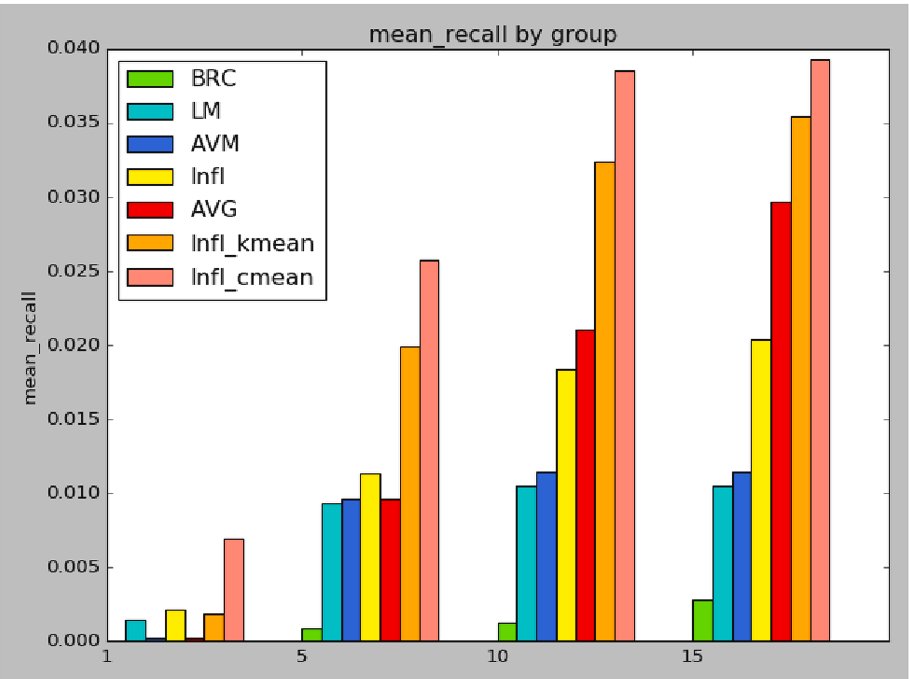
- Fuzzy vs. Hard Clustering: The
infl_cmean(fuzzy) model consistently outperformed theinfl_kmean(hard) version, proving that influence is a spectrum. - Scalability: The method actually performed better as the group size increased (up to 12 members), suggesting that the influence model effectively filters out the noise of conflicting preferences in larger crowds.
Critical Analysis & Takeaways
The brilliance of this work is its move away from "black-box" social influence toward observable "behavioral shifts." By comparing Pu (Solo Profile) with PGu (Group Profile), the authors found an elegant way to quantify social power without needing explicit surveys or trust networks.
Limitations:
- The model currently treats influence as a static value for the user across all groups. In reality, a person might be a leader among friends but a follower among colleagues.
- It relies on "ephemeral" logic but requires a significant solo check-in history to build the initial profile.
Future Outlook: The integration of Conversational AI (like LLMs) could be the next frontier—simulating the "negotiation" phase that happens in group chats before a POI is finally selected. This paper provides the mathematical foundation for such a social-aware recommendation engine.