
TSG: Beyond Friendship—Leveraging Reputation and Multi-Center Geography for POI Recommendation
A Point of Interest Recommendation Approach by Fusing Geographical and Reputation Influence on Location Based Social Networks
This paper introduces TSG, a unified Point of Interest (POI) recommendation framework that integrates TF-IDF based user preference modeling, geographical influence (multi-center distance and popularity), and social reputation. The method achieves state-of-the-art performance on the Brightkite dataset by replacing direct social links with global reputation scores.
TL;DR
Point of Interest (POI) recommendation is no longer just about where your friends go—it's about who the "experts" are and where your personal life centers are located. This paper proposes TSG, a framework that fuses TF-IDF personalized preferences, K-medoids geographical clustering, and PageRank-derived social reputation to significantly boost recommendation precision, outperforming traditional friend-based methods by nearly 300%.
Background & Motivation: The "Friendship" Fallacy
In Location-Based Social Networks (LBSNs) like Foursquare or Brightkite, the industry has long relied on Friend-based Collaborative Filtering (FCF). The logic seemed sound: if your friend likes a cafe, you might too.
However, the authors uncover a startling reality in the Brightkite dataset: the average ratio of common visited locations between friends is a mere 0.45%. Relying solely on direct social links is mathematically sparse and logically flawed. Furthermore, existing models often treat geographical influence as a single-point decay, ignoring that humans usually have multiple "anchor points" like home, work, and gym.
Methodology: The TSG Framework
The authors propose a unified score function that balances three distinct technical pillars:
1. TF-IDF for Personalized Interest
Instead of simply counting check-ins, the authors adopt the TF-IDF (Term Frequency-Inverse Document Frequency) logic from Information Retrieval.
- TF: If you visit a specific park often, it's important to you.
- IDF: If everyone visits that park, it doesn't define your unique taste. If only you visit a niche bookstore, that bookstore is a high-signal indicator of your personal preference.
2. Multi-Center Geographical Modeling
Unlike models that assume a single center of activity, this paper uses K-medoids clustering to identify a user's primary activity hubs.
- By calculating the distance from the nearest cluster center, the model respects the physical reality of human mobility.
- They found that an inverse proportion model () outperformed power-law or exponential decays in predicting check-in likelihood.
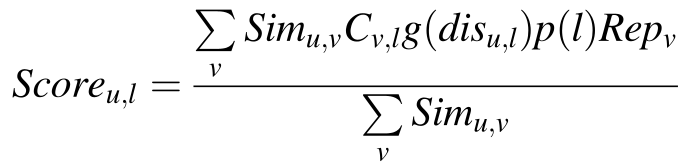 The Unified TSG Scoring Formula: Fusing Similarity, Geography, Popularity, and Reputation.
3. Social Reputation (The PageRank Pivot)
Since friends often have different tastes, the authors look toward Social Reputation. Using the PageRank algorithm on the social graph, they assign a weight () to each user. When generating a recommendation, the "advice" of a high-reputation user carries more weight than that of a random connection.
Experiments & Results
The authors conducted extensive testing on the Brightkite dataset (1.4M+ check-ins).
SOTA Comparison
The TSG model was compared against User-CF, FCF (Friend-based), and USG (a previous unified model).
- Precision@5: TSG reached 0.023, while the baseline User-CF sat at 0.0078.
- Social Impact: Results showed that reputation-based social influence is far more effective than simple friend-link influence, especially in sparse datasets.
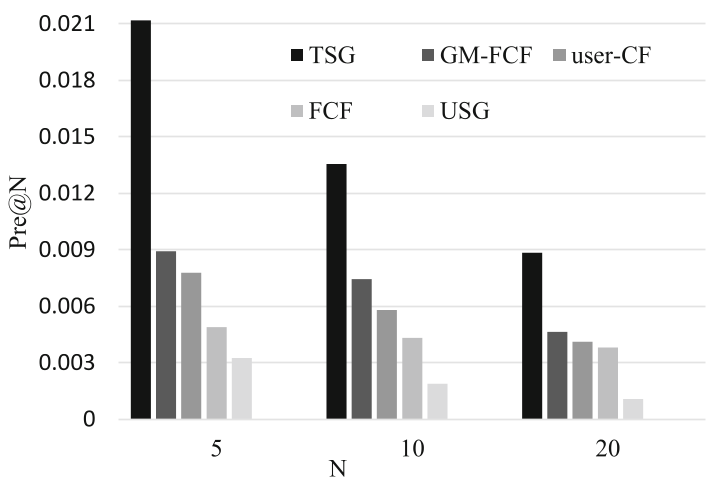 Figure 3: Recall and Precision metrics showing TSG (Top Curve) consistently outperforming baselines.
The Distance Factor
The study also validated that the Inverse Proportion model for distance provided the best fit for human movement patterns compared to the Power Law Distribution commonly used in earlier literature.
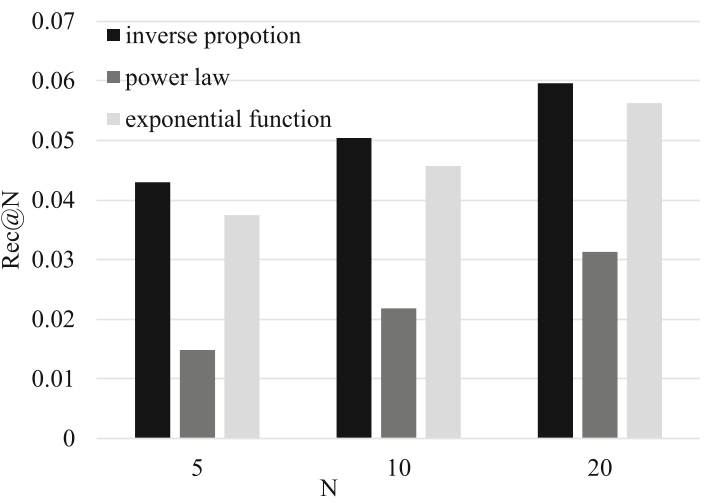 Figure 2: Performance of different geographical decay functions.
Critical Insight & Conclusion
The core contribution of this work is the realization that social "authority" transcends social "proximity" in the context of spatial exploration. While we might talk to our friends, we follow the patterns of experts and local influencers when exploring new territories.
Limitations: The model relies on static reputation. Future iterations could benefit from Temporal Reputation—acknowledging that a user's influence might wane over time or be category-specific (e.g., a "Foodie" expert vs. a "Hiking" expert).
Future Work: Integrating User Generated Content (UGC) and NLP-based sentiment analysis from reviews could further refine the TF-IDF interest profiles into semantic interest profiles.