
PTHS: Leveraging Local Expertise and Spatial Hierarchies for Precision Task Assignment
Based Point of Interest and Experience to Task Assignment on Location-Based Social Networks
The paper introduces PTHS, a task assignment and POI recommendation model for Location-Based Social Networks (LBSNs). It integrates geographical influence, social links, and user expertise by combining the Pitman-Yor probabilistic model with a Tree-Based Hierarchical Graph (TBHG) and an enhanced HITS (Hypertext-Induced Topic Search) algorithm.
TL;DR
Assigning the right task to the right user in a Location-Based Social Network (LBSN) requires more than just knowing where someone is. This paper presents PTHS, a framework that mines historical trajectories to identify "local experts." By combining Pitman-Yor probabilistic modeling with a hierarchical HITS algorithm, the system achieves a 40% improvement in recommendation precision over traditional collaborative filtering.
Background & Motivation: The "Local Expert" Intuition
Why do we check in at certain places? Usually, it's a mix of convenience (locations near home/work) and specific interest (traveling across town for a famous restaurant). Current LBSN platforms often fail to distinguish between a casual visitor and a genuine "expert" of a neighborhood.
The authors argue that a user's value to an LBSN platform depends on their Experience and Point-of-Interest (POI) similarity. If a platform needs to assign a "perceived task" (like verifying information at a specific POI), it should target users who high have high "authority" in that specific geographical context.
Methodology: The PTHS Algorithm
The core of the paper is the PTHS (Pitman-Yor, Tree-based, HITS) algorithm. The workflow is split into three distinct phases:
1. Spatial Clustering with TBHG
Instead of treating all locations as a flat list, the model uses a Tree-Based Hierarchical Graph (TBHG). This clusters POIs based on density across multiple levels—from city-wide regions down to specific neighborhoods.
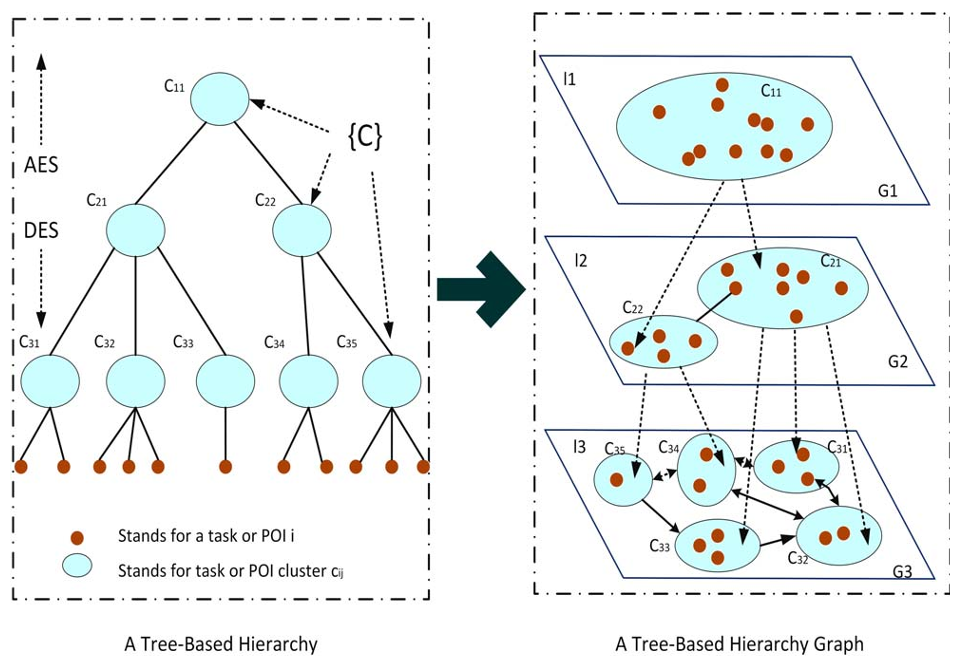
2. Probabilistic Modeling
The Pitman-Yor model is employed to handle the "power-law" nature of human check-ins. It calculates the probability of a user visiting a specific POI by considering geographical influence alongside social ties.
3. Hierarchical HITS Inference
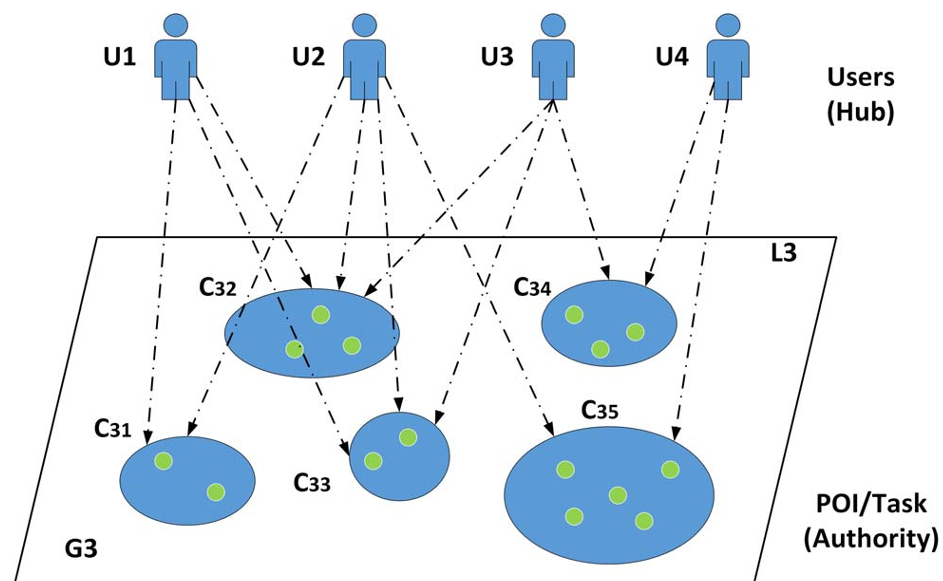
The genius of the paper lies in adapting the HITS algorithm (originally for web ranking) to spatial data.
- Authority (a): A location is "authoritative" if many experienced users visit it.
- Hub (h): A user is a "hub" (expert) if they visit many authoritative locations in a specific region.
The scores are calculated iteratively within the matrix representing user-location interactions:
Experimental Validation
Using a large-scale Foursquare dataset from New York, the authors compared PTHS against:
- U: Basic User-based Collaborative Filtering.
- T: Time-aware Collaborative Filtering.
- PY: Pitman-Yor based modeling.
Key Findings:
- Precision Gains: The PTHS approach achieved significantly higher Pre@N and Rec@N scores. Specifically, at Pre@10, it outperformed the baseline by 40%.
- Ranking Quality: Using nDCG and MAP metrics, the model proved superior in ranking the most relevant tasks for users based on their specific historical "authority."
| Metric | PTHS Improvement vs. Baseline |
|---|---|
| Precision@10 | +40% |
| Recall@10 | Significant gain over non-temporal models |
Critical Insight & Future Outlook
The shift from "Global Social Influence" to "Geospatial Authority" is the primary contribution here. By recognizing that a "Shanghai expert" might be a "Nanjing novice," the paper provides a blueprint for more efficient crowdsourcing and localized marketing.
Limitations: The model relies heavily on dense historical check-in data. For new cities or "cold-start" users with few check-ins, the Hub/Authority calculation may lose its predictive power. Future work could benefit from integrating real-time sensor data (accelerometers, barometers) to augment sparse GPS trajectories.
Conclusion
PTHS offers a robust mathematical framework for connecting the "Digital Social" with the "Physical Local." By treating the city as a hierarchy and users as localized hubs of knowledge, it sets a new standard for task assignment in the next generation of LBSNs.