
POILP: Bridging User Interest and Business Promotion in Social Networks
Point-of-Interest Recommendation for Location Promotion in Location-Based Social Networks
This paper introduces the Point-of-Interest Recommendation for Location Promotion (POILP) framework, a novel approach designed to balance user satisfaction with business advertising needs in Location-Based Social Networks (LBSNs). By leveraging social influence and submodular optimization, the method identifies a list of POIs that maximizes the "Influence Scope Gain" (ISG) of a target user to attract more visits to specific locations.
TL;DR
The paper introduces POILP (Point-of-Interest Recommendation for Location Promotion), a framework that solves a critical gap in Location-Based Social Networks (LBSNs): How to recommend places that a user likes while maximizing the commercial impact for businesses. By modeling category-specific social influence and using submodular optimization, the system identifies POIs that turn users into effective "influencers" for their social circles.
Problem & Motivation: The Missing Link in POI Systems
Most current POI systems treat recommendation as a one-way street: find what the user likes and give it to them. However, for LBSN platforms like Foursquare or Yelp, the merchants are equally important stakeholders.
The authors identify two fatal flaws in prior work:
- Neglect of Promotion: Traditional SOTA methods focus on Accuracy/Recall but ignore whether a check-in will trigger a "viral" effect among the user's friends.
- Context-Blind Influence: Traditional Influence Maximization (IM) assumes a user has a fixed influence. In reality, your friend might follow your restaurant recommendations but completely ignore your gym suggestions. Influence is Topic-Aware.
Methodology: The Core Architecture
The researchers built a heterogeneous network that links users to POIs through two primary lenses:
1. Dual-Influence Modeling
The probability of user influencing friend to visit POI is defined as a weighted sum:
- Geographical Influence (): Uses Power-Law distributions to model how physical distance affects the likelihood of a visit.
- Topic-Aware Influence (): Calculated by analyzing the user's expertise/activity history in specific POI categories.
2. Submodular Optimization
A major technical challenge is Overlap. If you recommend three coffee shops to a user, the "Influence Scope" (the set of friends likely to visit) might be nearly identical for all three. This is redundant for the business. The authors treat the influence scope function as monotone and submodular, allowing them to use an efficient greedy algorithm to pick POIs that provide the highest marginal gain.
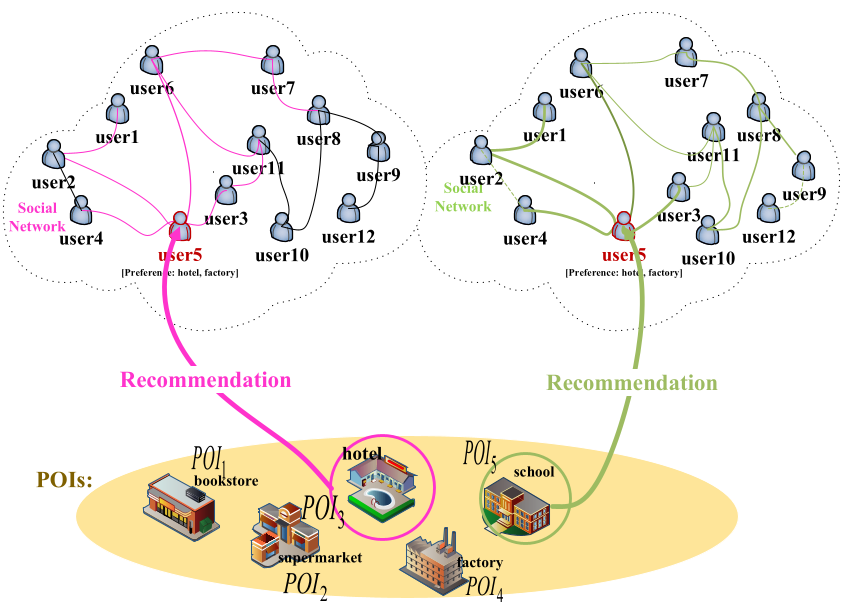 Fig 1: The model accounts for how a target user influences different clusters of friends depending on the POI category.
Experiments & Results
The team tested their algorithm against several baselines:
- USG-based: Collaborative filtering with geo-influence.
- CKNN: Category-based K-Nearest Neighbors.
- UP-based: LDA-driven preference modeling.
Key Findings:
- Social Efficiency: In terms of Influence Scope Gain (ISG), the POILP method showed a massive advantage over all SOTA baselines (see Fig 3). This proves that specifically optimizing for promotion works significantly better than "hoping" that accurate recommendations naturally lead to social spread.
- Accuracy Preservation: Despite the shift in focus towards promotion, the Precision and Recall remained competitive. While the UP-based method (which focuses solely on user preference) had slightly higher accuracy, POILP was a close second, offering a much better trade-off for the platform's ecosystem.
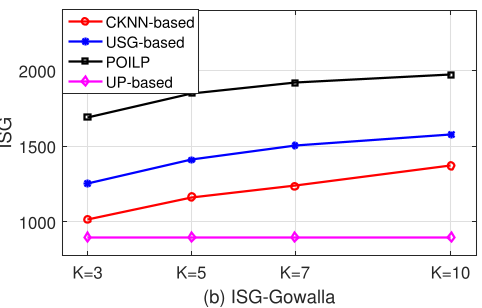 Fig 3: POILP consistently achieves higher Influence Scope Gain (ISG) across different values of K, outperforming USG and CKNN.
Critical Analysis & Conclusion
The POILP framework is a sophisticated acknowledgment of the Social Influence economy within LBSNs.
Takeaway: The real value of a check-in isn't just the single transaction by the user—it is the "Information Dissemination" that follows. By selecting POIs where a user has high category-specific authority, platforms can effectively automate "Viral Marketing."
Limitations: The model assumes that the system knows the social graph perfectly. In many modern privacy-centric environments, the "influence" between friends may need to be inferred from sparse interaction data rather than explicit social links. Future research could investigate how this model holds up when the social graph is partially "hidden" or dynamic.