
Personalized POI Recommendation: Bridging Human Behavior and Geographic Intelligence
A Point-of-Interest Recommendation Method Based on User Check-in Behaviors in Online Social Networks
The paper introduces a personalized Point-of-Interest (POI) recommendation method that integrates user check-in behavior, geographic influence, and social links. By categorized users into local people and newcomers, the system utilizes a multi-factor ranking model combining user preference, POI attraction, and time-aware social recommendations to achieve high-precision results on the Gowalla dataset.
TL;DR
This research presents a robust Point-of-Interest (POI) recommendation framework tailored for Online Social Networks (OSNs). By analyzing user check-in trajectories, the method narrows down candidate locations based on a user's "travel experience" and ranks them using a sophisticated mix of personal preference, geographic proximity, and time-decayed social influence.
The Challenge: Navigating the "Sparsity" of Human Movement
Most recommendation engines face the Data Sparsity problem, but in geographic services, this is extreme. A user might visit a favorite coffee shop 50 times but never step into the gym next door. Traditional Collaborative Filtering (CF) fails because it assumes that if you and a friend both like one place, you'll like everything they like—ignoring the fact that geographic movement is constrained by physical distance and familiarity.
The authors identify a critical oversight in existing SOTA: the failure to distinguish between Local Inhabitants (who follow routine patterns) and Newcomers (who rely on popularity and social proof).
Methodology: Experience-Aware Filtering
The core innovation lies in treating humanity's "spatial experience" as a filter.
1. Geographic Partitioning & Travel Experience
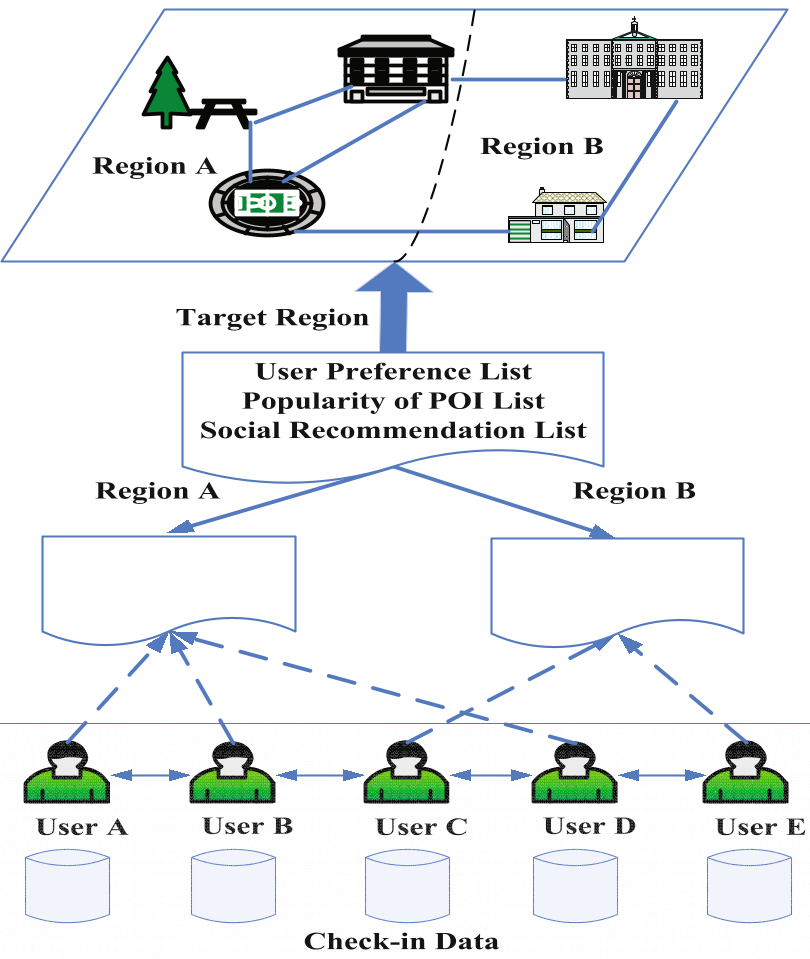
Using DBSCAN (Density-Based Spatial Clustering of Applications with Noise), the system partitions the map into sub-regions. It then calculates a user's "Travel Experience" () in those regions by looking at:
- Frequency: How often you visit.
- Recency: A "forgetting factor" ensures recent visits weigh more.
- POI Entropy: Visiting a "hidden gem" (low entropy/private) versus a "tourist trap" (high entropy/public) defines your expertise level.
2. The Multi-Factor Ranking Model
The final recommendation score is a weighted linear combination of three pillars:
- User Preference: Based on your historical check-in density and frequency.
- Attraction of POI: A product of the POI's popularity and its geographic distance from your recently visited locations.
- Social Recommendation: Leveraging the interests of your friends, modified by a temporal forgetting factor to ensure old trends don't clutter current needs.
Experimental Validation
The model was tested using the Gowalla dataset, focusing on check-ins within Los Angeles.
SOTA Comparison
The researchers compared their method against:
- Baseline 1: The full ranking model without the candidate filtering.
- Baseline 2: Traditional friend-based Collaborative Filtering.
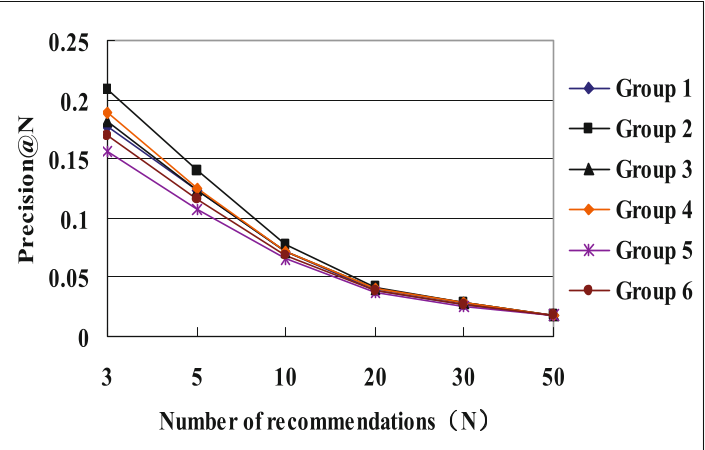
The results were striking. The proposed method outperformed traditional CF (Baseline 2) by a wide margin in both Precision and Recall. Interestingly, the performance of the proposed method and Baseline 1 (no filtering) was nearly identical. This proves that the Candidate Range Reduction (filtering by travel experience) maintains high accuracy while significantly reducing the computational load—a vital feature for real-time mobile applications.
Critical Insight & Future Outlook
While the paper successfully integrates geographic and social factors, it treats every visit equally in terms of "intent." The authors acknowledge that Travel Motivation (e.g., shopping vs. working) is the next frontier.
Key Limitation: The model relies on explicit check-in data. In a modern "passive" tracking world, the challenge shifts toward filtering noise from continuous GPS streams rather than sparse check-in points.
Conclusion
This work provides a logical blueprint for building location-aware services that feel "human." It moves beyond simple popularity rankings by understanding that our "experience" in a city dictates how we discover new places. For developers in the LBSN space, the takeaway is clear: Context (local vs. visitor) and distance decay are the keys to relevance.