
POISED: Spotting Twitter Spam by Mapping Information Diffusion Paths
POISED: Spoing Twier Spam Off the Beaten Paths
This paper introduces POISED, a novel spam detection system for Twitter that identifies malicious content by analyzing information diffusion patterns across "Parties of Interest." Unlike traditional methods focusing on account features, POISED leverages a probabilistic model of message propagation through networked communities, achieving 91% precision and 93% recall.
TL;DR
Classic spam filters look at what is being said or who is saying it. POISED shifts the paradigm to how a message travels. By modeling the natural flow of information through "Parties of Interest" (communities sharing common topics), POISED identifies spam as anomalous "off-path" propagation. It reaches an F1-score vastly superior to current baselines and remains resilient even against adversarial evasion.
Background: The Failure of Account-Based Defense
In the cat-and-mouse game of social media security, attackers have learned to bypass account-based silos. A compromised high-reputation account can tweet malicious links that bypass bot-detection algorithms. The core problem is that existing systems ignore the topological intuition of social networks: legitimate content propagates based on human interest (Homophily), while spam propagates based on a target list.
The Core Insight: Parties of Interest
The authors hypothesize that networked communities—strongly connected subgraphs—are essentially communities of interest. If a community usually discusses "Hollywood News," they are likely to share content from other communities interested in the same niche. These clusters form Parties of Interest. Spam, conversely, is "topic-blind"—it infiltrates communities regardless of their shared interests to maximize reach.
Methodology: The POISED Pipeline
The system operates in five distinct technical phases:
- Community Detection: Using the Infomap algorithm to find structural partitions where users are tightly knit.
- Topic Modeling: Applying Latent Dirichlet Allocation (LDA) to user timelines to define a community’s semantic profile.
- Clustering: Grouping similar messages using four-gram analysis (identifying clusters of tweets that share identical phrases).
- Diffusion Mapping: Calculating the probability of a message appearing in Community B given it appeared in Community A.
- Classification: A supervised model (SVM/Random Forest) trains on these probability vectors to distinguish benign "topic-aligned" flow from "anomalous" spam flow.

Proving the Hypothesis
The authors first validated that structural communities are indeed "Communities of Interest." Using entropy-based metrics (Completeness and Homogeneity), they compared real communities against a "Null Model" (random partitions).
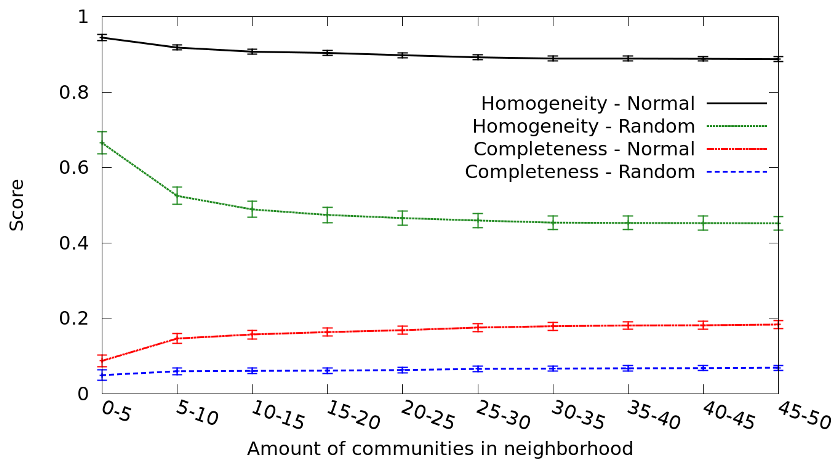
The results (above) show that real communities have significantly higher homogeneity scores (~0.90), meaning community members discuss a restricted, predictable set of topics compared to random groups.
Experimental Performance vs. SOTA
POISED was tested against three heavyweights: SpamDetector, COMPA, and BotOrNot. While those systems struggled with "sophisticated" spam (compromised accounts or human-mimicking bots), POISED achieved an F1-score of 0.90.
| System | Precision | Recall | F1-Score |
|---|---|---|---|
| POISED | 0.91 | 0.93 | 0.90 |
| SpamDetector | 0.21 | 0.20 | 0.20 |
| BotOrNot | 0.36 | 0.04 | 0.07 |
Resilience and Early Detection
A critical challenge for any spam filter is Latency. Can we catch the spam before it goes viral? POISED demonstrates that even with only 30% of the propagation data available, it maintains a precision of 90%.
Furthermore, the authors simulated Evasion and Poisoning attacks. Even when an attacker compromises 30% of the network to "mimic" legitimate propagation, POISED retains a precision of 75-82%. To truly evade the system, an attacker would need nearly perfect global knowledge of the network's topic-interest distribution—a prohibitively expensive task for most spammers.
Critical Insight & Conclusion
POISED proves that social context is the strongest signal. By moving the detection layer from the individual account to the "dissemination path," the system forces attackers to choose between relevance (mimicking small, niche propagation) and reach (blasting the network and getting caught). This "Off the Beaten Path" approach marks a significant step toward a more structural, behavior-focused era of social network security.