
The Physics of Echo Chambers: How Spontaneous Symmetry Breaking Explains Social Polarization
Polarization Model of Online Social Networks Based on the Concept of Spontaneous Symmetry Breaking
This paper introduces a theoretical framework to model online social network (OSN) polarization by applying the concept of Spontaneous Symmetry Breaking (SSB) from quantum field theory. By extending the established Oscillation Model of user dynamics, the authors characterize polarization as a structural transition where sparse networks fragment into complete-graph subnetworks, triggering new dynamics analogous to the Nambu-Goldstone mode.
TL;DR
Why do online social networks (OSNs) suddenly fracture into hostile, hyper-active echo chambers? This paper moves beyond simple data observation and applies the heavy machinery of Quantum Field Theory—specifically Spontaneous Symmetry Breaking (SSB)—to model how the literal "atmosphere" of a polarized community emerges as a new physical force called the Nambu-Goldstone mode.
Background: OSNs as Oscillating Systems
Current research on polarization is often descriptive, noting that people polarize but rarely explaining the physics of how the network's state changes. The authors build upon the Oscillation Model, which treats user interactions as waves traveling through a graph. In this world, social influence isn't just a static link; it's a dynamic energy transfer governed by a Hamiltonian.
The Core Insight: From Fermions to Bosons
The most striking claim of this paper is the distinction between "normal" social interactions and "polarized" ones through the lens of quantum statistics:
- Normal (Sparse) Networks = Fermions: In a typical OSN, you are only connected to a few people. The authors show that the math governing this state follows anticommutation relations. Like fermions (e.g., electrons) that obey the Pauli Exclusion Principle, user dynamics here are strictly limited by the physical link structure.
- Polarized (Complete) Clusters = Bosons: When a group polarizes, it often forms a "complete graph" (everyone influences everyone else, even if indirectly through a single bulletin board). This transition allows for boson-like behavior, where a collective "atmosphere" can emerge.
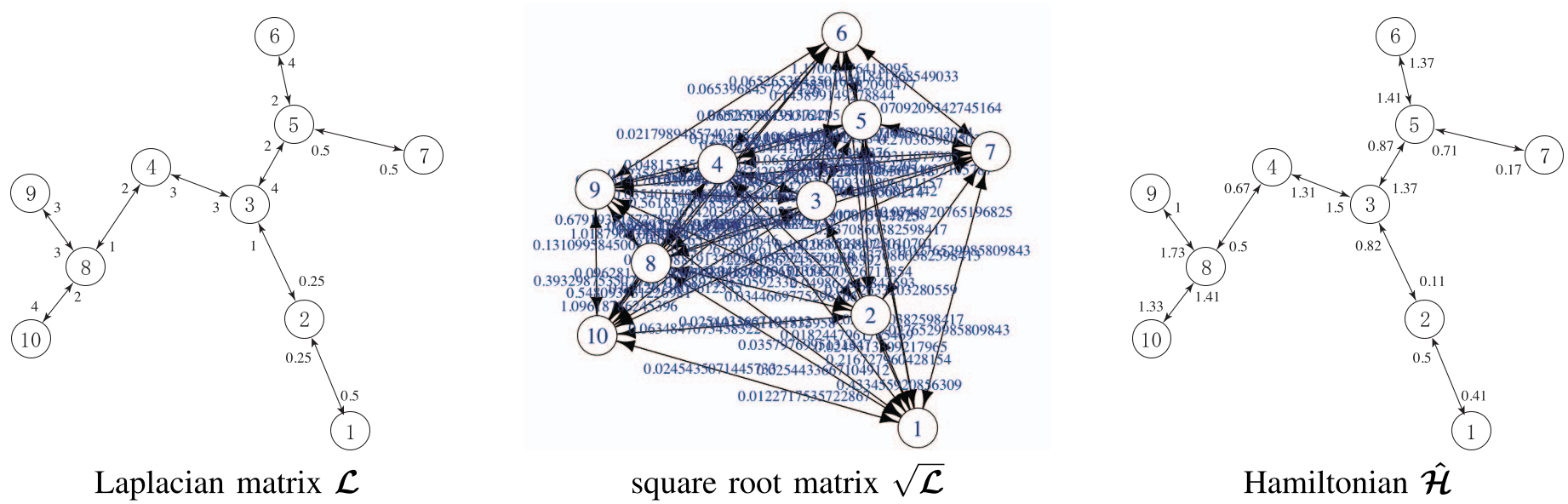 Fig 1: The structural transition from a sparse Laplacian (L) to a Hamiltonian (Ĥ) representing complete sub-networks.
Dynamics of Polarization: The Mexican Hat
How does the split happen? The authors use the Mexican-hat potential.
- Before Polarization: The potential has a single bottom (symmetry is intact). Users gravitate toward a neutral equilibrium.
- After Polarization: The "hat" forms. The old neutral equilibrium becomes unstable. The system "spontaneously" picks a new, biased equilibrium point.
Because the new equilibrium is far from the old center, the oscillations (user activity) acquire "mass"—explaining why polarized discussions feel so much more intense and "heavy" than casual ones.
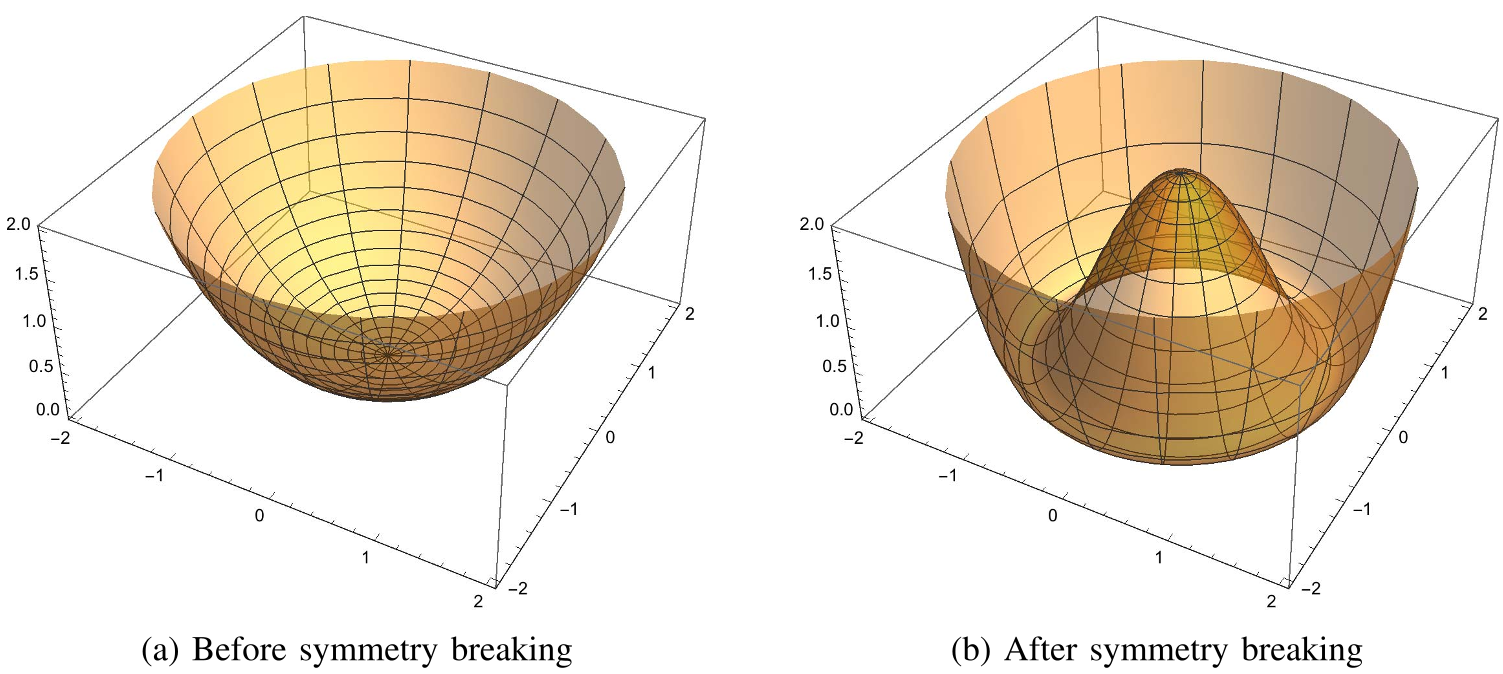 Fig 2: The transition from a stable ground state (a) to a spontaneously broken symmetry (b), creating the "valley" where the Nambu-Goldstone mode resides.
The Nambu-Goldstone Mode: The "Atmosphere" of the Field
The most profound contribution is the interpretation of the Nambu-Goldstone (NG) mode. In physics, SSB always produces a new, massless particle/mode (like a phonon in a crystal). In social networks, the authors identify the NG mode as the "Atmosphere of the Field."
- It isn't a direct interaction between User A and User B.
- It is a collective, coherent entity that exerts influence over the entire closed community.
- It only appears when the network fragments into complete clusters.
Experimental & Mathematical Evidence
The paper provides a rigorous mathematical derivation of the closed-form solutions for these dynamics. By comparing the fragmented "spring" model of networks to the Hamiltonian of the system, they demonstrate that fragmentation is the physical trigger for SSB.
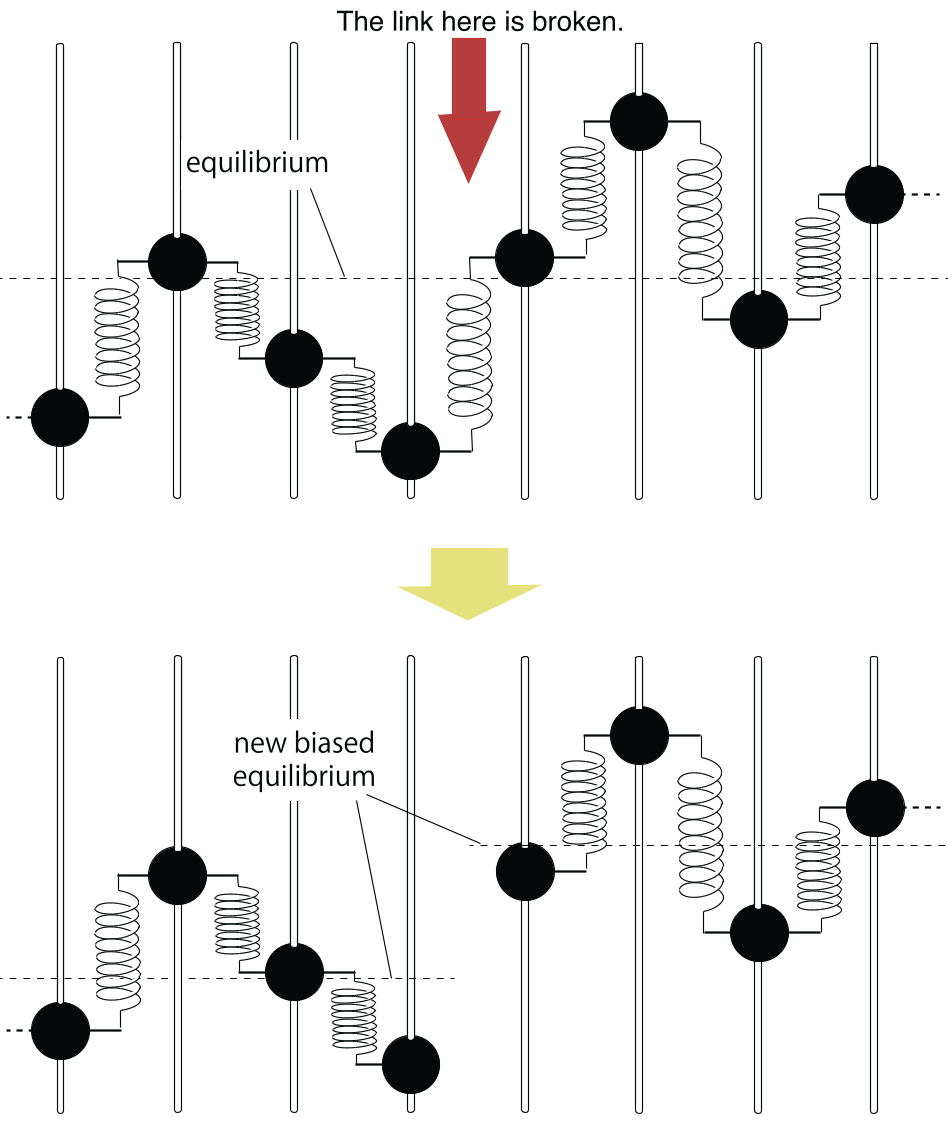 Fig 3: Fragmentation of the network shifts the equilibrium points, creating the biased "ground states" seen in polarized echo chambers.
Critical Insight & Future Work
The takeaway for social media architects is clear: Polarization is a phase transition. Once the "atmosphere" (NG mode) is generated, it becomes an autonomous force that is much harder to stop than individual instances of hate speech.
Limitations: The model assumes marginalized clusters become "complete graphs." While a useful theoretical simplification, real-world clusters are often hyper-dense but not mathematically complete. Future research should investigate the "critical density" required to trigger the Nambu-Goldstone mode in non-complete graphs.
Conclusion
By treating OSNs not just as data points but as physical systems, we gain a new vocabulary for polarization. We aren't just looking at "biased opinions"; we are looking at broken symmetry and the emergence of a collective social field.