
Beyond Binary Access: A Purpose-Driven Framework for Privacy-Preserving Social Data
A Policy Based Infrastructure for Social Data Access with Privacy Guarantees
This paper presents a policy-based infrastructure designed to enable scientific research on social datasets while strictly preserving individual privacy. It introduces a multi-layered framework using "Sticky Policies" and an extended SecPAL authorization language to support granular data access modes beyond binary allow/deny semantics.
TL;DR
Researchers at UMBC and Microsoft Research have developed a policy-based infrastructure that moves beyond simple "Yes/No" access to data. By introducing Sticky Policies and Multiple Access Modes (Complete, Abstract, and Statistical), the framework allows users to share data for specific purposes while enabling researchers to perform aggregate analysis via Differential Privacy.
Background: The Social Data Paradox
We live in an era where datasets from platforms like HealthVault (medical) or Facebook (social) hold immense scientific value. However, this data is often trapped in corporate silos. The paradox is that while users want to benefit from collective knowledge (e.g., tracking a neighborhood epidemic), they fear privacy leaks. Previous SOTA methods either focused on high-level trust relationships or strictly binary access control, which lacks the nuance required for modern data sharing.
The Core Insight: Purpose and Granularity
The authors argue that privacy isn't just about who sees the data, but why they see it and in what form. Their methodology introduces two pivotal concepts:
- Purpose-Based Access Control: Policies are tied to the "Intent" (e.g., Emergency vs. Marketing).
- Access Modality: Instead of blocking a researcher entirely, the system provides a "Statistical" view that is mathematically anonymized.
Methodology: The Three-Tiered Access Model
The architecture relies on a delegation chain where a Local Administrator delegates authority to Data Providers, who in turn respect User-defined "Sticky Policies."
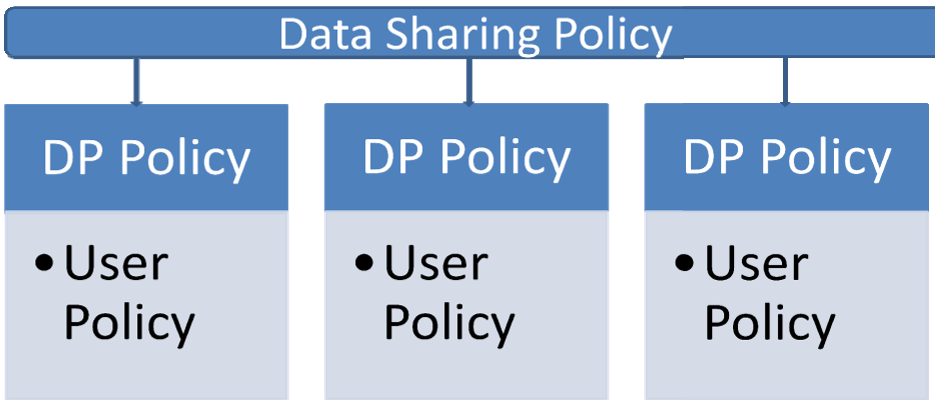 Figure 1: The hierarchical delegation chain ensuring both provider-level constraints and user-level preferences are met.
The framework supports three distinct modes:
- Complete Access: The raw data (for high-trust entities like a personal doctor).
- Abstract Access: Generalizations (e.g., sharing a Zip Code instead of a GPS coordinate).
- Statistical Access: Aggregate results designed for research, powered by Differential Privacy to ensure no single individual can be re-identified from the results.
Implementation & Experimental Results
The team extended SecPAL, a decentralized authorization language, to handle these new roles. They tested the system using the UCI Census dataset.
The most compelling evidence of the system's efficacy is found in the Statistical Access evaluation. By adjusting the (epsilon) parameter in Differential Privacy, the framework controls the "Privacy Budget," allowing researchers to see valid demographic trends (like age distribution) while injecting enough mathematical noise to protect individuals.
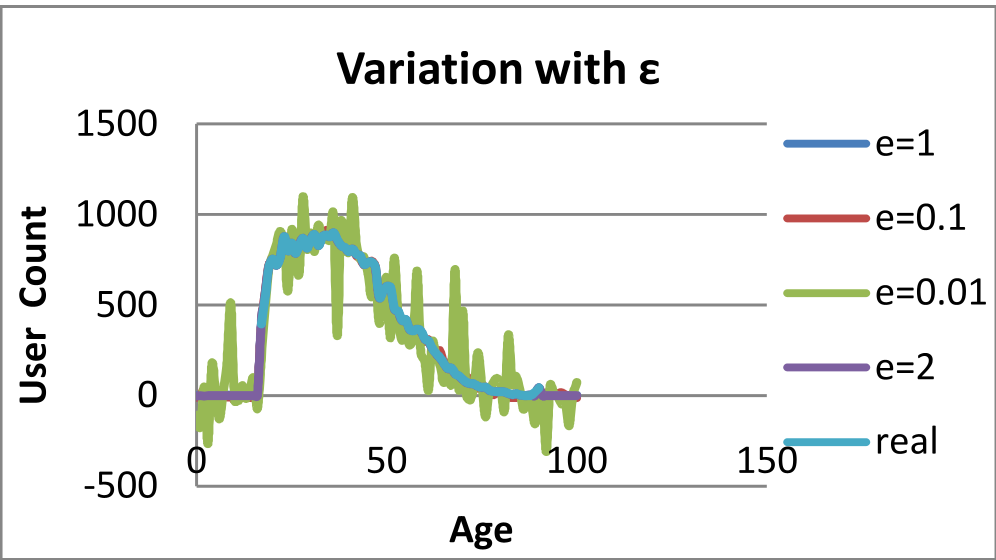 Figure 2: User count vs. Age under different Differential Privacy guarantees (). As decreases, privacy increases while maintaining the general utility of the data.
Critical Analysis & Conclusion
Takeaway
This work provides a robust blueprint for Data Altruism. It proves that we don't have to choose between total privacy and scientific progress. By encoding "Purpose" into the policy layer, we can automate the safe release of information.
Limitations & Future Work
While the SecPAL implementation is elegant, the "Manual" generation of policies by users remains a bottleneck. Future iterations might require AI-assisted policy generation to help non-technical users define their "Sticky Policies" effectively. Furthermore, exploring how this scales to real-time streaming data (like live GPS feeds) remains an open challenge for the research community.
Final Thought
This paper shifts the focus from defensive privacy to enabling privacy—a necessary evolution for the future of open science in a digital society.