
Virtual Worlds, Real Problems: Navigating the Policy Maze of the Metaverse
Policy and Legal Challenges of VirtualWorlds and Social Network Sites
2008-09-01
Summary
Problem
Method
Results
Takeaways
Abstract
This paper investigates the multifaceted policy and legal challenges inherent in Virtual Environments (VEs), including Virtual Worlds, Social Network Sites, and MMOGs. It introduces a sophistication-based classification of web environments and analyzes how increasing interaction complexity correlates with legal ambiguity and policy incomprehensibility.
## TL;DR
As digital environments shift from static pages to complex social ecosystems, the legal guardrails protecting users and operators are fraying. This paper explores why virtual environments (VEs) like Second Life or Facebook create unique policy challenges—ranging from virtual property rights to the "unreadability" of legal terms—and argues that the evolution of software code must be constrained by rigorous, negotiated policy.
## The Evolution of Digital Interaction
To understand where we are going, the authors categorize the web into three levels of sophistication:
1. **Brochure-ware**: Static, informational sites (e.g., General Electric).
2. **E-commerce**: Transactional hubs (e.g., Amazon).
3. **Virtual Environments (VEs)**: Participatory spaces where "conducers" (consumers + producers) build the world itself.
The transition to VEs isn't just a technical upgrade; it's a social and legal paradigm shift. In a VE, an operator isn't just a service provider—they are a "Sovereign" governing an economy.
## The "Complexity Gap": Why You Don't Read the ToS
One of the most striking findings is the quantitative analysis of policy complexity. Using the Flesch readability formula, the authors demonstrate that as a site becomes more interactive, its legal terms become more alienating.
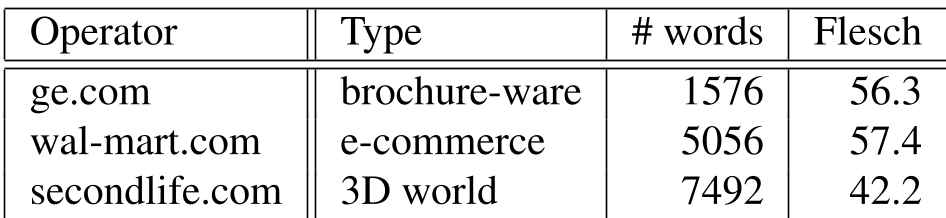
As shown in the table above, Second Life’s terms of use are not only longer but significantly more difficult to parse than a standard corporate site. This creates **uncertainty**: if neither the user nor the software developer fully understands the legal constraints, the "Compliance" of the system becomes a gamble.
## Key Policy & Legal Pain Points
### 1. The Code vs. Policy Paradox
Operators often face a "mapping" problem. A privacy policy written in English must be translated into software constraints. However, as Facebook’s early history shows (where "private" notes were made public due to bugs), the gap between **intended policy** and **implemented code** is a major source of liability.
### 2. Virtual Property: Real Value, Fragile Rights
If a user spends $1,000 to buy virtual land, and the operator changes the "code" to devalue that land, is that a breach of contract or local law? The authors point out that while "Code is Law" in a functional sense, the legal system is beginning to treat virtual assets as having real-world economic protections.
### 3. High Switching Costs
Unlike switching from one news site to another, leaving a social network or an MMOG means losing your **social identity** and **invested capital**. This creates a lack of competition in "policy quality"—users accept "unbalanced contracts of adhesion" because they are essentially locked in.
## Critical Insight: The Path to Negotiation
The authors suggest a move toward **automated negotiation**. Instead of a "Take It or Leave It" checkbox, future VEs might use machine-readable data to allow users to state their privacy needs, which the system then matches with the operator’s requirements.
## Conclusion: Toward Policy-Driven Systems
The paper concludes that we cannot rely on "God-like" operators to self-regulate. As VEs become more central to our financial and social lives, we need:
* **Consistency**: Aligning natural language policies with executable code.
* **Enforcement**: Developing tools to detect virtual trademark violations or harassment automatically.
* **Future Ethics**: Addressing how a virtual world "ends" without causing economic catastrophe for its residents.
While written in the early days of these environments, the paper's warnings about **unbalanced policies** and **implementation bugs** remain the primary hurdles for the modern "Metaverse" vision.