
Political Bots and the Swedish Election: Unmasking Digital Mimicry in Democracy
Political Bots and the Swedish General Election
This study investigates the presence and influence of political bots during the 2018 Swedish general election using a Random Forest machine learning model. By expanding the definition of "bots" to include automated behavior and human-operated "sock puppets," the researchers identified that approximately 6% of accounts discussing the election exhibited bot-like characteristics, contributing to 5% of the total political discourse on Twitter.
TL;DR
Researchers from the Swedish Defence Research Agency and Oxford University deployed a 140-feature machine learning model to track political bots during the 2018 Swedish election. They found that while bots accounted for only ~6% of active accounts, they were weaponized to amplify specific narratives, particularly within right-wing clusters, and were twice as likely to distribute external links compared to human users.
Contextualizing the Digital Battlefield
The 2016 US election was a watershed moment for "computational propaganda," where bots were responsible for nearly 19% of the conversation. This paper shifts the lens to Sweden, seeking to understand if the "Swedish model" of political discourse—traditionally more reserved—is susceptible to the same automated distortion. Unlike previous work, this study expands the scope of a "bot" from mere code to automated behavior, capturing humans who act like machines to flood the zone with specific agendas.
Methodology: The Anatomy of a Bot
The authors leveraged a Random Forest classifier, a choice driven by its proven robustness in high-dimensional feature spaces. The model doesn't just look at what is said, but how it is shared.
The 140-Feature Architecture
The features are divided into two critical silos:
- User Meta-Data: Follower-friend ratios and account longevity.
- Behavioral Micro-signals: This is where the model shines, analyzing text entropy (simplicity of language) and inter-arrival times (the mathematical consistency between retweets).
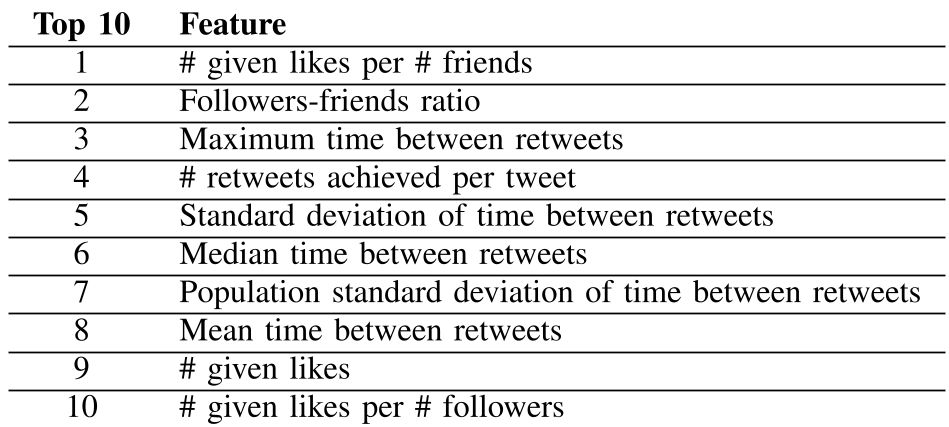 The study reveals that the "Likes-per-Friend" ratio and "Retweet Timing" are the strongest predictors of non-human behavior.
Key Results: Precision in Detection
The model achieved an Accuracy of 95.7%, placing it at the top of the supervised learning leaderboard for this task. It particularly excelled in Recall (97.6%), meaning it rarely missed a bot account, a critical metric for security and defense applications.
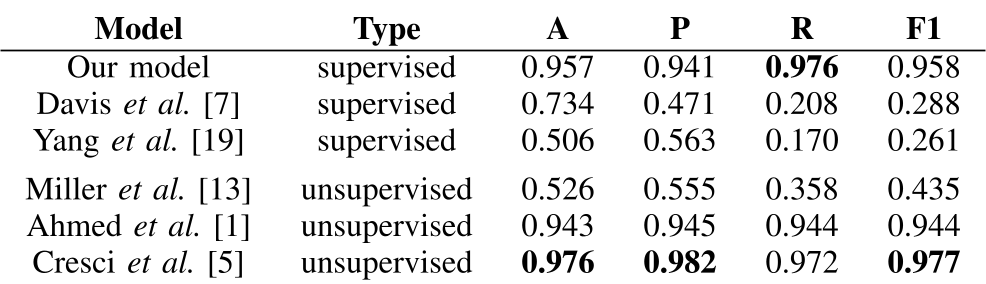 Comparison of the proposed model against SOTA baselines like Davis et al. and Cresci et al.
Insights from the Swedish Election
By applying the model to Swedish Twitter data (#svpol, #valet2018), several patterns emerged:
- URL Saturation: Bots are "link-heavy." 20% of bot tweets contained external URLs, compared to just 9% for genuine users.
- Thematic Hyper-focus: Bots and suspended accounts were disproportionately active in "Immigration-critical" themes (7.68% vs 6.17% for humans).
- Polarized Networks: Visualization of the retweet network showed two distinct clusters. The right-wing cluster was larger, more active, and contained a higher density of bot-like interactions.
Critical Analysis & Conclusion
While the 6% bot presence in Sweden is lower than in the US, it is remarkably similar to the level of bot activity seen in the German elections (7.4%). This suggests a "European baseline" for digital interference that is more subtle but highly structured.
Limitations: The study relies on Twitter's Public API, which may miss more sophisticated "stealth bots" that do not use common hashtags. Furthermore, the dictionary-based thematic analysis, while verified by experts, may miss evolving slang or coded language used by extremists.
Takeaway: The real threat of modern political bots isn't just volume—it's topological. By embedding themselves in specific ideological clusters, bots can effectively "skew the narrative" without needing to dominate the global conversation.