
Hierarchical Congestion: How Corruption Paralyzes Social Networks
Political corruption and the congestion of controllability in social networks
This research applies complex systems control theory to analyze political networks, introducing the concept of "hierarchical congestion." By examining cosponsorship data from 20 European parliaments, the study demonstrates that the anticipation of corrupt payments incentivizes individuals to manipulate their network positions, subsequently reducing overall network controllability.
TL;DR
When politicians expect to be "bought," they don't just wait for a bribe—they actively reshape their social connections to make themselves more indispensable. This research reveals that higher corruption leads to "Hierarchical Congestion," making political networks significantly harder to control and less efficient.
The "Quid-Pro-Quo" of Network Control
In most social network analyses, we look at "who knows whom." However, Philip C. Solimine’s research views these connections through the lens of Control Theory. If a political network is a dynamical system where opinions flow like electricity, a "corrupt" node is one willing to accept a control signal (a bribe) to change its state and influence its neighbors.
The central insight is simple yet profound: If being a key influencer pays well, everyone will try to become the "bottleneck" of the network.
The Mechanism: Pruning for Profit
Common sense suggests that to be powerful, you should have many connections. But control theory suggests otherwise. To be a Driver Node—one of the minimum set of individuals required to steer the whole network to a specific state—you often need fewer incoming links.
Why? Because if many people influence you, a controller can reach you through them. If you isolate yourself from incoming influence while maintaining outgoing influence, you become a "source" that the controller must pay directly.
The Theoretical Core
The author uses the DeGroot Model of social learning: Where is the adjacency matrix of influence and is the control schematic. The paper hypothesizes that nodes maximize their "Control Capacity" by strategically altering their position in to ensure they appear in .

Evidence from European Parliaments
The study analyzed cosponsorship networks across 20 European countries over two decades. By merging this with World Bank Governance Indicators, the author found a striking pattern:
- Controllability Collapse: As corruption increases, the fraction of driver nodes () rises. The network becomes "congested" because everyone is trying to be the leader, requiring more external inputs to achieve consensus.
- Density Drop: In corrupt environments, network density often decreases. Politicians prune their "weighted propensity to cosponsor" to avoid being part of a "cycle" or a "cactus" matching path that would make them redundant.
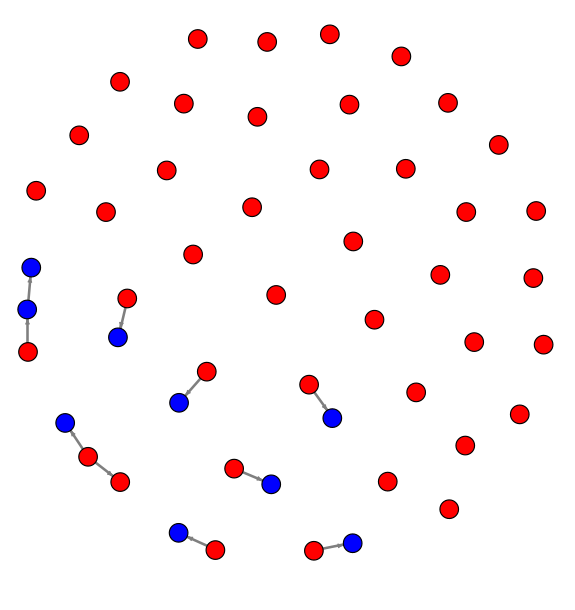 In the figure above, the "high controllability" network (left) shows a clear hierarchy, while the "low controllability" network (right) suffers from structural fragmentation driven by individual rent-seeking.
Why This Matters: Controllability as a Proxy
Corruption is notoriously hard to track using surveys alone. This paper suggests we can use network topology as an instrument. By calculating the minimum driver set of a legislature's cosponsorship network, we can create an "instrumental variable" for corruption that doesn't rely on self-reporting.
The study utilized this to show that when controlling for corruption via network metrics, EU membership significantly boosts governance effectiveness—a result that is often blurred in standard econometric models.
Conclusion: The Price of a Seat at the Table
"Hierarchical Congestion" is a tax on social efficiency. When individual incentives (getting a "piece of the action") align with structural isolation, the entire system loses its ability to respond to external needs or internal leadership.
Future Outlook: This framework isn't just for politics. It could be applied to corporate "gatekeeping" or even biological systems where individual nodes compete for signal dominance at the expense of the collective.
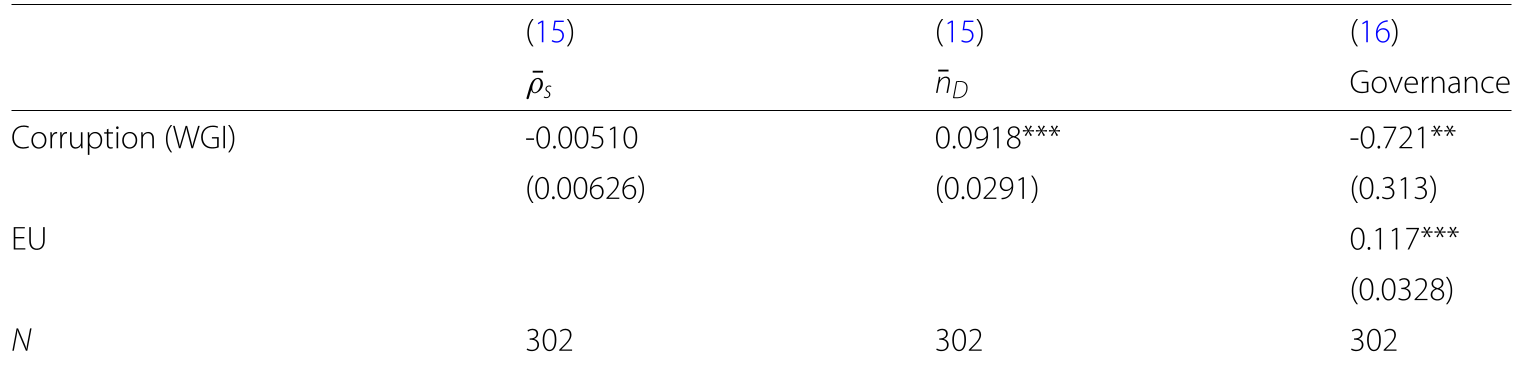 Table 3: The highly significant correlation (p < 0.01) between Corruption and Adjusted Controllability ().