
The Echo Chamber Effect: Lessons from the 2009 Portuguese Political Blogosphere
Political Deliberation in the Blogosphere: The Case of the 2009 Portuguese Elections
This study investigates the deliberative potential of the Portuguese political blogosphere during the 2009 electoral cycle using web mining and traffic analysis. By analyzing three major party-affiliated blogs (SIMPlex, Jamais, and Rua Direita), the research examines whether digital platforms foster democratic debate or merely reinforce existing partisan silos.
TL;DR
Does the internet actually broaden our minds, or just build taller walls around our opinions? This study analyzes the 2009 Portuguese elections to reveal a sobering reality: despite the technical ability to engage with opposing views, 80% of blog readers and commentators stayed strictly within their own ideological "digital bunkers." The blogosphere functioned as a mirror of partisan loyalty rather than a forum for democratic deliberation.
Background: The Digital Public Sphere Ideal
The concept of the Public Sphere, famously articulated by Jürgen Habermas, envisions a social space where citizens form public opinion through rational-critical debate. In the early 2000s, blogs were hailed as the ultimate tool to realize this ideal. Unlike traditional media, blogs allowed for instant feedback (comments), hyperlinking to sources, and decentralization.
However, the author of this paper points out a critical tension: does the blogosphere foster deliberation (changing preferences through the "force of the better argument") or polarization?
Methodology: Beyond Content Analysis
Most studies on the blogosphere focus on what is written. This research goes deeper by examining who is watching. By utilizing Sitemeter data and web mining across three major partisan blogs—SIMPlex (Center-left), Jamais (Center-right), and Rua Direita (Right-wing)—the researcher tracked:
- Cross-commenting: Do supporters of one party engage with the posts of another?
- Reading Patterns: Do visitors actually read different perspectives?
- Link Analysis: How often do bloggers reference their opponents?
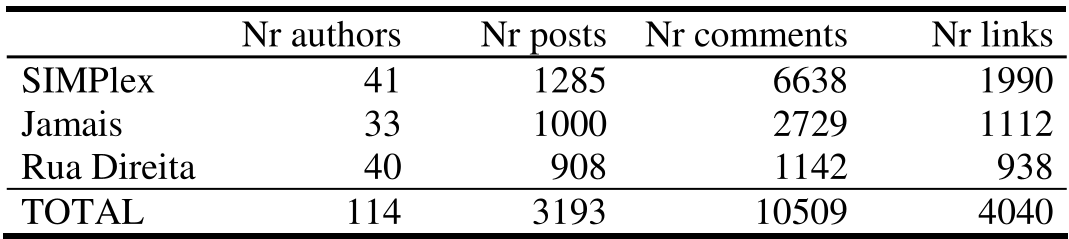 The table above shows the uneven distribution of activity, with the ruling party's blog (SIMPlex) dominating in terms of posts and comments.
Key Insights: The Reality of "Digital Bunkers"
1. Readers are Monastic
The most striking finding involves "reading events." By tracking IP addresses, the study found that 80% of visitors only visited one blog. Only 3% had the curiosity to check all three major political viewpoints within a two-hour window. This suggests that "lurkers"—the silent majority of the internet—are just as polarized as the loud commentators.
2. Commentators Don't Cross the Aisle
Engagement was equally siloed. Only 20% of authors ever commented on a rival blog. When looking at total comments, the numbers are even more dismal: for the SIMPlex blog, only 0.3% of its comments came from bloggers of the main opposition (Jamais).
 This table highlights the low percentage of users who seek a "diverse range of options," undermining the deliberative potential of the platform.
3. The Blogosphere as a "Barometer"
Interestingly, while the blogosphere failed as a discussion forum, it excelled as a barometer. The percentage of blog visits closely mirrored the actual electoral results (with a margin of error of only 1.7% to 3.7%). This suggests that while blogs don't change minds, they accurately reflect the intensity and size of a party's base.
Critical Analysis: Why the Failure?
The author posits that the "natural aversion to confront ideas" is not solved by technology. Even with anonymity and the lack of face-to-face conflict, users choose Selective Exposure. We seek out information that confirms our biases and ignore that which challenges us.
From a technical perspective, the "linking mechanism" was also underutilized. Only about 8-12% of posts included links to the other blogs in the study. Without these structural bridges, the average reader is unlikely to stumble upon a different point of view.
Future Outlook and Limitations
The study admits to technical hurdles, such as NAT/Firewalls masking IP addresses and the difficulty of tracking users who change nicknames. Furthermore, the 2009 context is "pre-algorithm." Modern social media uses recommendation engines that likely exacerbate these silos even further than the voluntary choices of the 2009 bloggers did.
Takeaway for Today: The transition from the "Blogosphere" to "Social Media" has likely only hardened these silos. For developers and researchers, the challenge remains: how do we design interfaces that encourage exposure to "the other" without triggering defensive radicalization?
Conclusion
The 2009 Portuguese elections provided a unique laboratory to test the "Public Sphere" theory. The result? Structure does not dictate behavior. You can build a bridge, but you cannot make the partisans cross it. The blogosphere, in this case, served not as a town square, but as a series of disconnected cheering sections for the converted.