
The Cost of Diversity: How Political Disagreement Breeds Ambivalence and Inertia
Political disagreement and ambivalence in new information environment: Exploring conditional indirect effects of partisan news use and heterogeneous discussion networks on SNSs on political participation
This study investigates how partisan news consumption and social network site (SNS) discussion networks influence political participation in South Korea. Using a moderated mediation model, it demonstrates that political ambivalence serves as a key psychological mechanism that either mobilizes or demobilizes civic engagement depending on the nature of information exposure.
TL;DR
In the idealized digital public sphere, exposure to diverse viewpoints is the bedrock of democracy. However, this study by Kim and Hyun (2017) reveals a sobering paradox: encountering counter-attitudinal news and diverse social media discussions increases political ambivalence, which in turn significantly demobilizes political participation. While "preaching to the choir" (proattitudinal news) energizes voters by reducing psychological conflict, the very act of engaging with the "other side" can lead to civic paralysis.
The Problem: The Deliberation-Participation Trade-off
Democratic theory often assumes that exposure to political disagreement is an unalloyed good. Yet, scholars have long suspected a "trade-off." If you only hear one side, you are certain and motivated to act (Participatory Democracy). If you hear both sides, you become conflicted and hesitant (Deliberative Democracy).
The researchers focused on South Korea—a highly polarized environment with a vibrant SNS culture—to ask: Does our new information environment, filled with partisan news sites and diverse social networks, make this paralysis worse?
Methodology: Mapping the Psychological Mediation
The study utilizes a survey of 542 SNS users to test a Conditional Indirect Effects model. The key variables are:
- Independent Variables: Frequency of using Proattitudinal vs. Counter-attitudinal news sites.
- Mediator: Political Ambivalence (the simultaneous presence of positive and negative evaluations of political objects).
- Moderator: SNS Heterogeneity (how often you talk to "the other side" on Facebook/Twitter).
- Outcome: Political Participation (voting, protesting, donating).
Core Insights: Mobilization vs. Demobilization
The findings confirm two distinct pathways:
1. The Mobilization Path (Proattitudinal News)
Users who frequent news sites aligning with their ideology experience a reduction in ambivalence. This "certainty" acts as a catalyst for action. This path remains relatively stable regardless of social media discussion types, suggesting that proattitudinal news creates a "defensive mindset" that shields the user's convictions.
2. The Demobilization Path (Counter-attitudinal News)
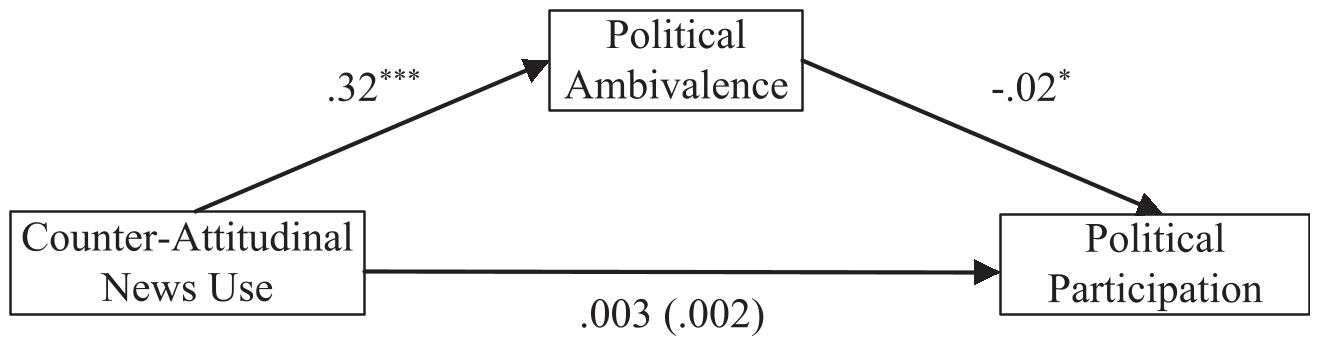
Exposure to opposing news increases ambivalence. When people see valid points on both sides (or simply feel overwhelmed by conflicting narratives), they are less likely to participate.
3. The "Differential Losses" Multiplier
The most striking finding is the interaction between news and social networks. As shown in the data, the negative impact of counter-attitudinal news on participation is amplified when the person also has a heterogeneous social network.
- Low SNS Heterogeneity: Counter-attitudinal news has a negligible effect on participation.
- High SNS Heterogeneity: The combination of "hostile" news AND "hostile" discussion leads to a significant spike in ambivalence and a subsequent drop in participation.
Critical Analysis: The Silence of the Moderates
This research highlights a dangerous feedback loop in modern politics:
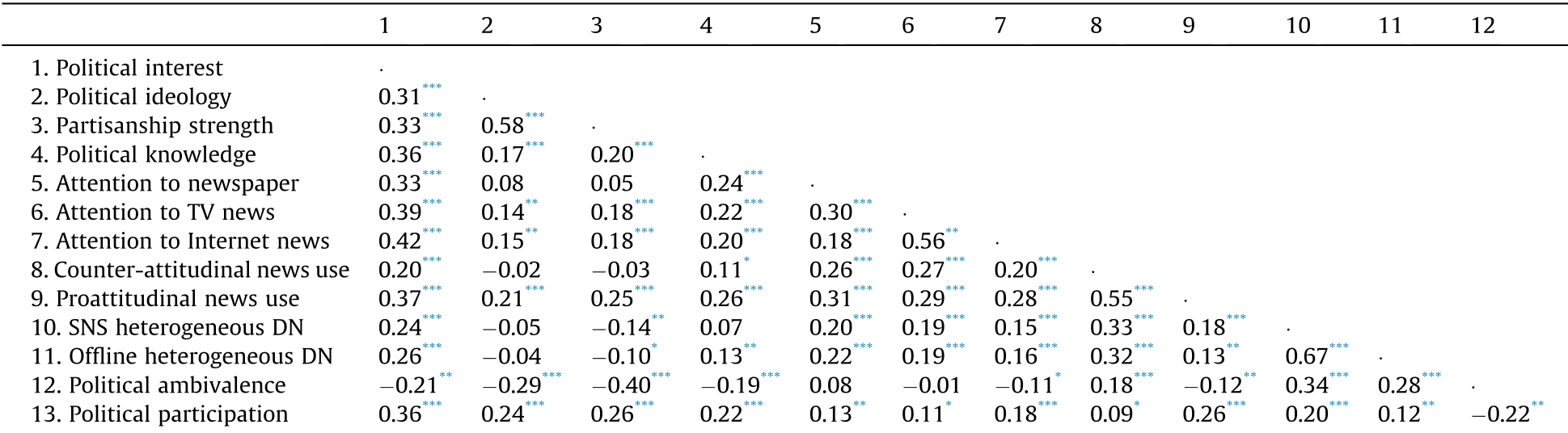
- Extremists consume proattitudinal news, remain low in ambivalence, and dominate the political landscape through high participation.
- Moderates/Open-minded individuals consume diverse news, become highly ambivalent due to the complexity of the issues, and eventually retreat from the political sphere.
Limitations: Since the data is cross-sectional, we cannot definitively say that news causes ambivalence; it is possible that ambivalent people naturally seek out more balanced/diverse news. Furthermore, the study focused on tech-savvy young adults, whose behavior might differ from older generations.
Conclusion
The study suggests that while SNS platforms could theoretically bridge divides, the psychological cost of that bridging is often indecisiveness. For developers and political strategists, the takeaway is clear: to maintain engagement without sacrificing diversity, we need tools that help citizens navigate ambivalence—not just by "picking a side," but by translating complex, conflicting information into meaningful, actionable steps.
Takeaway: In a polarized world, the "balanced" citizen is at high risk of becoming the "silent" citizen.