
Taking the Pulse of Political Emotions: Why Simple Sentiment Isn't Enough for Latin American Politics
Taking the Pulse of Political Emotions in Latin America Based on Social Web Streams
This paper presents a computational social science study that leverages Twitter and blog streams to track the "political pulse" of 18 Latin American presidents. By applying a multilingual sentiment analysis framework based on the NRC Emotion Lexicon, the authors map social media mentions to Plutchik’s eight basic emotions and polarity.
TL;DR
Researchers at the L3S Research Center analyzed over 165,000 social media documents to track the popularity of 18 Latin American presidents. They discovered that while simple "positive vs. negative" sentiment is a poor predictor of actual approval ratings, a nuanced model using Plutchik’s basic emotions—specifically Joy and Anticipation—can predict poll outcomes with 81% accuracy.
Background: Move Over, Opinion Polls
Traditional opinion polls are the "dinosaurs" of political science: expensive, slow, and often limited to a few thousand respondents. In regions like Latin America, where Twitter penetration is among the highest globally, the "Social Web" offers a real-time alternative. However, the technical challenge lies in the language (Spanish) and the complexity of human emotion. Is a tweet about a president "negative" because of the leader, or because the user is expressing "fear" regarding a policy?
The Methodology: Mapping Emotions in Real-Time
The authors collected data on 18 presidents between 2011 and 2012. Instead of the computationally expensive route of translating every tweet into English, they translated the NRC Emotion Lexicon (EmoLex) into Spanish once.
The Analytical Pipeline
The system follows a three-step process to close the loop between data and insight:
- Collection: Gathering specific mentions of presidential names from Twitter and Google News RSS.
- Profiling: Using Part-of-Speech (POS) tagging to isolate nouns and adjectives.
- Vectorization: Mapping terms to Plutchik’s Wheel of Emotions (Joy, Sadness, Anger, Fear, Trust, Disgust, Anticipation, Surprise).
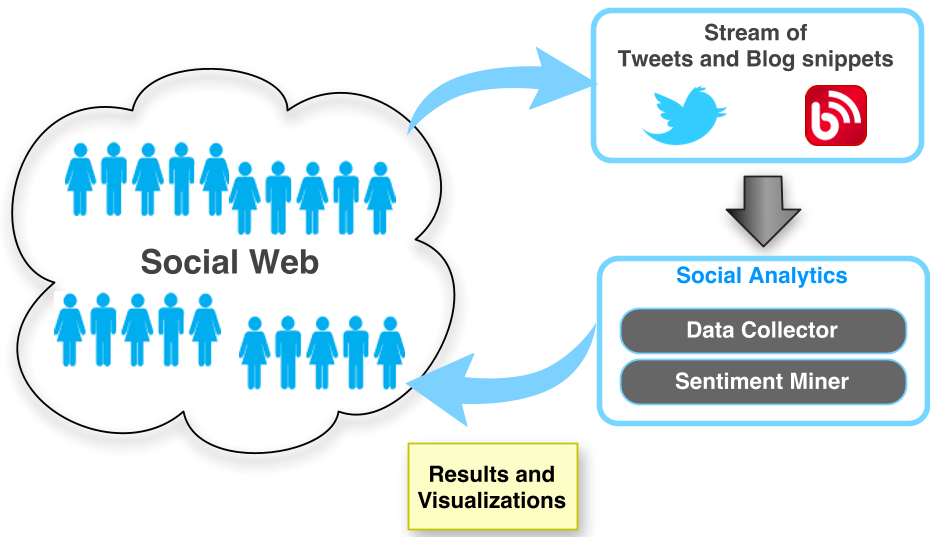 Figure 1: The Social Analytics loop translating raw social streams into actionable global patterns.
Beyond Polarity: The Power of Emotion Pairs
A key insight of this paper is that Polarity is too coarse-grained. A president might have a 54% negative sentiment (like Mexico's Felipe Calderón during the study), but understanding why requires looking at the specific emotional mix: sadness, anger, fear, and disgust.
The researchers used a Support Vector Machine (SVM) to find which emotions actually correlate with traditional poll results (Consulta Mitofsky).
Key Experimental Results
- Polarity Only: AUC 0.61 (Barely better than a coin flip).
- Emotional Vector (Combined): AUC 0.81 (Strong predictive power).
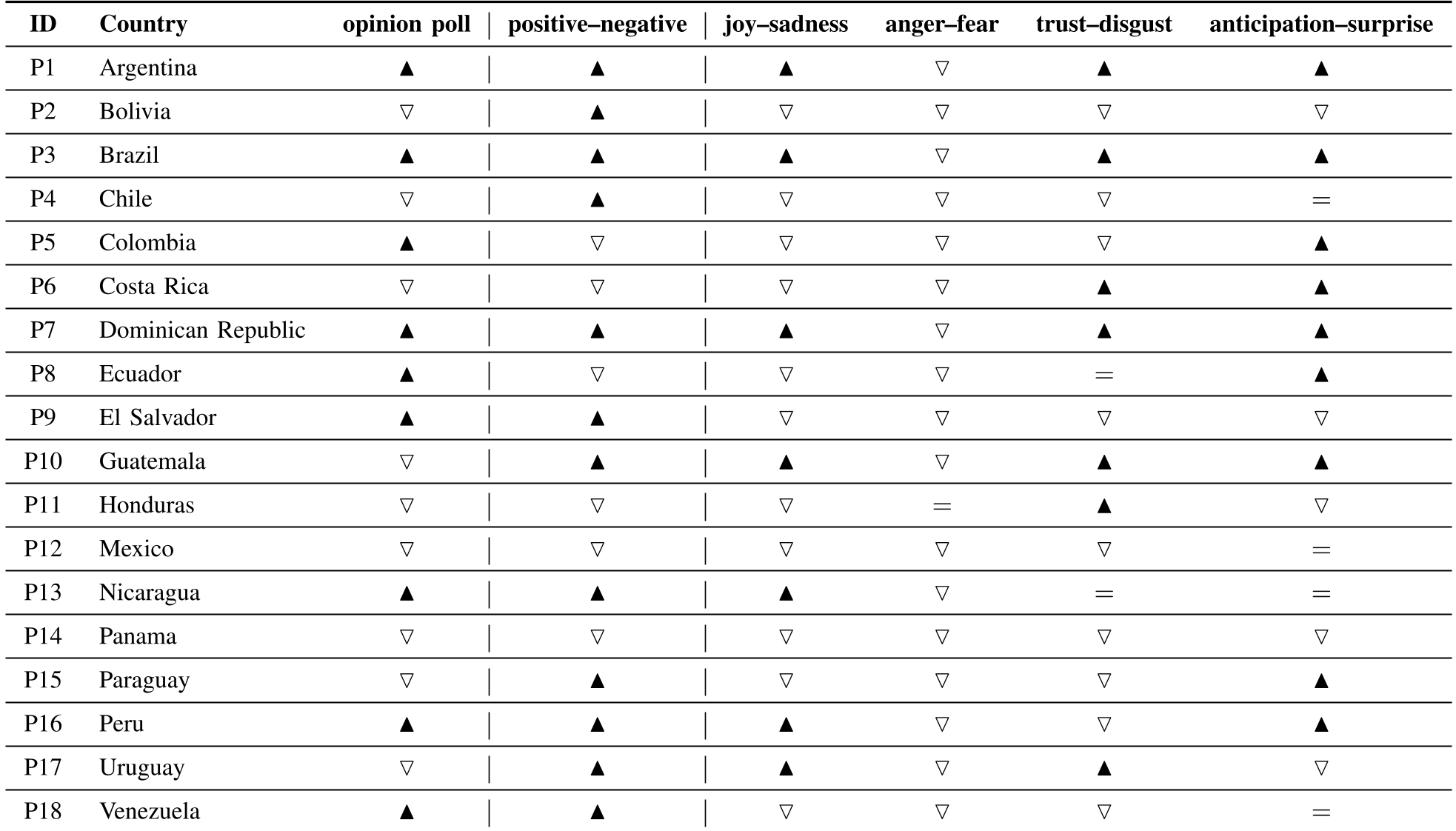 Table II: Comparing Opinion Polls against individual emotion pairs across 18 countries.
The study found that the weights for Joy–Sadness (1.748) and Anticipation–Surprise (1.694) were the highest. This suggests that public approval is driven more by the presence of "Joy" and "Hope/Anticipation" than simply the absence of "Negativity."
Critical Insight: The "Why" behind the Success
Why did this approach work? Most sentiment tools fail because they ignore the Inductive Bias of political discourse. Politics is inherently emotional. By using Plutchik’s Wheel, the authors captured "oppositional" states that mirror political polarization.
Furthermore, the decision to translate the lexicon rather than the tweets is a masterstroke for real-time systems. It reduces the processing bottleneck, allowing for a "Pulse" that is actually live, rather than lagging behind translation APIs.
Conclusion and Future Outlook
This work proves that social media isn't just "noise"—it's a high-resolution mirror of public sentiment if you use the right filters.
Limitations: The study relies on exact name matches and doesn't account for the heavy presence of sarcasm and irony in Latin American political discourse. Future models will likely need to integrate context-aware embeddings (like Transformers) to catch the nuance that a static lexicon might miss.
Takeaway: If you want to predict the next election or public reaction, stop counting "likes" and start measuring "Joy" and "Anticipation."