
Hierarchical Veracity: Solving Fine-Grained Fake News Detection via Multistage Modeling
Political Fake Statement Detection via Multistage Feature-assisted Neural Modeling
This paper introduces a multistage feature-assisted neural modeling approach for fine-grained political fake statement detection. By utilizing Dual GRU layers combined with extensive lexical features and a novel three-stage or five-stage classification hierarchy, the authors achieved a SOTA Accuracy of 46.13% on the LIAR-PLUS dataset without relying on speaker metadata.
TL;DR
Assessing clinical-grade truth in politics isn't a binary "True or False" game; it's a spectrum. This paper tackles the LIAR-PLUS benchmark by replacing traditional single-stage multi-class classifiers with multistage neural hierarchies. By modeling both the political statement and the fact-checker's justification through a Dual GRU architecture and specific lexical features, the authors achieved state-of-the-art results (46.13% Accuracy) even when speaker profile data—a common "crutch" in previous research—is missing.
Background: The Limits of Single-Stage Truth
In the realm of Political Fake Statement Detection (FSD), models are tasked with assigning labels like Pants-on-Fire, False, Barely-True, Half-True, Mostly-True, and True.
Existing SOTA models face two major hurdles:
- Dependency on Metadata: Many models rely on the speaker’s "Credit History." In the real world, when a new claim surfaces, we don't always have a historical portfolio of that politician's lies.
- Fuzzy Boundaries: A statement can be "Mostly True" while containing a "False" quantitative claim. Standard classifiers struggle to distinguish these subtle nuances in one go.
Methodology: The Power of Hierarchy
The authors propose that truth is best filtered through a taxonomic hierarchy rather than a flat list.
1. Classification Hierarchies
They explored two primary strategies:
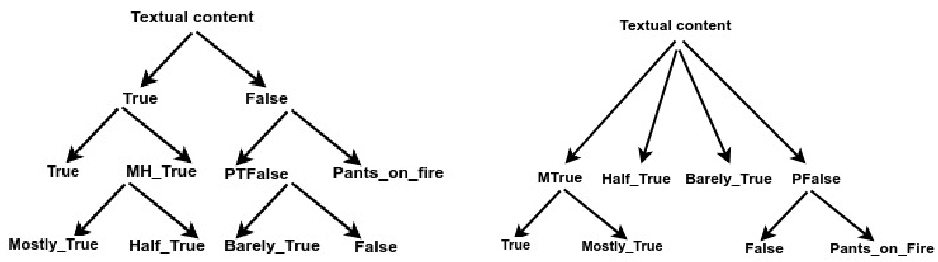
- Five-Stage Design: Treats the problem as a sequence of five binary decisions (e.g., first deciding if it's "True-leaning" vs "False-leaning," then drilling down).
- Three-Stage Design (The Winner): Groups labels into four "Archetypes"—Factual, Incomplete, Manipulative, and Hoax—and then uses sub-stages to refine the specific veracity label.
2. The Dual-GRU Feature-Assisted Model
Instead of feeding everything into one "black box," the model uses a specialized architecture:
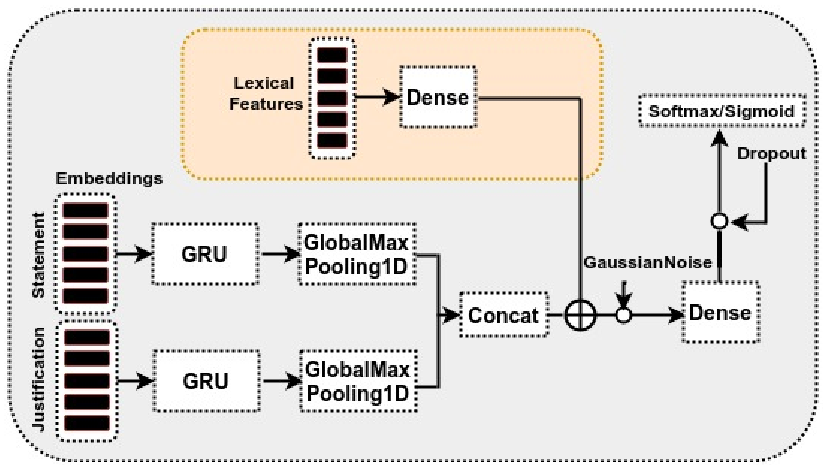
- Dual-GRU: Separately processes the Statement and the Justification (the evidence provided by fact-checkers).
- Lexical Fusion: Incorporates BoW, Sentiment (VADER), and "Refuting words" (like hoax, deny) directly into the feature vector.
- Gaussian Noise: A critical trick! Adding noise at the hidden layer level during training acts as data augmentation, forcing the model to learn more robust, generalized features.
Experimental Breakthroughs
The results prove that "how" you classify is just as important as "what" features you use.
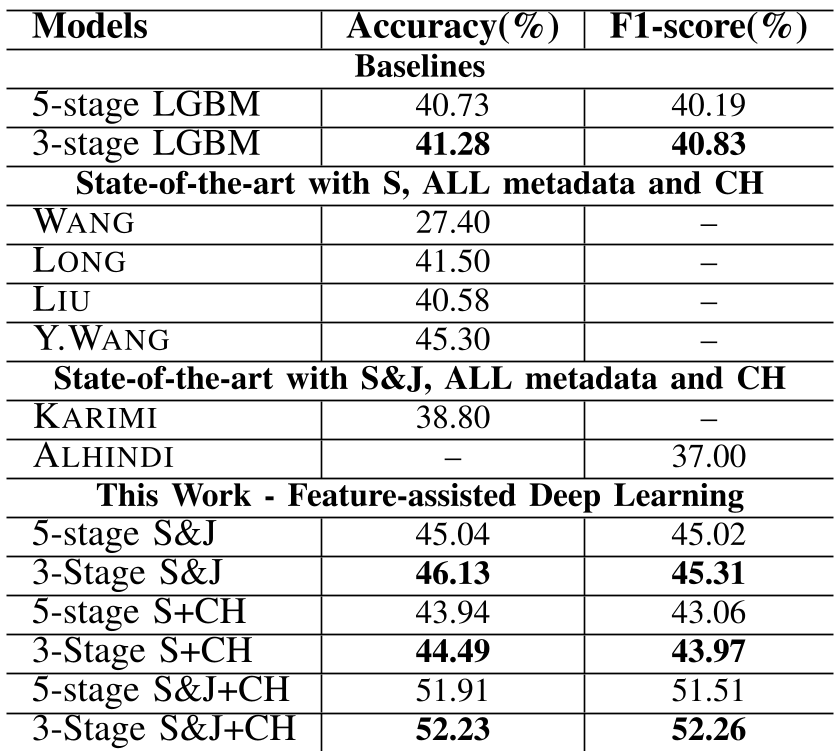
- Metadata-Free SOTA: By using only the Statement (S) and Justification (J), the 3-stage model reached 46.13% Accuracy, beating previous BERT-based models and self-attention models that had the advantage of using speaker profiles.
- The "Credit History" Boost: When Credit History (CH) is available, the model's accuracy jumps to 52.23%. This confirms that a politician's past is indeed a strong predictor of their future honesty.
Deep Insight: Why Why Does It Work?
The core "Insight" here is the Stance Detection analogy. By treating the Justification as a "document" and the Statement as a "claim," the model learns the relationship between the evidence and the claim. The ablation study showed that adding Gaussian Noise was the single most effective optimization, preventing the model from simply memorizing specific words in the training set and instead learning the semantic "vibe" of misinformation.
Conclusion & Future Outlook
This work shifts the focus of fake news detection from "who said it" to "what is the evidence saying about the claim." While effective, the model still relies on human-written justifications. The next logical step for the industry is to replace these human justifications with automated retrieval-augmented generation (RAG), allowing the system to fact-check claims in real-time by pulling data from the live web.
Key Takeaways for Practitioners:
- If your fine-grained classes are getting confused, try a hierarchical/multi-stage approach.
- Gaussian Noise at the hidden layer is an underrated data augmentation tool for small NLP datasets.
- Don't ignore lexical features (BoW, Sentiment); they still provide powerful inductive biases that deep learning alone might miss.