
Political Framing: The COVID-19 Blame Game on US Twitter
Political Framing: US COVID19 Blame Game
This paper investigates political framing on Twitter during the initial stages of the COVID-19 pandemic, specifically focusing on the 2020 US presidential race. Using unsupervised stance detection and rhetorical analysis via DocuScope, the authors demonstrate how the pandemic was transformed from a public health crisis into a polarized "blame game."
TL;DR
In the lead-up to the 2020 US election, COVID-19 ceased to be a health issue on Twitter and became a high-stakes political weapon. This study reveals how Republican and Democratic users utilized sophisticated "framing" to either protect or attack President Trump, shifting the narrative from medical safety to partisan accountability. Using unsupervised AI to cluster users, the research proves that social media ecosystems prioritize "The Blame Game" over scientific information.
Background: SARS-CoV-2 as a Political Pivot
By May 2020, the US faced a staggering death toll. However, for the "Twitter-active" population, the virus wasn't just a pathogen—it was a talking point. The authors position this work within Framing Theory, which suggests that how an issue is "packaged" determines how the public perceives it. The paper identifies a massive divergence between two "realities" existing simultaneously on the same platform.
The "How": Unsupervised Stance & Rhetorical Analysis
The researchers didn't just look at keywords; they built a pipeline to understand Stance.
- User Clustering: By looking at who users retweeted (rather than what they said), the authors used UMAP and Mean Shift clustering to separate 25,000+ users into Pro-GOP (Republican) and Pro-DNC (Democrat) camps with almost perfect accuracy.
- Valence Scoring: They calculated which terms were "uniquely" belonging to one side using a valence formula that highlights extremity.
- DocuScope: A sophisticated linguistic tool was used to map 60 million English patterns to "rhetorical effects," identifying hidden intentions behind the text.
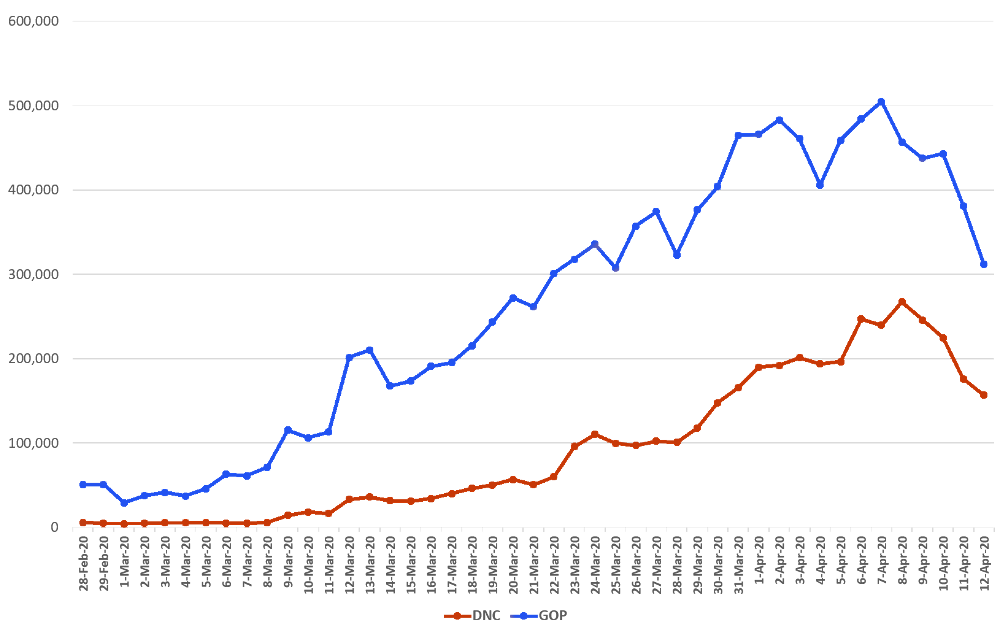 Figure 1: Comparison of daily tweet activity between DNC and GOP supporters shows synchronized response to news cycles.
Methodology: The Architecture of a Frame
The study identifies three overarching frames that dominated the discourse:
- Assignment of Blame: DNC focused on Trump; GOP focused on China and "Deep State" conspiracies.
- Candidate Support: Using the pandemic to either justify Trump’s re-election or argue for his removal.
- Social Solidarity: The only area of minor overlap, involving lockdown-related messaging (#StayHome).
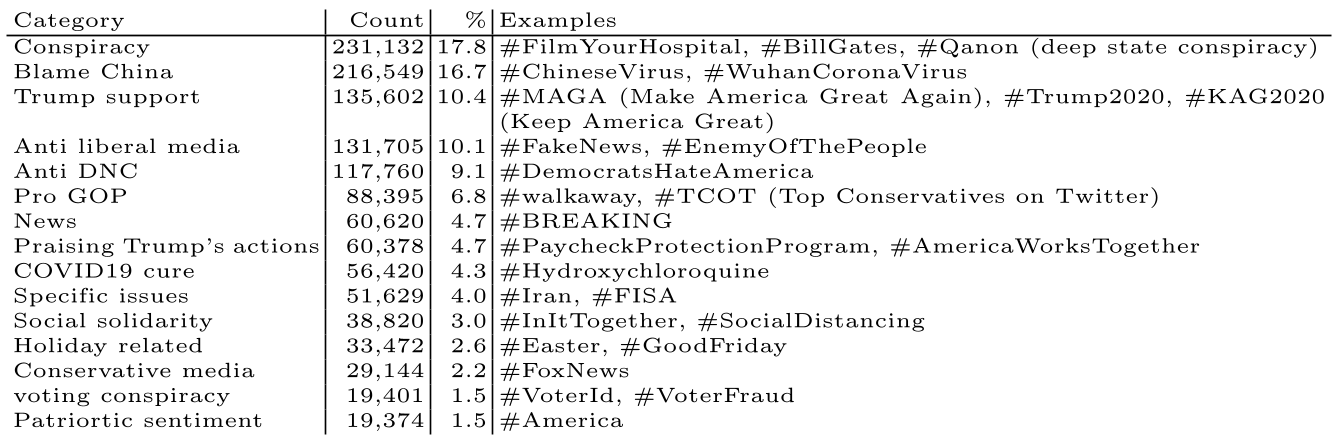 Table 1: GOP framing focused heavily on Conspiracies (17.8%) and Blaming China (16.7%).
Contrast: The Partisan Divide
The results are stark. For DNC supporters, 56% of the discourse was categorized as "Anti-Trump." For GOP supporters, the focus was multidimensional: blaming China, attacking "liberal media" (#FakeNews), and promoting alternative treatments like Hydroxychloroquine to reinforce a narrative that "everything is under control."
The study utilized DocuScope to reveal how even neutral words were "weaponized." For example, when mentioning "Media," GOP supporters used rhetorical devices emphasizing "Trickery" and "Sham," while DNC supporters used "Breaking News" devices to highlight "Bungled Responses."
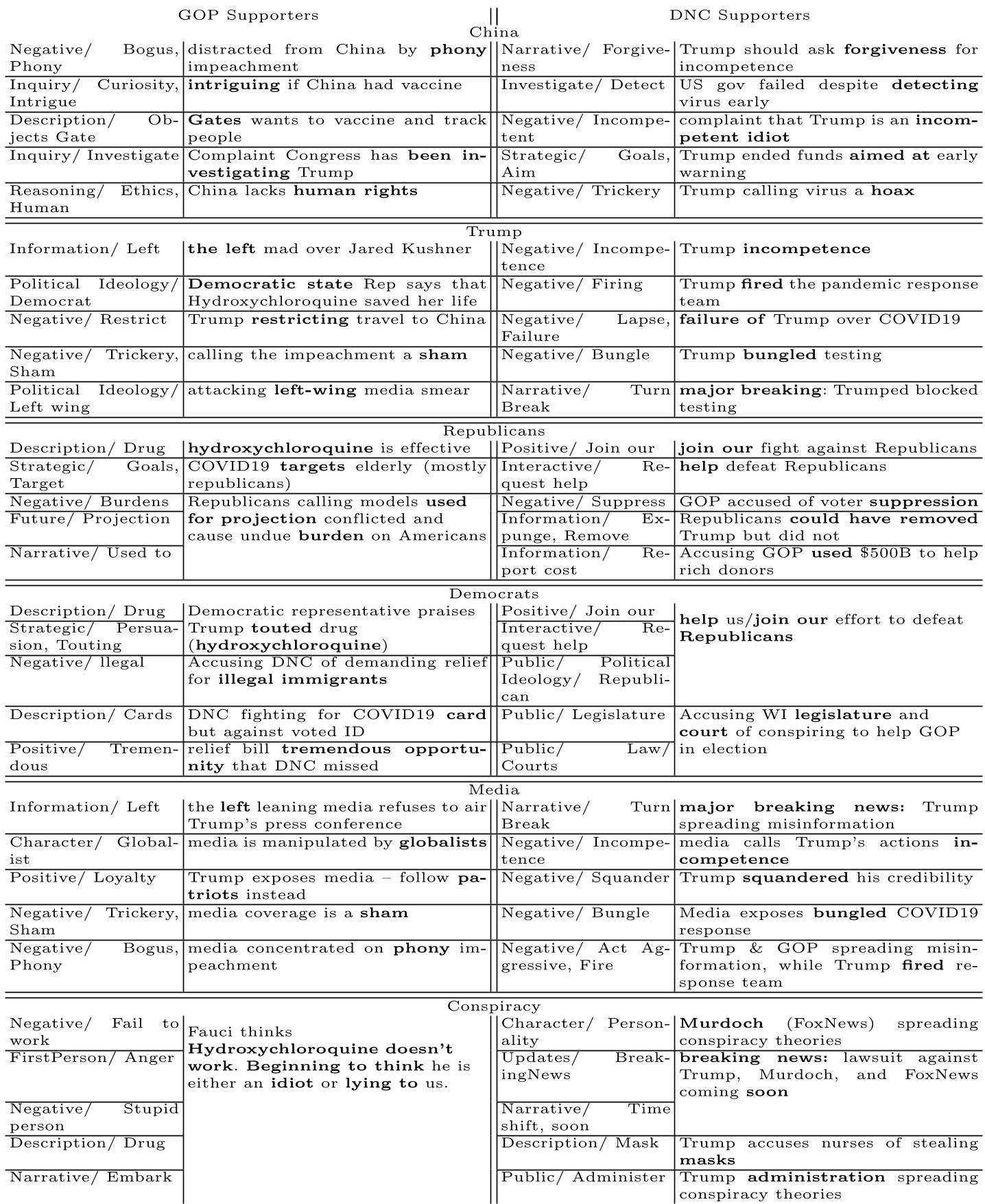 Table 7: How different camps used rhetorical devices to describe the same targets (China, Trump, Media).
Deep Insight: Is Twitter Representative?
A critical finding of this paper is the comparison between the "Politicized" dataset and a "Sampled" (random US) dataset. In the random sample, political framing accounted for only 27% of the hashtag volume, compared to nearly 80% in the active clusters. This suggests that while hyper-partisan users dominate the noise and set the agenda, they are not necessarily representative of the broader public—though their influence via retweets is pervasive.
Conclusion & Limitations
The study concludes that framing is autological—it reinforces what the user already believes.
- Pros: The methodology is highly reproducible and demonstrates a clear path for real-time political monitorng.
- Cons: The study is limited to English-speaking US users and a specific timeframe (Jan-April 2020).
- Future Outlook: These techniques could be applied to current crises (climate change, inflation) to see if "blame frames" continue to outperform "solution frames" in the digital sphere.
Final Takeaway: COVID-19 was a medical event, but on Twitter, it was a battleground for the 2020 election.