
Political Hashtag Hijacking: Mapping the Frontlines of U.S. Twitter Wars
Political hashtag hijacking in the U.S.
This paper investigates "political hashtag hijacking" on Twitter by analyzing the temporal change in hashtag polarization during U.S. political debates. The researchers developed a volume-based voting methodology to identify sudden shifts in political leaning, categorized as "change points," and quantified the behavior of the highly active "hijacker" users responsible for these shifts.
TL;DR
This research uncovers the phenomenon of "hashtag hijacking"—a tactical maneuver where political activists flood an opponent's hashtag to shift its perceived sentiment. By tracking the political leaning of hashtags over time, the authors identify "change points" caused by hyper-active users who focus their efforts on vulnerable, low-volume hashtags to dominate the digital frame.
Problem & Motivation: The Fluidity of Polarization
In the digital Town Square, hashtags like #obamacare or #tcot are more than just metadata; they are ideological battlegrounds. Previous research often treated a hashtag's political leaning as a fixed trait. However, this paper argues that political orientation is dynamic.
The authors observed that the political "left" and "right" engage in "hashtag wars." For instance, while one side might establish a term to frame a policy, the opposing side can "hijack" it to subvert the original message. Understanding when and how these jumps in polarity occur is crucial for campaign organizers and citizens who want to distinguish between organic debate and organized activism.
Methodology: Identifying the "Change Points"
The researchers developed a multi-step pipeline to quantify the "leaning" of a hashtag:
- User Labeling: Users are assigned a political leaning based on who they retweet (e.g., retweeting
@BarackObamavs. right-wing seed accounts). - Hashtag Polarization: A formula called
Lean(h, w, p)calculates the leaning of hashtag h in week w for party p, using a volume-based voting approach that prevents low-volume noise from creating extreme outliers. - Heuristic Detection: "Change points" are identified when a hashtag's leaning jumps significantly above its standard deviation, specifically in cases where that party is usually inactive on that hashtag.
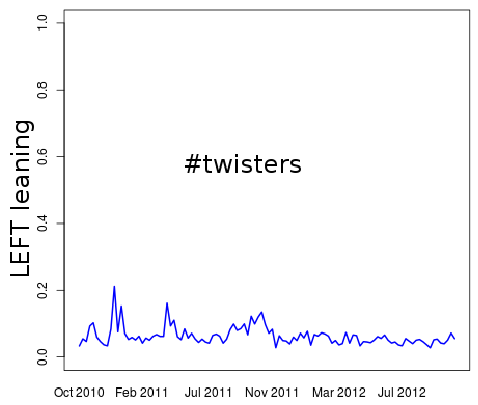 Figure 1: Highlighted green points indicate sudden jumps in political leaning (Change Points).
Anatomy of a Hijacker
Who are these "hijackers"? By analyzing the users active during change points, the authors discovered a distinct profile of a political "super-user."
| Metric | Normal User (Right) | Hijacker (Right) |
|---|---|---|
| Avg. Tweets | 3,928 | 17,306 |
| Fol-lowers | 1,291 | 5,930 |
| Avg. Leaning Score | 0.74 | 0.95 |
Hijackers are not just random participants; they are more active, have more followers, and possess a more extreme political leaning than the average user. Their activity is focused: they contribute a much higher fraction of their volume to these "hijacked" hashtags compared to their general behavior (up to 27% focus for some groups).
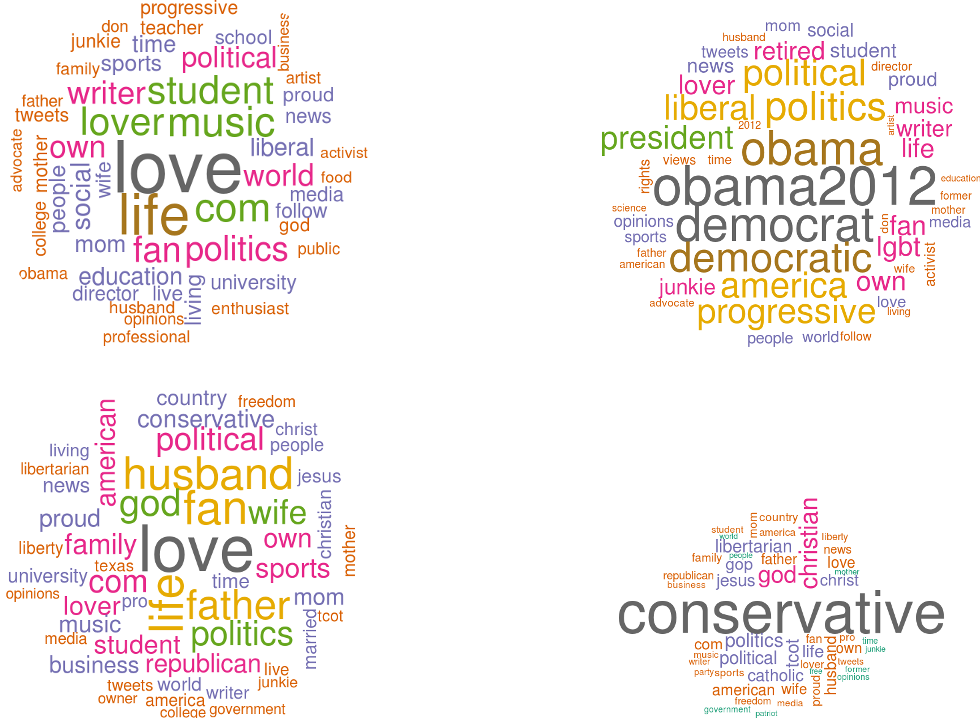 Figure 2: Profile term clouds show that hijackers use party-related terms (e.g., "conservative", "liberty", "p2") much more frequently than normal users.
Experimental Analysis: Why It Works
The statistical analysis (using Student t-tests) revealed a strategic pattern:
- Vulnerability: Hijacking is most successful on low-volume hashtags. It is much harder to hijack a massive trend like
#tcotthan a niche or emerging hashtag. - Intensity: During a hijacking event, the "invading" side typically increases its normalized volume by 5 to 8 times its usual activity to force the leaning shift.
 Table: Comparison of Normalized Volume (NV) and Trending Scores (TS) between Change Points (CP) and Non-Change Points (NCP).
Critical Insight & Conclusion
This work highlights that political polarization on social media is a proactive, often coordinated process. The concept of "hashtag hijacking" proves that digital narratives are not just formed by consensus but seized by the most active "activist" nodes in the network.
Limitations: The study relies on 2013 data and rule-based heuristics. In the modern era of LLM-powered bots, the "hijackers" might no longer be humans but sophisticated automated agents, making detection even more complex.
Future Outlook: The methodology provides a roadmap for real-time monitoring of "narrative attacks." Future systems could theoretically alert organizations the moment a hashtag begins to shift polarity, allowing for more rapid responses in the digital information war.