
Political Hashtags: The Design Choice Killing Online Discourse
Political Hashtags & the Lost Art of Democratic Discourse
This study investigates the impact of political hashtags (e.g., #MeToo, #BlackLivesMatter) as a design element in social media news articles. Through a randomized control experiment (n=3205), the researchers found that including these hashtags significantly alters the quality of democratic discourse by narrowing topical focus and increasing emotional toxicity.
TL;DR
A common practice in digital journalism is the use of viral hashtags like #BlackLivesMatter or #MeToo in headlines to increase reach. However, a major study from CHI '20 reveals a disturbing side effect: these hashtags act as "contextual anchors" that steer readers away from the actual news facts, fueling anger, fear, and a "black-and-white" rhetorical style that destroys civil debate.
The "Public Sphere" vs. The Branding Reality
Social media news posts are supposed to be our modern-day town squares. Ideally, these spaces should facilitate deliberation—reasoned, respectful debate among citizens. Yet, the reality is frequently toxic.
The authors of this study argue that hashtags are not just metadata; they are design inputs. While activists use them for storytelling, journalists use them for "branding" and visibility. The research team posed a critical question: If you take the same news story and simply add or remove a hashtag, does it change how the average reader reacts?
Methodology: A Randomized Control Lens
To answer this, the researchers deployed a controlled experiment with 3,205 participants. They used actual news articles from NPR and the New York Times covering sensitive social issues.
- Control Group: Saw the news post without the hashtag.
- Treatment Group: Saw the exact same post but with a political hashtag (e.g., #BlackLivesMatter) in the headline.
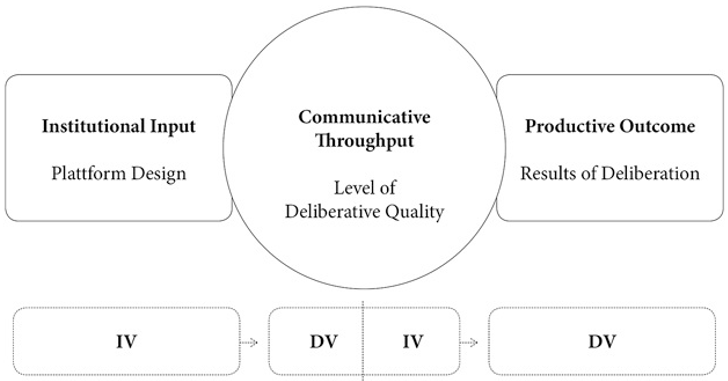 The study evaluates 'Input' (Hashtags) and their effect on 'Throughput' (Quality of Discourse).
Finding 1: The "Drowning Out" Effect (Topic Focus)
Using Pointwise Mutual Information (PMI), the researchers analyzed the keywords in user comments.
- In the Control Group: People discussed the specific nuances of the article (e.g., "charter schools," "education funding," "safe spaces").
- In the Hashtag Group: The specifics of the story vanished. Discussions were "drowned out" by the hashtag parlance, with commenters focusing almost entirely on the racial or partisan politics of the hashtag itself rather than the reported facts.
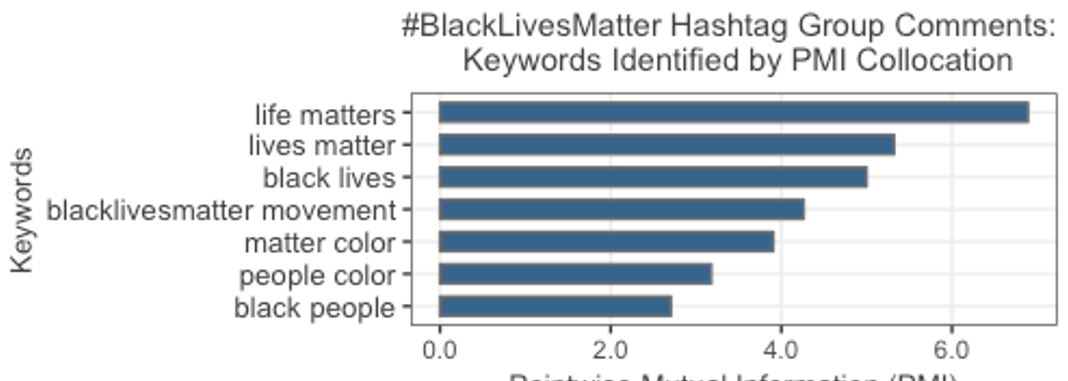 Comparison of keyword focus: The hashtag group (left) gravitates toward repetitive hashtag terms, while the control group (right) engages with broader topical context.
Finding 2: Amplifying the "Dark" Emotions
The data showed a statistically significant spike in negative emotions when hashtags were present. Using the sentimentR package—which is sophisticated enough to detect "valence shifters" (like "not good" vs "good")—the team found:
- Anger: Significantly higher in hashtagged posts.
- Disgust & Fear: Lexical markers for these emotions increased, suggesting that hashtags trigger a "Heuristic Processing" mode where readers judge content through their preconceived biases rather than critical thinking.
 Regression models showing that Hashtag Presence is a significant predictor of Anger, Disgust, and Fear (p < .001).
Finding 3: The Death of the "First-Person" Perspective
Qualitatively, the most striking finding was the shift in rhetorical style.
- Control Group commenters tended to use "I" and "We." They grounded their arguments in personal experience, which invites civil dialogue (e.g., "I think the main problem is...").
- Hashtag Group commenters switched to "Black-and-White" rhetoric. They made sweeping, declarative statements (e.g., "Education is straightforward, you either excel or you don't.") and were more likely to use aggressive language.
Critical Insight: Why Does This Matter?
The study suggests that by attempting to stay "relevant" and "trending," the news industry may be inadvertently dismantling the potential for civil discourse. When a user sees a hashtag, it acts as a mental shortcut (heuristic). Instead of reading the article, they immediately "know" which side of the political fence the story sits on and react with partisan armor.
Conclusion & Future Outlook
If we want to design for a digital public sphere that works, we must reconsider the Inductive Bias built into our social media systems.
- For Designers: Algorithms that prioritize viral hashtags may be optimized for clicks but are destructive to community health.
- For Journalists: Labeling a nuanced report with a viral hashtag might gain a few clicks, but it effectively closes the door on reasoned debate among your readers.
As the study concludes, the "Lost Art of Democratic Discourse" isn't just about what we say—it's about the invisible design structures that tell us how to feel before we've even read the first sentence.