
The Pulse of Online Politics: Integrating Emotions, Virality, and Agent-Based Models
Political polarization and popularity in online participatory media: an integrated approach
This paper introduces an integrated framework to analyze political popularity in online participatory media by combining sentiment analysis, computational social science, and Agent-Based Modeling (ABM). Applying this to U.S. Presidential campaign YouTube data and Greek Voting Advice Applications (VAAs), the authors quantify collective emotions and information diffusion patterns like "virality" to bridge the gap between individual behavior and emergent social phenomena.
TL;DR
Researchers have developed a multi-layered framework to decode political popularity. By analyzing millions of YouTube views and comments alongside private data from Voting Advice Applications (VAAs), they reveal that Democrats win on viral speed while Republicans win on content persistence. More importantly, they show that voters don't just pick the "closest" candidate—they often lean toward those who take a stronger "directional" stand.
Context: Beyond the "Vocal Minority"
Most political analysis of social media focuses on the loudest voices on platforms like Twitter. However, this "vocal minority" rarely represents the broader electorate. This paper moves toward an Integrated Approach, looking at the "silent majority" through anonymous interaction data and mapping how individual emotions aggregate into "collective states."
The Mechanics of Virality: Speed vs. Memory
The authors apply a statistical model to YouTube view time-series to separate the "Nature" of popularity into two categories:
- Exogenous: External promotion (e.g., being featured on a homepage).
- Endogenous: Organic user-to-user sharing.
Interestingly, they measure the Growth Rate —effectively the "infection rate" of a video.
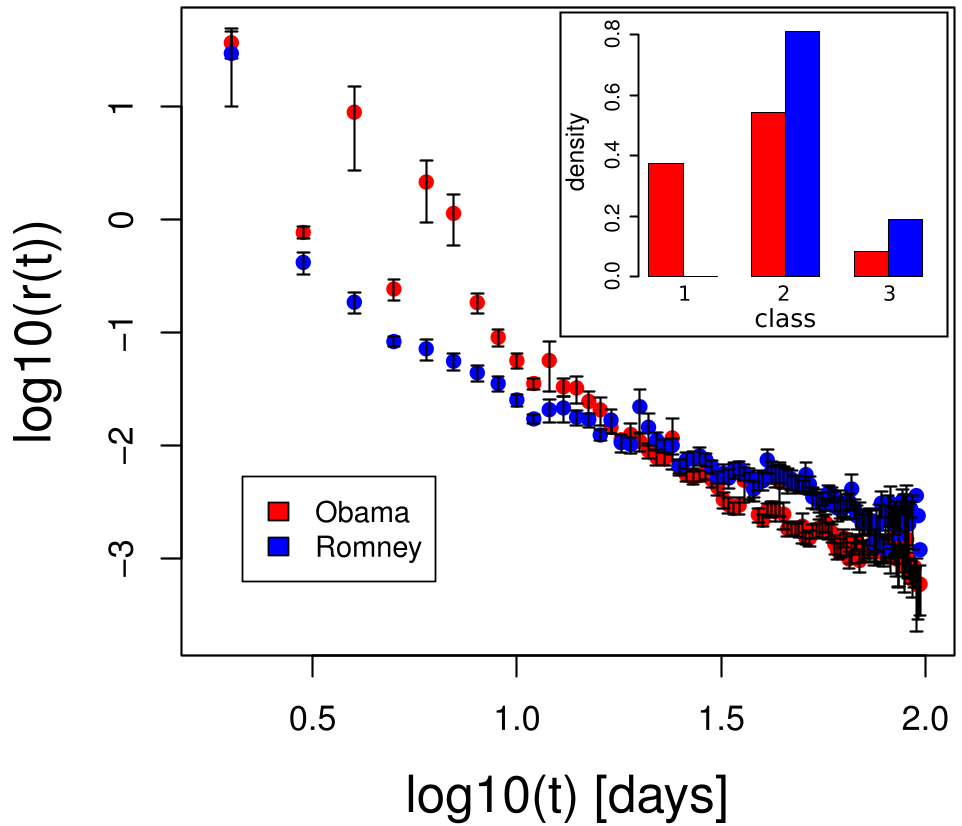 Figure: Average growth rates of Obama vs. Romney campaigns. While Obama (blue) started with higher sharing rates (viral speed), Romney (red) showed more stable persistence over time.
Collective Emotions: The Sentiment Triangle
Visibility is a double-edged sword. Using SentiStrength, the authors categorized the emotional response to videos into a "Triangle of Sentiment" defined by Positive (P), Negative (N), and Underemotional/Neutral (U) responses.
- Finding: Obama's 2008 campaign was overwhelmingly positive.
- Shift: By 2012, both candidates faced significantly more polarized and negative collective emotions.
- Insight: High popularity does not always mean positive popularity; it often triggers "bipolar" or "polarized" emotional states that can backfire on a campaign.
Mapping the Political Space: Partisans vs. Parties
The most striking part of the research involves Voting Advice Applications (VAAs). By mapping voters' actual policy answers against party manifestos in Greece, the researchers visualized the "Ideological Space."
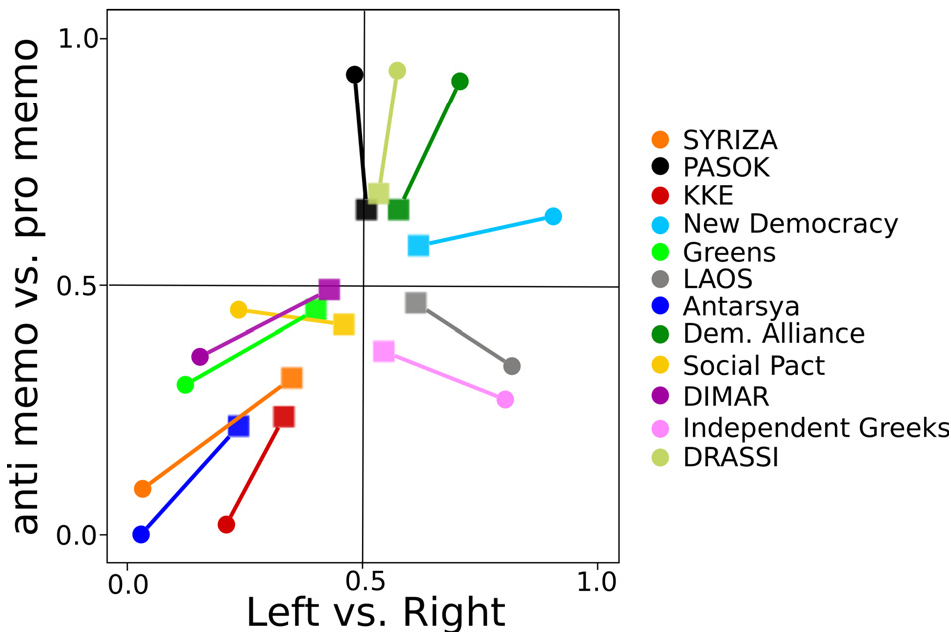 Figure: Greek Elections 2012. Circles are expert-coded party positions; Squares are aggregate voter positions. Note that voters (squares) are consistently less polarized than the parties they support.
The "Directional" Paradox
If voters are less polarized than parties, why do they support "extreme" candidates? The paper supports the Directional Theory: voters aren't looking for the "closest" policy match (Proximity Model). Instead, they want a candidate on the "right side" of an issue who shows strong leadership/intensity. This suggests that "extreme" or highly emotional content is an effective political tool because it signals clear directionality, even if the voter doesn't agree with every detail.
Critical Insight & Future Directions
The core achievement of this work is the Agent-Based Model (ABM) bridge. By using VAA data to feed into simulations, the authors can predict how a change in a single policy or a viral video might ripple through an entire online community.
Limitations: The study relies on 2008/2012 data; the current landscape of algorithmic "echo chambers" on platforms like TikTok may show even more drastic "criticality" in growth rates than the YouTube data analyzed here.
Summary Takeaway: Online popularity is a dynamic system of "infection" and "decay." For political researchers, the lesson is clear: don't just track how many people are watching; track how fast they are sharing and which side of the emotion-polarization triangle they occupy.