
Decoding Digital Partisanship: How Search Queries and Hashtags Reveal Political Polarization
Political Polarization of Web Search Queries and Hashtags
This paper introduces a data-driven methodology to quantify political polarization in the U.S. using web search logs and Twitter hashtags. By propagating ideological labels from known entities (blogs and politicians) to short text snippets, the author identifies patterns of partisan "leaning" and reveals phenomena like "hashtag hijacking" and negative sentiment bias in search results.
TL;DR
This research by Ingmar Weber provides a quantitative framework for measuring U.S. political polarization using two massive datasets: Yahoo! Web search logs and Twitter activity. By mapping short-form content to known ideological anchors (liberal/conservative blogs and politicians), the study uncovers how different camps "own" specific terms, hijack each other's hashtags, and encounter different emotional tones in their search results.
Problem & Motivation
In the United States, politics is remarkably one-dimensional: a "left vs. right" bipolar configuration that accounts for over 90% of legislative behavior. However, how does this translate to the average citizen's digital life?
The challenge lies in the sparsity of intent. A search query like "climate change" or a hashtag like #climategate is too brief for traditional sentiment analysis to determine a user's political "leaning." Previous work focused on the "blogosphere" or retweet networks, but this paper seeks to bridge the gap between intent (what we search for) and identity (who we follow), creating a temporal map of political friction.
Methodology: Label Propagation at Scale
The author navigates the lack of direct labels by using a "source-to-target" propagation method.
1. From Blogs to Queries
While a query is ambiguous, a blog often has a clear manifesto. By observing which users click on 155 annotated partisan blogs in response to specific queries, the researchers can calculate the "leaning" of the query itself.
- Logic: If users searching for "X" only click on Republican blogs, "X" is effectively a right-leaning query.
2. From Politicians to Hashtags
On Twitter, the jumping-off point is a set of "seed" accounts (e.g., @BarackObama vs. @MittRomney). Users who retweet these accounts are assigned a fractional leaning. Hashtags are then classified by the aggregate leaning of the users who employ them.
3. The Mathematical "Lean"
To prevent high-volume hashtags from skewing the results, the paper utilizes a smoothed normalization formula:

This formula accounts for volume bias and ensures that low-volume objects aren't assigned extreme leanings prematurely due to statistical noise.
Key Findings: Sentiments and Sabotage
Negative Sentiment in the Opposition
The study discovered a fascinating correlation between political leaning and search result sentiment. By passing query results through SentiStrength, the research found that right-leaning queries (which, at the time of the study, represented the opposition party) tended to surface results with higher negative sentiment and lower positive sentiment.
The Art of Hashtag Hijacking
One of the most provocative parts of the paper is the analysis of "Hashtag Wars." This occurs when one side attempts to "hijack" a hashtag predominantly used by the other side to disrupt their narrative.
The author defines Change Points—sudden jumps in a hashtag's leaning (e.g., a left-leaning tag suddenly moving right).
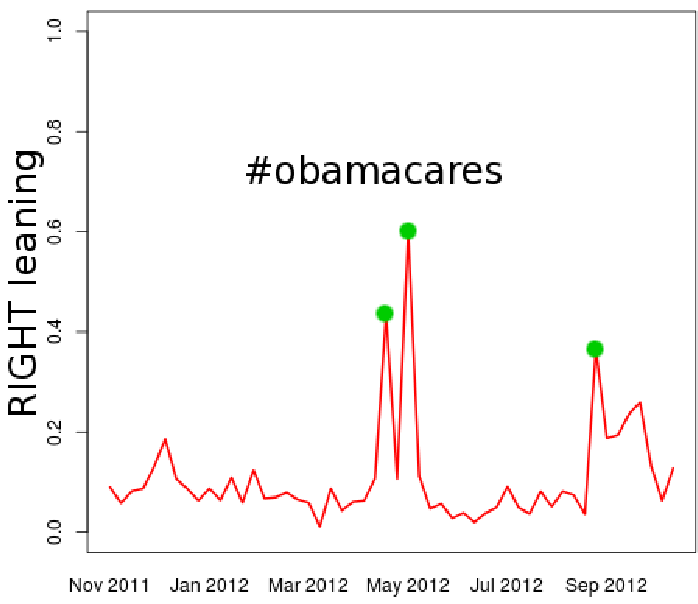
The perpetrators, "Hashtag Hijackers," were found to be significantly more active than the average user, featuring higher retweet rates and more followers, suggesting that hijacking is a concerted effort by highly engaged partisans rather than random noise.
Experimental Evidence
To validate the "Lean" metric, the researchers mapped user ZIP codes to 2010 midterm election results. The correlation was striking: users clicking on "left" blogs were significantly more likely to reside in Democrat-voting districts, proving that digital footprints are powerful proxies for offline geographic and political identity.
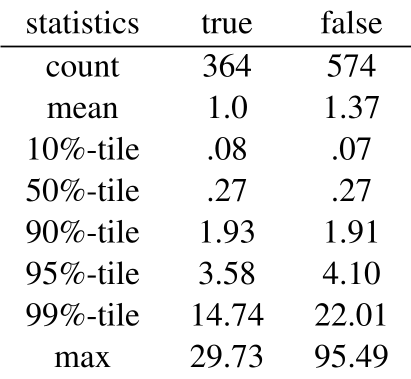 Table 1: Volume distribution showing that "False" or "Pants on Fire" statements often attract higher query volumes than "True" facts.
Critical Analysis & Conclusion
Takeaway
The paper successfully demonstrates that political polarization is not just a state of mind but a measurable digital phenomenon. The methodology of label propagation provides a scalable way to monitor the "health" of public discourse in real-time.
Limitations
- Selection Bias: The author admits that Twitter users are not representative of the general population.
- Bipolar Limitation: The model assumes a 1D (Left vs. Right) axis, which may not capture the nuances of libertarian or populist movements that don't fit the standard U.S. mold.
- Sentiment Noise: Using search result snippets to judge query sentiment is "noisy," as it measures what the web provides rather than purely what the user feels.
Future Outlook
The author concludes by noting that we are in the "17th century of data science," looking at society through "data goggles." Future advancements will likely involve "Mashups"—integrating search logs with voter registrations and Wikipedia edits to create a holistic view of the human political animal.