
Beyond Words: Unmasking Political Bias Through Social Graph Topology
Discovering political tendency in bulletin board discussions by social community analysis
The paper introduces a social community analysis framework to identify political tendencies in BBS discussions (specifically PTT in Taiwan). It constructs directed "Master Graphs" and derived subgraphs (Reply, Co-Reply, Advocate) to partition users into opposing ideological camps without utilizing linguistic content analysis.
TL;DR
This research demonstrates that your political "tribe" can be identified not by what you say, but whom you interact with and how. By analyzing user interactions on Taiwan's PTT BBS, the authors achieved over 60% accuracy in identifying political leanings (Pan-Blue vs. Pan-Green) using graph partitioning and clustering algorithms, completely bypassing the need for natural language processing (NLP).
The "Disagreement" Intuition
Most people assume that social networks are built on "homophily"—birds of a feather flock together. However, in the heated world of political Bulletin Board Systems (BBS), a different rule applies: The Disagreement Hypothesis.
The authors observe that users are significantly more likely to engage (reply) to an article they disagree with. In contrast, they tend to use "Advocate" buttons (similar to "Likes") for posts they agree with. This creates a fascinating structural duality:
- Direct Replies = Likely Disagreement.
- Co-Replies (two people replying to the same seed) or Advocates = Likely Agreement.
Methodology: Mapping the Political Mind
The researchers construct a Master Graph which is then decomposed into three functional subgraphs to test different social theories.
1. The Interaction Graphs
- Reply Graph: Vertices are authors; edges exist if User A replies to User B.
- Co-Reply Graph: Edges exist if two users reply to the same catalyst post.
- Advocate Graph: Edges exist when a user "supports" another's post.
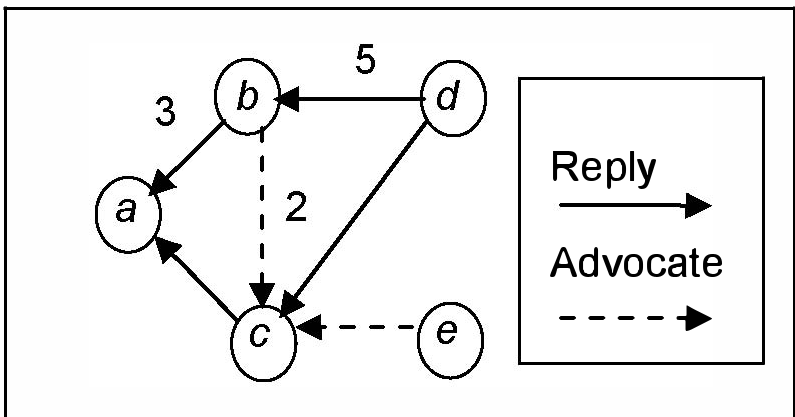 Figure 1: The Master Graph showing the interplay between direct replies and advocacy.
2. Algorithmic Warfare
The paper applies three distinct mathematical approaches to these graphs:
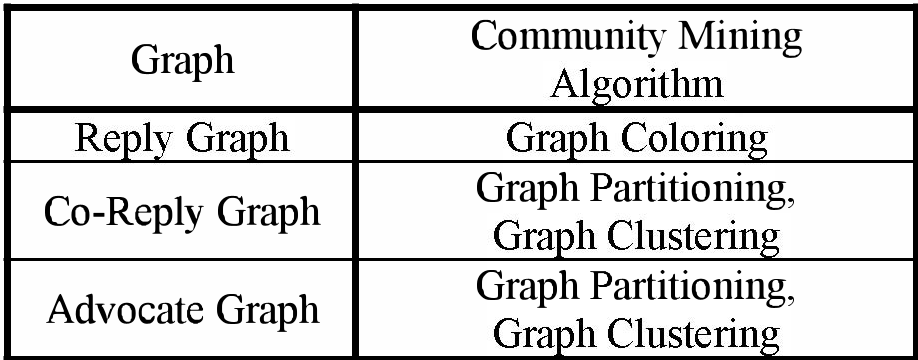
- Graph Partitioning (Metis/Spectral): Designed to find "minimum cuts" in agreement graphs (Co-Reply/Advocate).
- Graph Coloring: Used on the Reply Graph. Since adjacent nodes (repliers) likely disagree, the goal is to ensure they have different "colors" (political labels).
- Chameleon Clustering: A hierarchical approach that measures interconnectivity and closeness.
Hard Data: Which Graph Tells the Truth?
The experiment utilized a massive dataset from PTT, Taiwan's largest terminal-based BBS, focusing on the highly polarized "Politics" board.
The results revealed a counter-intuitive finding: The Co-Reply Graph outperformed the Advocate Graph.
Why? The authors argue that "Advocating" is too easy. It is a "low-cost" action that users perform casually, leading to noisy data. However, taking the time to write a reply—or co-replying to a specific thread—represents a "high-cost" investment of energy, which serves as a much stronger signal of a user's true political alignment.
Critical Insight: The "Neutral" Majority
The Graph Coloring analysis (used on the Reply Graph) required 8 colors to fully separate the network, but the top 2 colors covered 86% of users. Interestingly, many users in the "largest color group" were only adjacent to one other person. These are the Political Neutrals—users who lurk or occasionally comment but avoid the "tit-for-tat" warfare common among the hardcore Pan-Blue and Pan-Green partisans.
Conclusion & Future Look
This paper proves that structure is often louder than words. By treating a discussion board as a dynamic social graph rather than a collection of text strings, we can identify polarized communities with surprising accuracy.
Limitations: The study's accuracy (61.7%) suggests that while graph topology is powerful, it isn't a silver bullet. The next frontier in this research is clearly the Hybrid Model: combining the structural insights of social graphs with the semantic depth of modern LLMs to understand why the disagreement is happening in the first place.