
Geopolitics on the Ticker: How the US-China Trade War Fractured Global Auto Stocks
An analysis of political turmoil effects on stock prices: a case study of US-China trade friction
This paper investigates the impact of the 2018-2019 US-China trade friction on global automobile stocks using Hierarchical Clustering and Singular Value Decomposition (SVD). It identifies that political turmoil triggers distinct country-based clustering (Japan, US, Germany), particularly during sharp market declines.
TL;DR
When global trade wars erupt, do industries stick together, or do they retreat into national borders? This research analyzes the stock prices of the top 100 global automakers during 2018-2019. Using Hierarchical Clustering and SVD, the authors demonstrate that political turmoil causes "geographic decoupling," where stocks cluster tightly by their country of origin rather than global industry trends.
Background Positioning
While most financial models assume globalized markets, this paper serves as an empirical warning. It positions itself at the intersection of Machine Learning (Clustering) and Econophysics (Random Matrix Theory) to show that political shocks act as a catalyst for market fragmentation.
Problem & Motivation: The Breakdown of Global Linkages
Existing portfolio theories often assume that a "Global Auto Industry" moves somewhat in unison. However, the authors observed that the US-China trade friction created a unique "turmoil" environment. They hypothesized that significant market declines don't just reduce prices—they fundamentally rewrite the correlation matrix of the market, forcing companies into nationalistic silos.
Methodology: The Math of Turmoil
The authors employed two robust technical lenses:
1. Hierarchical Clustering (HRP Style)
Following the logic of Hierarchical Risk Parity (HRP), they calculated the distance between stock returns using: This allows for clustering without the need to invert a potentially singular covariance matrix.
2. Singular Value Decomposition (SVD)
SVD was used to extract Principal Components (PCs). In a stable market, the PCs might represent factors like "Growth" or "Value." But during a trade war, the authors found something startling: PC1 mapped almost perfectly to Japanese companies, PC2 to US companies, and PC3 to German companies.
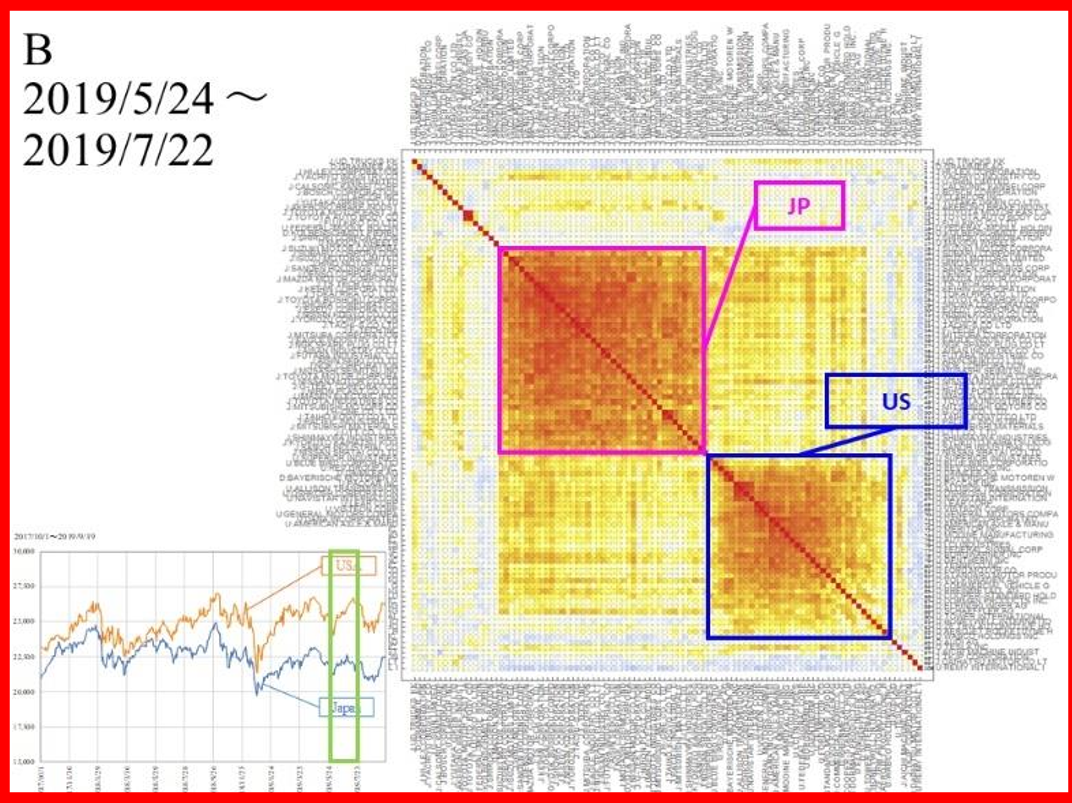 Above: Figure 3 demonstrates how correlation "boxes" (clusters) become sharply defined during periods of decline (A, B) and blur during recovery (D, E).
Experiments & Results: The "Stability Rate" Correlation
The authors defined a Stability Rate (minimum value / initial value) to quantify the severity of a market drop.
- The Japanese Case: In December 2018 (Period A), the Japanese cluster was at its densest. Regression showed that as stability decreased, the cluster size for Japanese firms actually solidified, meaning they "suffered together" in a highly correlated fashion.
- Eigenvalue Spikes: Using SVD, the authors found that the Eigenvalue of PC1 acts as a barometer for turmoil. In periods of high stress, PC1’s eigenvalue was significantly larger, capturing the massive shared variance of the national clusters.
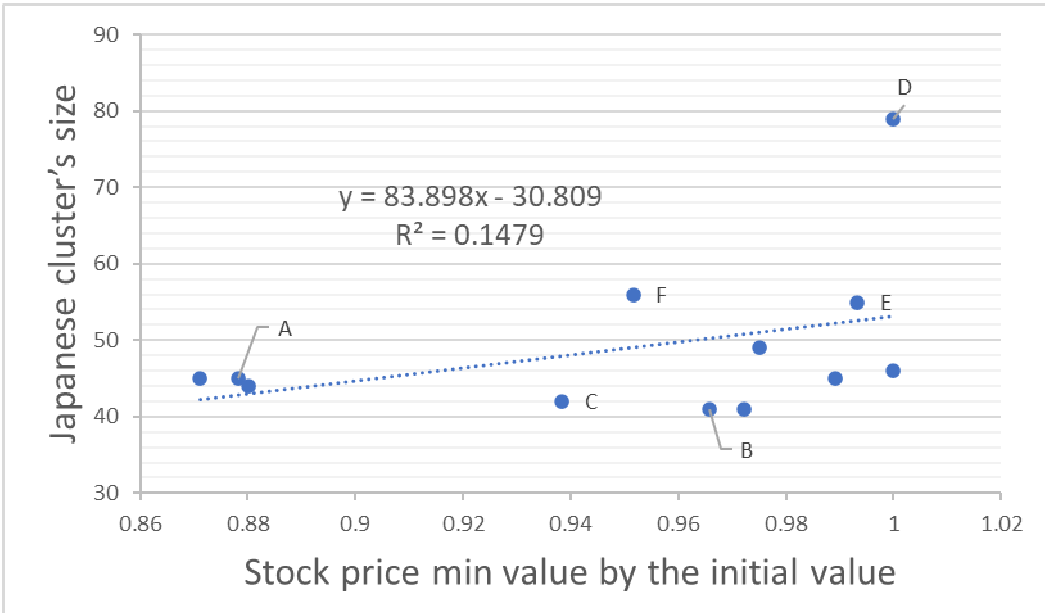 Figure 5: 3D plot of PCs showing clear spatial separation by country: Red (Japan), Black (US), and Blue (Germany).
Critical Analysis & Deep Insight
The "Nationality" Trap
The most profound takeaway is that during political crises, fundamental company performance is temporarily ignored by the market. Investors retreat to macro-theses based on geography. If you owned a diversified portfolio of global automakers thinking you were "hedged," the trade war proved you were actually just exposed to three distinct national risks that moved independently.
Limitations
- Sample Size: While 100 companies is significant, the German cluster was small (9 companies), making their statistical results less robust than the Japanese (56) or US (35) clusters.
- Index Simplicity: The "Stability Rate" is a one-dimensional metric for a multi-dimensional volatility problem.
Conclusion
This paper provides a data-driven confirmation of what many traders suspected: politics forces markets to "de-globalize" in real-time. For AI-driven finance, this means risk models must incorporate geopolitical "regime switching" flags to adjust for the fact that geographic clusters can emerge and dissolve based on a single presidential tweet.