
The Politics of Comments: Using Commenter Sentiment to Decipher Media Bias
The politics of comments: predicting political orientation of news stories with commenters' sentiment paerns
This paper introduces a novel social annotation analysis approach to predict the political orientation of news stories by analyzing commenters' sentiment patterns. By leveraging the consistent political biases of "predictive commenters," the researchers developed Bayes-based classification models that outperform traditional text-based analysis, achieving up to 80% precision in identifying liberal or conservative articles.
TL;DR
Researchers from KAIST have pioneered a method to identify the political leanings of news articles not by reading the news itself, but by observing the "predictive" behavior of regular commenters. By mapping how specific users react to different ideologies, their model achieves over 80% precision, proving that the digital footprints of biased readers are powerful sensors for detecting hidden media frames.
Problem & Motivation: The "Neutrality" Trap
In the world of journalism, bias is often invisible. News producers frame reality through selective fact-selection, word choice, and tone, rather than explicit opinion. This makes traditional News Text Analysis extremely difficult; a computer must understand deep political context to see through "objective" phrasing.
Furthermore, relying on the news outlet's brand (Meta-data Analysis) is insufficient. Many outlets are centrist, and even partisan ones sometimes report straight facts. The authors noticed a different signal: the Social Annotation. While news text is subtle, commenters are often anything but. Their emotional reactions (sentiments) serve as a condensed interpretation of the article's political soul.
Methodology: Users as Political Sensors
The researchers' core insight is the existence of Predictive Commenters. Through extensive observation of South Korea’s Naver News, they identified three types of users:
- Predictive: High regularity (e.g., Liberals who always bash Conservative articles).
- Cross: Irregular (e.g., users who sometimes attack their own side's opponents within a neutral article).
- Opaque: Random or off-topic chatter.
1. The Single-Commenter Model
The authors modeled individual commenters as a Multi-class Bayes Classifier. Instead of analyzing the news content, the input is simply the sentiment of a specific user’s comment.
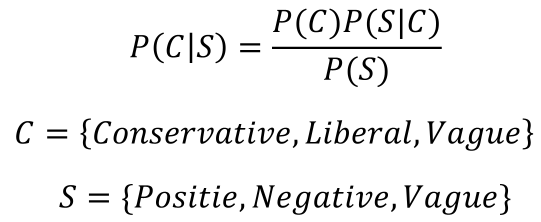 The formula calculates the probability of an article being Liberal or Conservative based on the observed sentiment and the user's historical pattern.
2. The Multi-Commenter Aggregation
To increase robustness, they introduced Maximum Votes (MV) and Maximum Posterior Probability (MPP). If ten known conservative-leaning predictors all post negative comments on a story, the system can conclude with high confidence that the article is liberal-leaning.
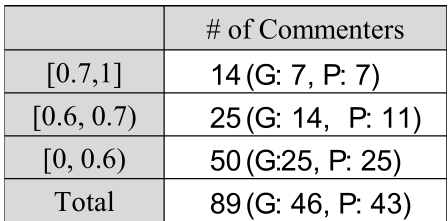 Distribution of commenters based on their predictive accuracy. High-accuracy "Predictors" are the gold standard for this method.
Experiments: Beating the Text Classifiers
The authors compared their model against a standard SVM (Support Vector Machine) text classifier (TA).
- Accuracy: While the text-based model hovered around 42-48% (barely better than a coin flip in a 3-class problem), the Sentiment Analysis (SA) approach reached 56-57% for general articles and shot up to 75%+ when specifically identifying Liberal vs. Conservative stories.
- Scalability: Surprisingly, the model doesn't need much data. Training on just 20 comments per user was enough to establish a reliable pattern.
- Collaborative Filtering for Politics: When the system aggregated data from 12+ commenters, the accuracy peaked at over 80%.
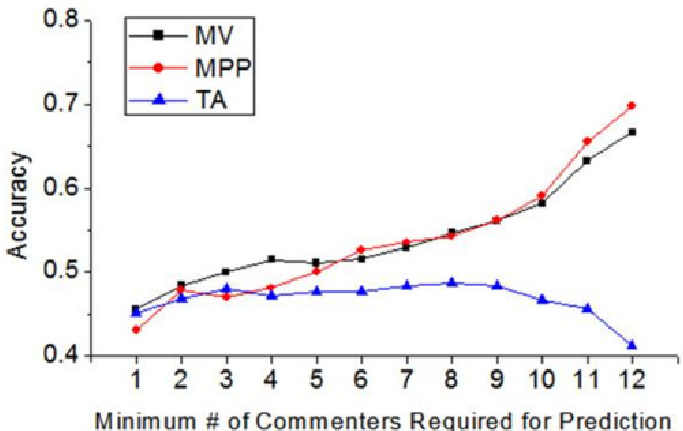 Figure 7: The performance gap between Multi-commenter methods (MV/MPP) and traditional text analysis (TA).
Critical Insight & Conclusion
This work highlights a profound shift in how we process information: The "Why" vs. the "Who". Traditional AI tries to understand why an article is biased by looking at keywords. This paper asks who is reacting to it and how.
Limitations:
- Vague Articles: The model struggles with neutral or "vague" news because even predictive commenters don't have a consistent "vibe" for neutral reporting.
- Echo Chambers: The method relies on active, vocal partisans. If a platform discourages commenting or lacks diverse viewpoints, the "sensors" disappear.
Future Outlook: In the era of LLMs, this research reminds us that human behavior is often the best "ground truth" for subjective concepts like political orientation. Modern recommendation systems could use these findings to balance "Filter Bubbles" by identifying the orientation of news in real-time and suggesting opposing viewpoints to readers.