
Decentralized Polling: Securing Votes in Native Social Graphs
On the Polling Problem for Social Networks
The paper proposes a decentralized polling protocol for social networks that ensures vote privacy and result accuracy without relying on cryptography or rigid overlay structures. It leverages existing social graph properties and a secret sharing scheme to define a family of "honest graphs" where decentralized consensus can be achieved reliably.
TL;DR
The paper introduces a decentralized polling protocol that works on the actual topology of social networks. Unlike previous works that forced users into rigid rings or clusters, this method uses a secret sharing scheme and a clever shortest-path verification mechanism to ensure privacy and accuracy, even when up to 20% of the network is actively trying to cheat.
Context & Motivation: The "Perfect Square" Trap
In decentralized Online Social Networks (OSNs), polling is a critical tool for collective decision-making. However, existing protocols like DPol suffered from a "structural rigidity" problem. They required the network to be reshaped into a cluster-ring overlay where the total number of users must be a perfect square.
The authors argue that this is fundamentally non-decentralized: someone (or some algorithm) must centrally organize the users into these groups. Their goal is to allow polling to happen on natural social links (your actual friends) while maintaining high privacy and resilience against dishonest coalitions.
Methodology: Secret Sharing and Shortest Paths
The protocol operates in three distinct phases: Sharing, Broadcasting, and Aggregating.
1. The Sharing Scheme
Each user generates shares. If they want to vote , they create shares of and shares of . These are distributed randomly among neighbors. This ensures that unless a coalition controls a majority of your neighbors (), they cannot reconstruct your original vote.
2. Intelligent Broadcasting
To avoid exponential message flooding in a social graph, the authors introduce a distance-bound . A node only accepts a message if the path length falls within the range: This mathematical boundary ensures that nodes receive enough redundant information to detect cheating but not so much that the network crashes from congestion.
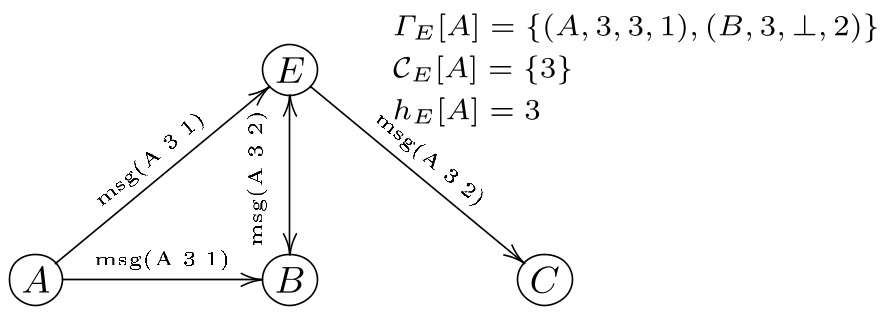 Figure: The sharing phase (b) and subsequent aggregation (c) where node A distributes and collects shares.
3. Verification & Reputation
What if a dishonest node changes a "+1" to a "-1" before forwarding it? The protocol uses Routing Tables. If a node detects an inconsistency (receiving two different values for the same source), it triggers a verification. Because honest nodes are the majority, the "liar" is eventually exposed and tagged, damaging their reputation—a heavy cost in a social network.
Performance: Theoretical Bounds vs. Reality
The authors define the "Impact" () as the difference between the true result and the reported result. They prove that the dishonest coalition's influence is capped at .
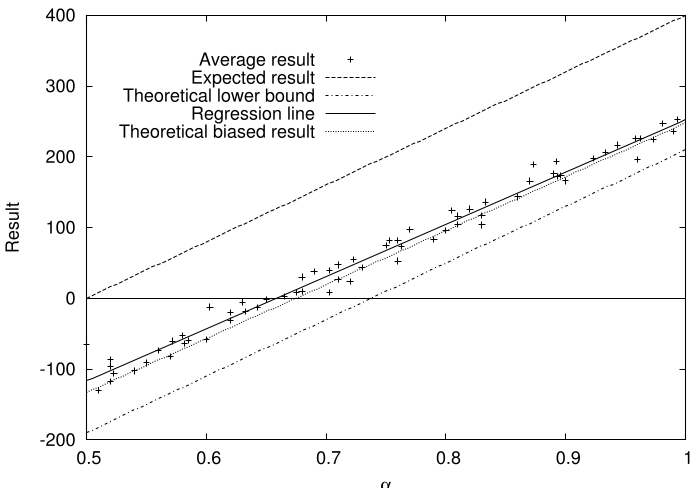 Figure: Performance for k=1 and k=2. The results show that as privacy () increases, the potential impact of dishonest users also grows.
Key findings from experiments:
- For a network of and , the protocol successfully keeps the biased outcome within the predicted theoretical window.
- Increasing the privacy parameter makes it harder to leak individual votes but slightly increases the "noise" dishonest nodes can inject into the final count.
Critical Insight: The Value of "Honest Graphs"
The most significant contribution is the formal definition of G2 (The Family of Honest Graphs). The authors prove that as long as a graph is "honest" (there is always a path of honest nodes between any two honest users), centralized overlays are unnecessary.
Limitations & Future Work
The current model assumes a static network without message loss or node crashes. In a real OSN, users go offline and Wi-Fi drops. The next frontier for this research is adapting these shortest-path bounds to a dynamic environment where the graph topology changes during the poll itself.
Conclusion
This work shifts the paradigm of decentralized voting from "fixing the network to fit the protocol" to "fitting the protocol to the network." By utilizing the natural redundancy of social connections and the social cost of a bad reputation, it creates a robust framework for private, accurate digital democracy.