
Unmasking the LBSN Underground: Pollution, Bad-mouthing, and Local Marketing
Pollution, bad-mouthing, and local marketing: The underground of location-based social networks
This paper investigates "tip spam" in Location-Based Social Networks (LBSNs) using data from the Brazilian platform Apontador. It introduces a taxonomy of three distinct spam types—local marketing, pollution, and bad-mouthing—and proposes a supervised machine learning framework for their detection.
TL;DR
As Location-Based Social Networks (LBSNs) like Yelp and Foursquare become central to our urban navigation, they have birthed a new breed of "underground" activity. This paper moves beyond traditional "fake reviews" to categorize and detect three specific types of LBSN tip spam: Local Marketing, Pollution, and Bad-mouthing. Using data from Apontador, the authors demonstrate that by combining geographic behavior with social graph metrics, machine learning can flag these irregular activities with high accuracy.
Context: Why LBSN Spam is Different
In a standard social network, a spammer wants your attention. In an LBSN, the target is the Place. Whether it's a restaurant owner trying to boost their visibility or a disgruntled rival trying to sink a competitor's rating, the "Location" adds a layer of complexity that textual analysis alone cannot solve. Prior work largely ignored the geographic "intent" behind these tips, leaving a gap in how platforms maintain trust.
Methodology: The Four Pillars of Detection
The authors argue that a spammer's "digital footprint" in an LBSN is fundamentally different from a legitimate user's. They extracted 60 attributes categorized into:
- Content: Not just keywords, but the frequency of phone numbers (common in ads) and sentiment polarity.
- User Behavior: Analyzed the "Tip Focus" and "Tip Entropy." Do they only post in one 50km radius (Local Marketers), or is their activity scattered and random?
- Place Metrics: Does the spam target popular spots or low-rated venues?
- Social Graph: Do they have a reciprocal relationship with others, or are they "link farming"?
Model Architecture: Flat vs. Hierarchical
The study compared two strategies for classification:
- Flat: A single model distinguishing between Non-Spam and the three spam types.
- Hierarchical: A two-stage process where the first model separates Spam from Non-Spam, and the second classifies the specific type of spam if the instance is flagged.
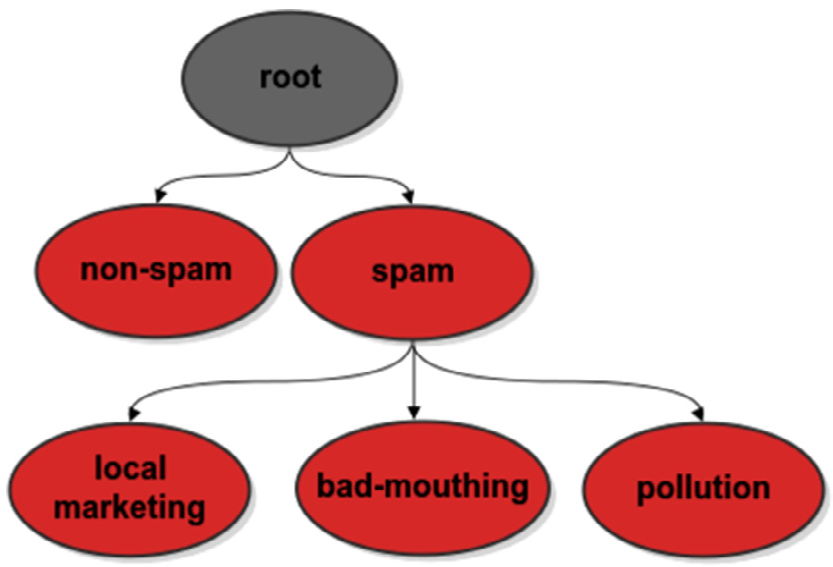 Figure 1: The hierarchical taxonomy used to refine spam detection.
Key Insights from Experiments
The experiments revealed fascinating behavioral archetypes:
- Local Marketers are "Power Users": Unlike typical polluters, local marketers register places and post photos. They interact deeply with the system—they just do it for commercial gain.
- Bad-mouthers Target the Weak: Most "bad-mouthing" tips are directed at places already rated 1-3 stars, suggesting they are either participating in a "kicking them while they're down" scenario or are part of organized reputation attacks.
- Geography Matters: 80.8% of local marketing tips stay within a single local area, whereas legitimate users often post tips across great distances (e.g., while traveling).
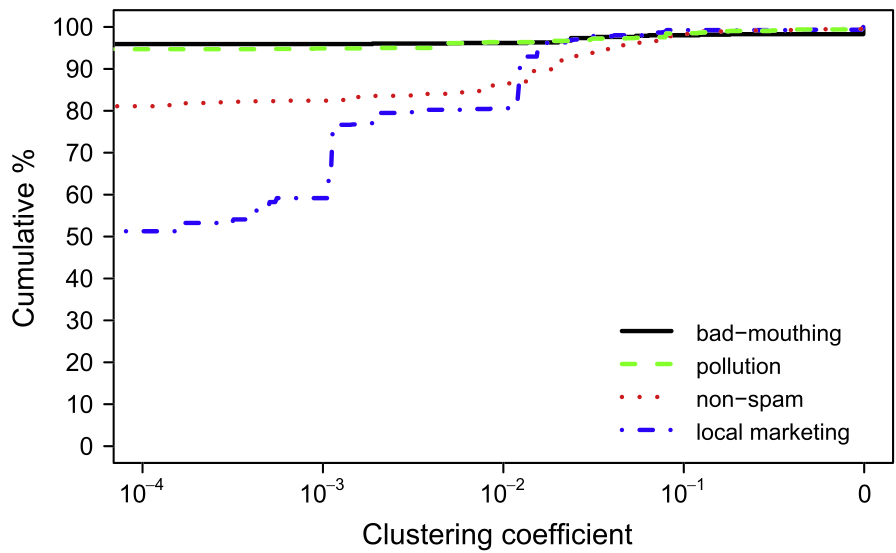 Figure 2: Social attributes showing that Local Marketers often have higher clustering coefficients and follower ratios than other spammers.
Performance Benchmarks
Random Forest outperformed SVM across almost all metrics. While "Non-Spam" and "Local Marketing" were relatively easy to identify (Recalls of 93% and 76% respectively), "Bad-mouthing" remained the most elusive class, often confused with "Pollution."
| Class | Precision | Recall | F1-Score |
|---|---|---|---|
| Non-Spam | High | 93.1% | 0.907 |
| Local Marketing | Mid | 76.4% | 0.827 |
| Pollution | Mid | 68.8% | 0.682 |
| Bad-mouthing | Low | 56.6% | 0.612 |
Critical Analysis & Future Outlook
This work highlights a critical management strategy for LBSN owners: Don't just ban everyone. By identifying "Local Marketers," platforms can transition these users into a "Sponsored Content" model, turning a platform threat into a revenue stream.
Limitations: The study relies on manual labeling by moderators, which can be subjective. Furthermore, as spammers adopt Large Language Models (LLMs) to generate more human-like, context-aware "tips" (a technology shift since this 2014 paper), the reliance on simple content attributes like "number of numeric characters" will likely need to be replaced by deeper semantic analysis.
Takeaway for Researchers: Geographic intent—where a user posts relative to their history—remains the strongest signal for detecting opportunistic behavior in local systems.