
PopTour: Mining Hot Travel Routes from Sparse Instagram Trajectories
PopTour: Discovering Journey Group T-Patterns from Instagram Trajectories to Recommend Hot Travel Routes
The paper introduces PopTour, a system designed to discover "Journey Group" (JG) T-Patterns from sparse Instagram trajectory data. Using a novel density-based mining strategy, it identifies collective movement patterns to recommend hot travel routes.
TL;DR
PopTour is an innovative system that mines Journey Group (JG) T-Patterns from Instagram data. Unlike GPS-heavy methods, it handles the inherent sparsity of social media check-ins using a time-ordered clustering approach to discover and recommend popular tourist routes.
Background: From GPS Density to UGC Sparsity
In the era of big data, trajectory mining has traditionally relied on GPS devices that provide a steady heartbeat of location updates. However, most modern human mobility data is User Generated Content (UGC)—photos uploaded to Instagram or check-ins on Facebook.
The challenge? UGC data is "leaky." It is sparse, irregular, and lacks the continuous snapshots required by classic patterns like "flocks" or "convoys." The authors identify this gap: how do we find group behavior when we only have intermittent digital breadcrumbs?
Methodology: Defining the Journey Group
The core innovation is the Journey Group (JG) T-Pattern. Instead of requiring users to be at the same place at the exact same time, it looks for a sequence of clusters connected by a common time order.
The Technical Pipeline
- Grid-based Indexing: The geographical space is partitioned into cells using a space-filling curve, mapping multi-dimensional coordinates to a 1D hash table.
- Density-based Clustering: Using DBSCAN, the system identifies "dense areas" where many users upload content.
- JG Validation: A hash-based intersection operation filters these clusters. A "Participator" is defined as a user appearing in multiple clusters in a specific sequence. If the number of participators exceeds a threshold (), a JG T-Pattern is confirmed.
 Figure 1: The architecture of PopTour, showing the flow from raw Instagram data to visualized travel routes.
Visualizing the Pattern
The JG T-Pattern represents a shared path. Even if users and deviate from the trunk trajectory (as shown in the figure below), the "backbone" of their journey remains consistent through common clusters.
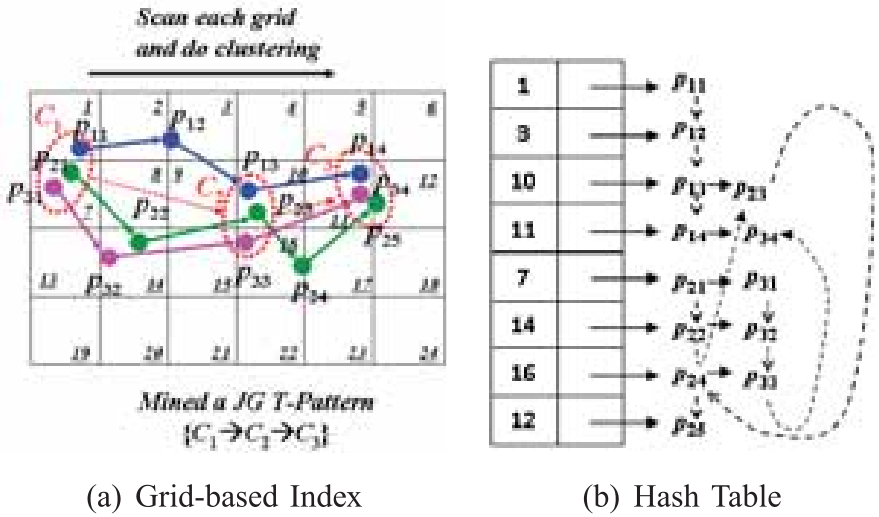 Figure 2: Conceptual view of JG T-Patterns as sequences of clusters ().
Experimental Results: Discovering Global Routes
The team tested PopTour on a dataset of 20,000 Instagram users across Australia. By setting the participation threshold , the system successfully filtered individual noise to find significant travel trends.
- Insight 1: A large volume of Australian travelers follow a specific sequence leading to the US or Singapore.
- Insight 2: The system allows for "zoom-in" capabilities, moving from a global route perspective to localized density-reachable regions within a specific city.
 Figure 3: PopTour interface displaying discovered clusters (red drop) and trajectory chains on Google Maps.
Critical Analysis & Conclusion
PopTour successfully pivots trajectory mining from "device-centric" to "user-centric." By relaxing the temporal constraints of the "Swarm" pattern, it makes social media data academically and commercially viable for travel recommendation.
Limitations: The reliance on DBSCAN means the system's performance is sensitive to the (radius) and parameters. Future work could benefit from adaptive clustering that adjusts density requirements based on local urban vs. rural data density.
Future Outlook: Integrating sentiment analysis of the photo captions alongside the JG T-Patterns could allow PopTour to not only recommend where people go, but why they enjoyed it, leading to highly personalized travel AI.