
SIoFT: Securing the Skies with Socially-Aware Flying Things and Popular Matching
Popular Matching for Security-Enhanced Resource Allocation in Social Internet of Flying Things
This paper introduces the concept of the Social Internet of Flying Things (SIoFT), proposing a security-enhanced resource allocation framework. It employs a "Popular Matching" theory to optimize channel allocation between UAVs and terrestrial D2D users, alongside joint trajectory and power control to maximize the average secrecy rate in the presence of eavesdroppers with uncertain locations.
TL;DR
As Unmanned Aerial Vehicles (UAVs) become integral to the Internet of Things, securing their open, broadcast-heavy communication links is paramount. This paper proposes the Social Internet of Flying Things (SIoFT), a framework that utilizes social trust to turn terrestrial D2D users into "friendly jammers." By combining Popular Matching theory with robust trajectory optimization, the authors achieve a significant boost in secrecy rates (+67.5%) even when eavesdroppers are hiding.
Problem & Motivation: The LoS Vulnerability
The greatest strength of UAV communication—strong Line-of-Sight (LoS) air-to-ground links—is also its greatest weakness. These links are easily intercepted by terrestrial malicious users. Traditional security methods face a "Security-Throughput" trade-off: to stay secure, you must reduce your data rate.
The authors' core Insight is the "No Pain, No Gain" principle. What if we leverage social ties? If a D2D user on the ground is "socially trusted" by a UAV, they can share the same spectrum. While this creates interference, the D2D user acts as a friendly jammer to the eavesdropper, effectively "masking" the UAV's sensitive signal.
Methodology: The Two-Stage Defense
The problem is complex because it involves continuous variables (flight paths, power) and discrete variables (who matches with which channel).
1. Robust Trajectory and Power Design
UAVs must fly to bypass eavesdroppers. Since eavesdropper locations are usually estimated with errors (represented as an uncertain circular region), the authors use the S-Procedure to convert infinite uncertain constraints into a finite set of Semidefinite Programming (SDP) problems.
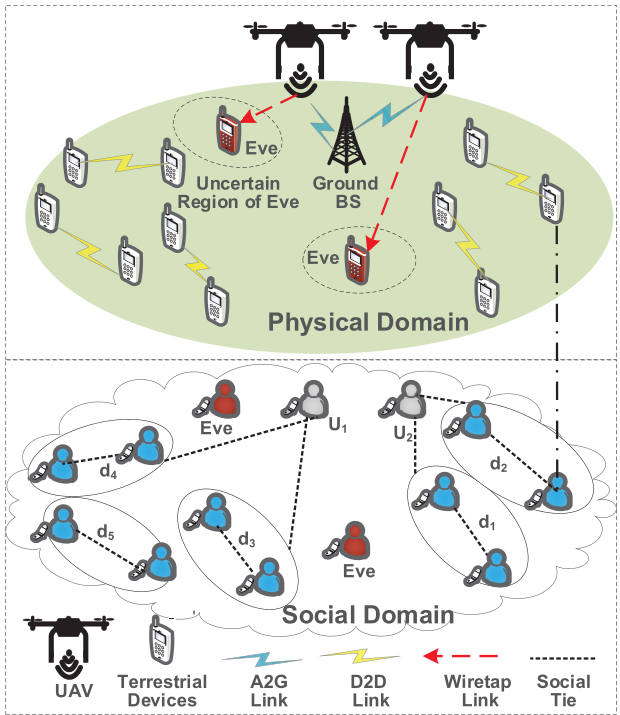 Figure 1: The SIoFT framework featuring UAVs, trusted D2D jammers, and hidden eavesdroppers.
2. Popular Matching with Externalities
Standard "Stable Matching" (like the Gale-Shapley algorithm) is often too restrictive—it focuses on local stability. The authors instead use Popular Matching, which ensures that no other matching arrangement is preferred by a majority of users.
- Hierarchical Matching (HM): Initially builds the matching graph.
- Rotation-Vote (RV): Handles "externalities"—the reality that when one D2D user moves to a new channel, the interference levels for everyone else change, altering their preferences.
Experiments & Results: Real-World Efficiency
The researchers simulated a 1x1 km² area with 8 UAVs and 50 D2D users.
Key Findings:
- Trajectory Intelligence: UAVs were observed to fly in an "arc path" to maximize distance from eavesdropper clusters while staying close to the Base Station.
- The Power of Jammers: By increasing the "quota" (the number of D2D users a UAV can share a channel with), secrecy rates improved significantly as more friendly jamming was applied to eavesdroppers.
- Social Impact: Higher social trust leads to more available friendly jammers, directly translating to a more secure network.
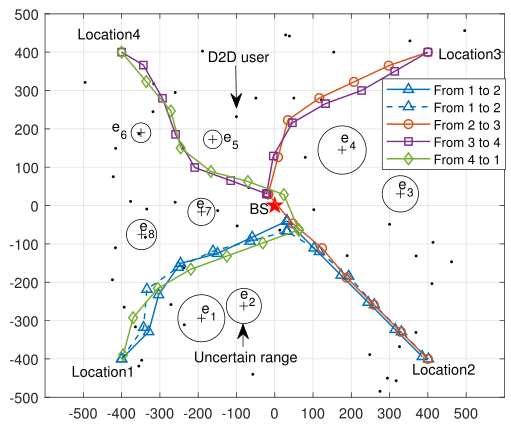 Figure 2: UAVs dynamically adjusting their flight paths to bypass eavesdropper uncertainty zones.
Critical Insight & Conclusion
The brilliance of this work lies in moving from "local stability" to "global popularity." In large-scale IoT networks, trying to keep every individual pair perfectly stable is computationally expensive and often results in lower overall system performance. The Popular Matching approach provides a more "fair" and efficient distribution of resources.
Limitations: The model assumes social ties are binary (trusted vs. non-trusted). In reality, trust is a spectrum. Future work could integrate "fuzzy social ties" or explore how multi-hop social relationships affect jammer selection.
Takeaway: By bridging social science (trust networks) and communication theory (matching & trajectory), this paper provides a robust blueprint for the next generation of secure, autonomous flying networks.